Introducing the S&P Pantera Digital Asset Index
By Cosmo Jiang, General Partner and Mason Nystrom, Partner
When we talk with institutional allocators about liquid digital assets, one complaint often comes up: they do not find today’s multi-asset index products compelling.
The reason is simple. Nearly every asset class is eventually subject to a kind of law of financial gravity. Price tracks fundamental value over time, and institutional capital allocation decisions are based on evaluating and underwriting that value.
Existing digital asset indices make institutional underwriting hard, because they include all tokens into a generic basket that allocators do not want for several reasons. That may include Bitcoin, a monetary asset that allocators may already have a policy around and they can get direct exposure to via single asset ETFs. It may also include memecoins and economically inactive chains, whose tokens lack fundamentals entirely and undermine the credibility of the indices.
What allocators have told us they wish they had instead is an index focused on tokens whose value is supported by fundamentals they can underwrite. That is the gap we set out to address.
Today, we are proud to launch the S&P Pantera Digital Asset Index – a fundamentals-based benchmark for the productive blockchain economy.
This index applies a rules-based approach grounded in financial viability. Rather than rewarding market hype or size (e.g. market capitalization) alone, it captures tokens backed by economically productive protocols. We believe this focus is essential as the industry grows by orders of magnitude in the years ahead.
The index brings together:
- S&P Dow Jones Indices — the world’s largest and most trusted index provider, home to the S&P 500 and other iconic benchmarks.
- Pantera Capital — the first institutional fund dedicated to blockchain, with deep expertise in evaluating protocols through a fundamental lens.
- Artemis — a leading provider of institutional-grade onchain data and metrics.
Financial Viability for Digital Assets
As investors and stewards of the industry, one of our responsibilities is translating crypto jargon into mainstream financial industry terms. When our team set out to create this index, we immediately went to the gold standard of equity indices, the S&P 500, and did a line-by-line analysis of its methodology and to create analogs between the nuances of digital assets and equities.
A core design principle of the S&P 500 that separates it from other major equity indices is the Financial Viability criterion. The S&P 500 requires four consecutive quarters of positive GAAP earnings. This criterion encourages financial discipline and keeps speculative names from diluting the benchmark. By emphasizing measurable maturity instead of just size, this standard has been critical to its credibility and long-term success.
The S&P Pantera Digital Asset Index applies the same principle: consecutive quarters of positive protocol revenue (subject to a minimum threshold), verified by onchain data from Artemis, and confirmation that revenue accrues to tokenholders (via buybacks, staking yields net of inflation, distributions, or tokenholder-controlled treasuries).
Institutional allocators inevitably want the answers to the same, reasonable, straightforward questions before they invest: “What service does this protocol provide” and “Does it make money?”
To respond to those investors, this index’s constituents had over $3bn of annualized revenue in the trailing two quarters. Every single protocol in the index is a protocol that is delivering a service that customers pay for, and its token has demonstrable value accrual. Whether that’s Hyperliquid the perpetual futures exchange, Solana the transaction settlement blockchain, or AAVE the lending marketplace.
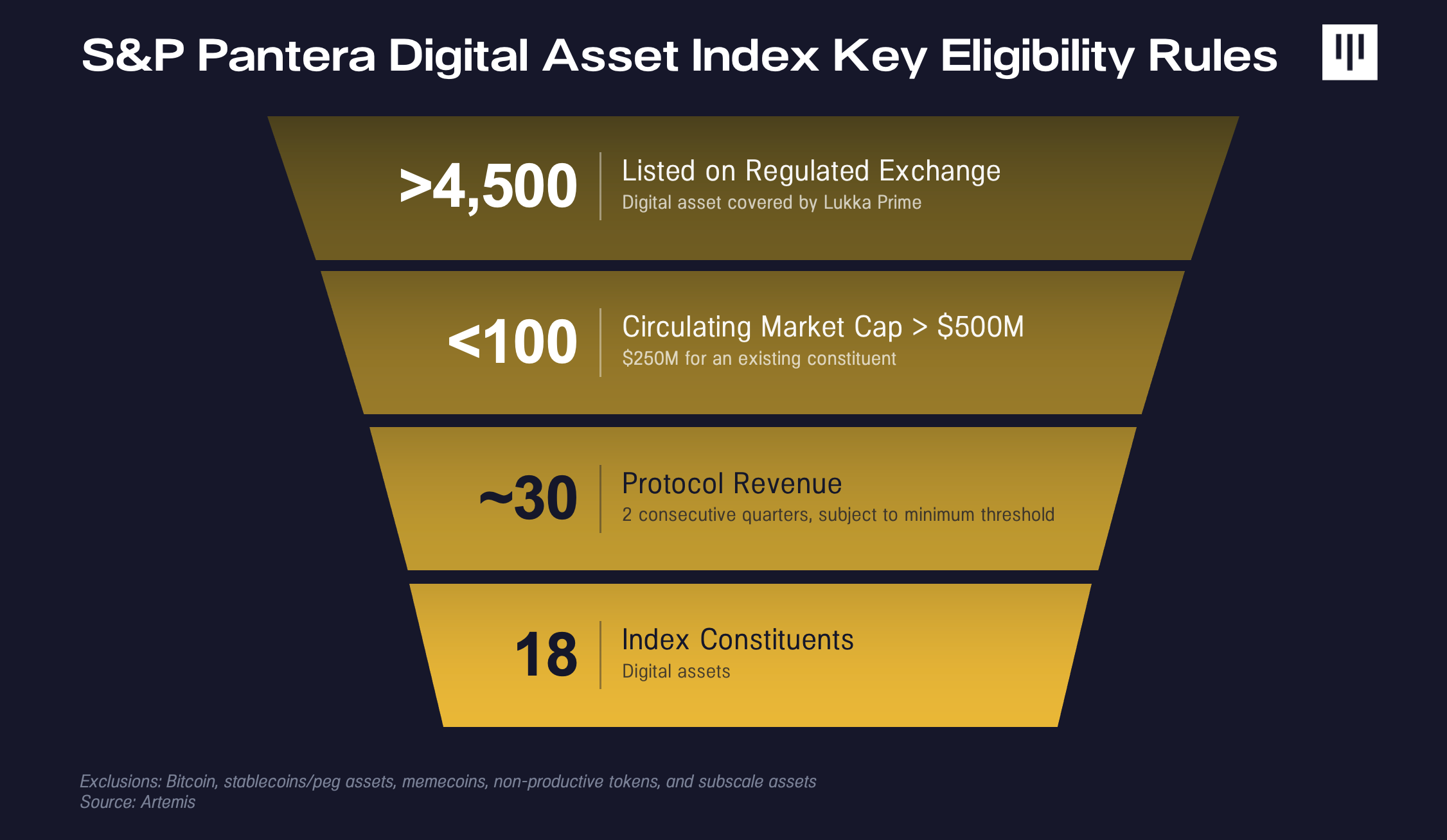
The index launches with 18 constituents, weighted by float-adjusted market cap. As more protocols achieve scale and prioritize tokenholder value accrual, the universe will expand naturally. (Find more information on the methodology below).
Why Now: The Blockchain Economy Needs This
Equity investors faced a version of this problem before 1957. For decades, the closest thing to a market proxy was the Dow, a narrow, price-weighted basket of thirty names with no fundamentals screen behind it. It was useful shorthand, but it was not a standard anyone could underwrite against. The S&P 500, introduced in 1957 out of an index series S&P had been refining since 1923, changed that. It gave the industry a broader, rules-based benchmark, and over time it added a financial viability requirement so that a company’s presence in the index signaled real, demonstrated earnings power, not just size or speculative attention.
Digital assets are at that pre-1957 moment today. Within digital assets the deeper issue remains the same – the yardstick most people use to judge this industry does not measure fundamentals at all. It measures Bitcoin’s price, and it lumps real, revenue-generating protocols in with tokens that have no economic function whatsoever.
This weak measurement has consequences. The prevailing narrative is that digital assets have been in a bear market for close to a year and, if excluding Bitcoin and stablecoins, total market cap sits below where it was five years ago. But this narrative is built on a benchmark that cannot see the difference between a protocol with real users paying real fees and a token with none.
There are practical applications generating meaningful, verifiable revenue right now, in stablecoin issuance, onchain trading, and lending markets. Product-market fit exists. It is simply invisible to a measurement standard built around price and speculation rather than usage and revenue. For instance, stablecoin monthly active users (MAUs) continue to grow, and this economic activity has largely decoupled from Bitcoin price activity.
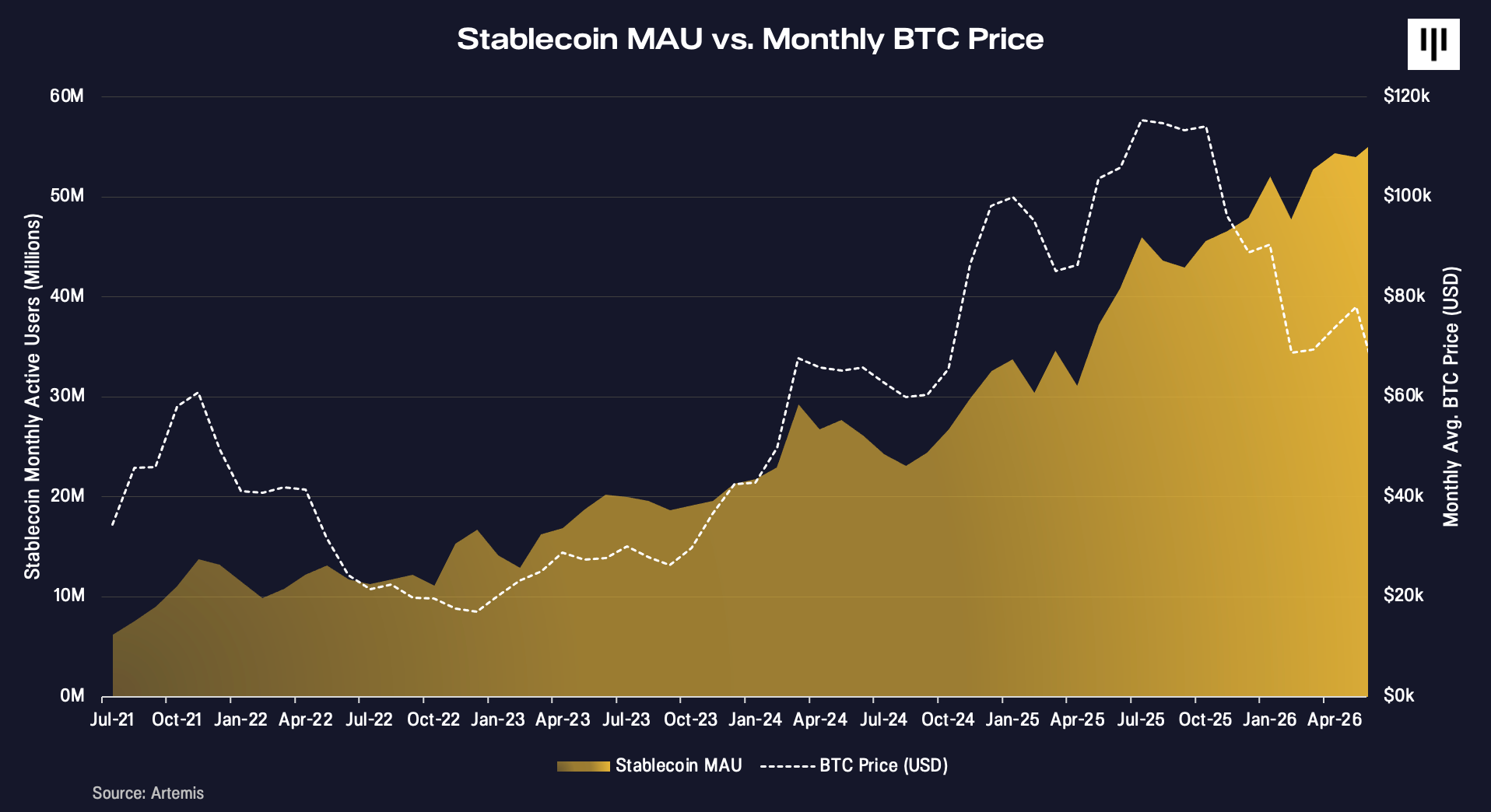
Importantly, it’s the underlying product market fit happening in the blockchain economy that makes the S&P Pantera Digital Asset Index possible to create today. Five years ago, creating a similar fundamentals focused index would have constituted a portfolio of 6 assets. The blockchain economy has dramatically evolved since, now consisting of dozens of protocols creating economic value.
The future of the blockchain economy will be measured by tokens that drive meaningful financial value towards stakeholders, and the S&P Pantera Digital Asset Index will be the yard stick by how we measure the performance of this industry.
Fundamentals Will Drive The Next Decade of Demand
Demand for digital asset exposure is poised to grow over the coming decade.
Bank of America and Fidelity now recommend a 1 to 4 percent allocation to digital assets in client portfolios. Yet J.P. Morgan Private Bank finds 89 percent of family offices still hold no digital assets at all, while EY-Parthenon research shows 60 percent of institutions prefer to gain exposure through registered vehicles versus via exchange or direct onchain exposure. The gap is not one of conviction, but a product gap. Every existing multi-asset vehicle over-indexes on Bitcoin, weights purely by market cap, and puts memecoins incongruously next to protocols with real revenue.
We are not making a valuation call on any individual asset, just as the S&P 500 does not. Financial viability is a starting point, not a complete investment thesis. But the backtest results are instructive. Applying the financial viability and investability screens produced stronger performance than S&P’s Broad Digital Asset Index, with or without Bitcoin, over the last five years.
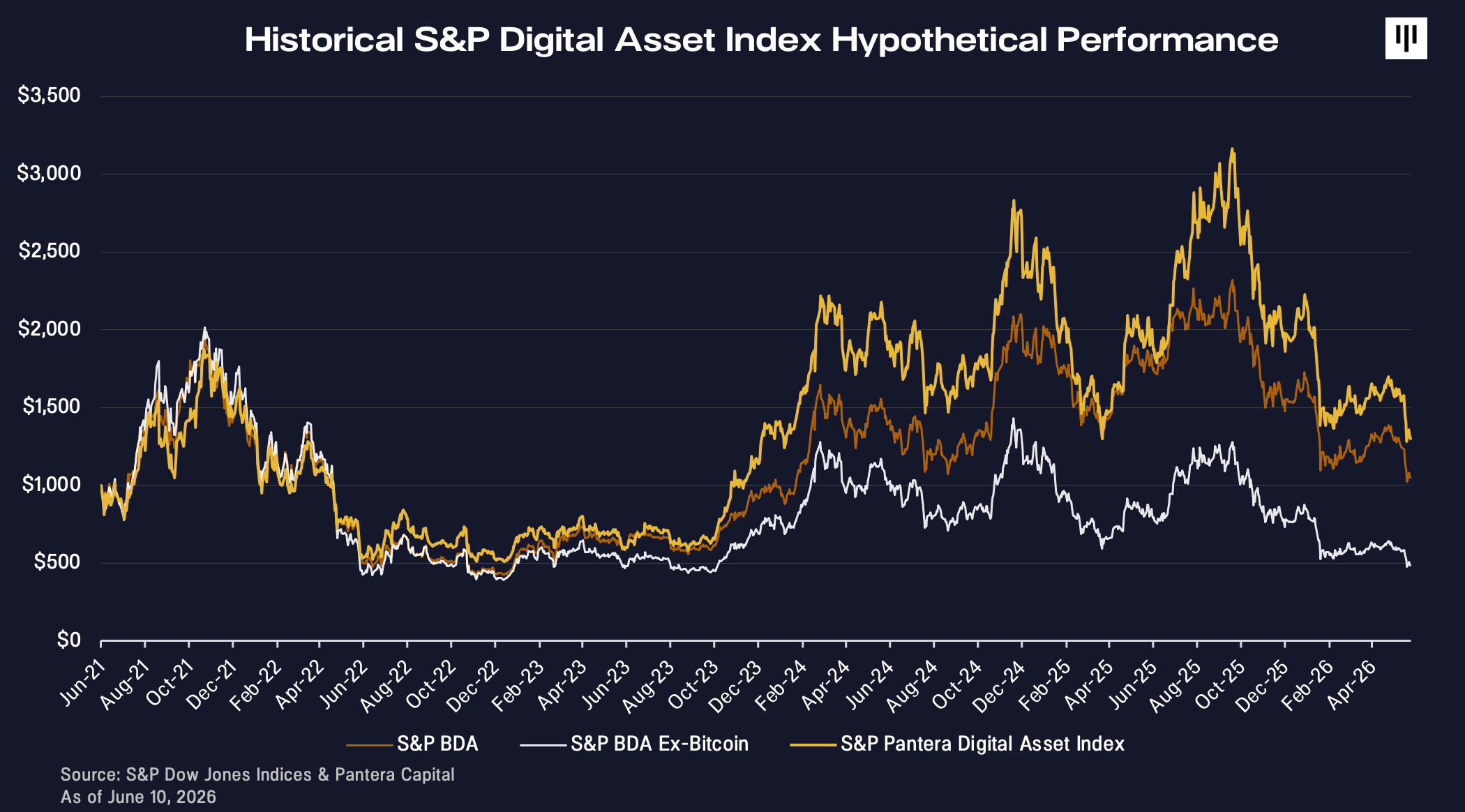
This index is a stronger yardstick. It highlights the productive part of the blockchain economy that many decision-makers are missing. By focusing on revenue-generating protocols with clear token economics (e.g., Hyperliquid’s programmatic buybacks funded by fees), it provides a more accurate view of where sustainable value is and will continue to be created in the future.
More important than any single backtest is the incentive this creates. A transparent standard for financial viability gives protocol teams and investors a shared framework. Better measurement supports better capital allocation decisions. That gives teams a reason to build durable, transparent token value accrual mechanisms. That in turn improves investor confidence and brings more capital into the industry. We are already seeing protocol teams reconsider how they allocate revenue so tokens participate more directly in the economics they help create.
The Index is also more useful as a scoreboard for the industry. For active managers with a fundamentals-based approach, selecting productive tokens should not necessarily be evaluated against Bitcoin or a broad basket containing assets with fundamentally different economic functions (or in many cases, no economic function). For industry observers and financial news providers, existing broad-based indices that don’t have the financial viability criterion don’t accurately reflect the growth of blockchain technology value creation.
Fast forward nearly 70 years later and the S&P is no longer just an index. It is the organizing benchmark behind the U.S. equity markets. As of 2024, about $13 trillion is passively indexed to the S&P 500. It is the go to reference for financial media (e.g. CNBC, Bloomberg) and active equity managers. The prospect of inclusion pushes companies at the fringe of financial variability to improve in order to join the index.
That is our vision for the impact that the S&P Pantera Digital Asset Index will have on the blockchain industry.
Build on the S&P Pantera Digital Asset Index
The blockchain economy is growing in adoption. Institutional allocators want to measure, value and invest in tokens underlying that growth. Now there is a way to do so.
The S&P Pantera Digital Asset Index is live today. It is a solid foundation for index-linked products, gives financial data providers and active managers a more relevant benchmark, and gives the industry a transparent standard against which productive token economics can be evaluated.
We are beginning discussions with asset managers about creating ETFs and other products using this index and with financial data providers about adopting it as the industry’s flagship benchmark.
If you are interested in learning more, reach out.
S&P Pantera Digital Asset Index: https://press.spglobal.com/2026-07-21-S-P-Dow-Jones-Indices-and-Pantera-Capital-Launch-New-Index-for-Digital-Assets
S&P Pantera Digital Asset Index Methodology: https://www.spglobal.com/spdji/en/documents/methodologies/methodology-sp-pantera-da.pdf
About S&P Pantera Digital Asset Index: https://www.spglobal.com/spdji/en/indices/digital-assets/sp-pantera-digital-asset-index/

Pantera Fund V :: Morgan Stanley Alternative Investments
By Scott Lawin, President
We’re proud to announce that Pantera Fund V is now available on the Morgan Stanley Alternative Investments platform, making it the first blockchain venture fund available through a Tier 1 global wealth management platform. This marks an important milestone not just for Pantera, but for the continued institutionalization of digital assets.
For much of the industry’s history, blockchain investing was primarily the domain of crypto-native investors and early adopters. Today, leading global wealth managers increasingly recognize the long-term opportunity being created by tokenization, stablecoins, digital payments, decentralized finance, agentic commerce and the broader transformation of financial markets.
Through this partnership, more than 16,000 Morgan Stanley Financial Advisors and their clients now have access to Pantera Fund V, bringing diversified institutional-quality blockchain venture investing to a significantly broader audience.
We’re grateful to the Morgan Stanley team for their partnership and confidence in Pantera. Their rigorous diligence and selection process reflects the growing demand for experienced, institutional-grade managers with deep expertise across the digital asset ecosystem.
Institutional adoption doesn’t happen overnight – it advances one milestone at a time. We believe this is one of them.
JOINING PANTERA :: STUTI PANDEY
By Stuti Pandey, Partner

I’m excited to share that I’m joining Pantera Capital as a Partner on the investment team. I’ll be focused on backing founders globally from Pre-Seed through Series B and will continue to be based in San Francisco.
What I’m Looking For
I’m joining to invest in founders innovating at the frontier of finance: the money, the mind that manages it, the markets it moves through, and the machines it runs on.
A few beliefs shape how I invest:
-
Two foundational costs are going to zero. Every financial business runs on two inputs: cognition and settlement. For a century both were expensive, and the architecture of finance grew around that expense. Now, both are collapsing at once. AI is driving the cost of financial cognition (i.e. advisory, underwriting, compliance, operations) toward zero. Stablecoins are doing the same to settlement: a dollar can now cross the planet in seconds for less than a cent. I call this the Two Zeroes. When both inputs go free, value migrates to what stays scarce: i.e. regulated trust, underlying assets, distribution, proprietary data. I’m looking for founders who will identify and own that scarcity. Next, value also migrates down into the physical inputs that produce intelligence. AI may feel free at the point of use, but someone is paying for it in megawatts. The Bitcoin miners that Pantera has known for over a decade, spent that time learning how to source power, finance infrastructure and operate large computing fleets. Many now sit inside the AI supply chain. I want to back the founders solving the technology bottlenecks around compute and energy, and building the markets around both.
-
New markets are opening. Every major cost collapse has opened markets that couldn’t clear before. Cheap computation gave us index derivatives and ad auctions. This cycle will price information by markets instead of pundits, give compute and power forward curves, and move assets that never fit the old rails onto new ones. The next great assets and exchanges are being founded now.
-
The labels are dissolving. Many of the defining financial companies of the next decade will run on stablecoin rails, and many will be run by AI agents. However, most won’t call themselves blockchain companies or AI companies at all, just as factories stopped advertising that they ran on electricity and startups stopped calling themselves dot-coms. Regulatory clarity is statute, stablecoins settle trillions a month as plumbing nobody notices, yet most of the world’s money still moves through systems designed for filing cabinets. The addressable market is the global financial system.
-
Founders come first. Great founders hold a memory of a future that does not exist yet and spend years building until the world catches up. In those years conviction and delusion wear the same face, and only time tells them apart. I aim to be the partner who recognizes that conviction early, challenges it honestly and remains useful for the full arc.
Why Pantera
In 2013, with Bitcoin at $65, Dan Morehead recognized that a new technology could become a new asset class and sized the firm’s conviction into one of the best trades of the 21st century. That orientation compounded, and the firm has become so much bigger than that trade. Under Paul Veradittakit leadership, Pantera’s venture portfolio has produced more than 20 unicorns.
Over that time, the firm has developed an extensive portfolio support platform across hiring, marketing, research, and business development, and I’m so excited to invest with this full capacity to back founders.
Pantera’s conviction in San Francisco also resonated with me as a Bay Area native. Many pass through Silicon Valley as tourists across the boom and bust cycles; Pantera set up a base here over a decade ago and has built the network and credibility to navigate the world’s most iconic technology center as a local.
Finally, I have known and admired several of this team for years for being the class act that they are, and it’s a pleasure to now walk into the same office.
I’m grateful to General Partners Dan, Paul, Franklin, and Cosmo for their trust.
About Me
I’m a Bay Area native and have a BSc from Carnegie Mellon. I began my career in public and infrastructure finance, moved into product and strategy roles in Silicon Valley, then moved to Germany in 2017 on early conviction in autonomous driving to found an Autonomous Mobility team in Volkswagen Group. I invested across mobility, marketplaces, and deep tech at Speedinvest and Maniv before nearly four years at Kraken Ventures, leaving as Partner with early investments in multiple unicorns.
If you’re building at the frontier, my inbox is open. stuti@panteracapital.com
PORTFOLIO SPOTLIGHT :: July 2026

Welcome to Portfolio Spotlight, Pantera Capital’s series highlighting portfolio companies at key inflection points and what those moments reveal about where progress is compounding.
The majority of today’s financial system runs during traditional business hours. Banks and Markets close on weekends. Trades settle days later. Money sent across borders sits in limbo while it passes through intermediaries adding delay and cost. It’s a financial system that was built for a world where everything moved at “human speed.”
That world is ending quickly. Blockchain doesn’t take weekends off, and neither do the people, businesses, and software increasingly relying on it.
In this edition, we highlight three Pantera portfolio companies each attacking a different piece of the “always-on” problem.
-
TurboFlow gives everyday traders access to markets that never close.
-
OpenFX gets money across borders in minutes instead of days
-
Orthogonal is building the payment rails for AI agents, that don’t sleep and don’t wait for business hours to complete a transaction.
Speed used to be a luxury reserved for institutions with the infrastructure to move fast. Now it’s becoming the default, for everyone and everything transacting online.
OpenFX :: The Bank That Never Closes
If you want to send $1,000 (or even $1 million) from the US to the UAE through a bank, you’ll likely have to wait two to five business days for it to arrive; and that’s if you send it on a weekday. Along the way to your destination, your payment gets handed off between multiple banks, each one taking a cut and adding delay. It’s the same process the world has used for cross-border payments since the 1970s.
OpenFX is replacing that process. Instead of routing a payment through a chain of banks, OpenFX settles it directly using stablecoins. The sender pays in their currency, stablecoins move the value instantly, and the receiver gets paid out in their currency. The sender and receiver never have to touch or think about crypto. They just see their money sent and received fast.
Transactions settle in under 60 minutes 98% of the time, compared to 2-5 days the old way. Costs run 90% lower. And the network works 24/7/365, including weekends and holidays, when traditional banks are closed.
OpenFX moved its first $1 billion in year one. By month 18, it was moving $1 billion a month. It’s now on pace to move $1 billion a day. In just two years, annualized volume has hit $70 billion. And that’s just a drop in the bucket compared to the cross-border payments market, which is worth roughly $200 trillion a year.
Clients like Yellow Card and VelaFi already rely on OpenFX to settle hundreds of millions of dollars a day. And demand isn’t just coming from humans. As AI agents start initiating their own payments, they’ll need a network that never sleeps and never waits for the banks to open on Monday.
Pantera participated in OpenFX’s $94 million Series A in March 2026, alongside Accel, Atomico, Lightspeed, M13, and Northzone. Money used to move at the speed of banking hours. Now it moves at the speed of the internet.
Orthogonal :: Giving AI Agents a Way to Pay
You’ve probably asked an AI assistant to draft an email, summarize a contract, or research a product and have been happy with the output. That’s because the agent is just processing information. However, the moment you ask it to actually do something like book a flight or pay an invoice, it can’t. AI tools are only built to transact with a handful of services they were specifically designed to talk to. Ask it to work with anything outside that list, and it gets stuck, stalls, or hands the task back to you to finish.
Orthogonal is building the missing piece: a way for AI agents to find the right service in real time, use it, and pay for it, all without a person involved. The agent describes what it needs,Orthogonal finds a service that can do it, plugs it in, and settles the payment automatically. It’s already wired into more than 35 different services agents can tap into.
This matters because agents don’t work like people. They don’t take weekends off, they don’t wait until Monday morning, and they don’t stop just because it’s the end of their workday. If AI agents are going to transact on their own, the infrastructure underneath them has to be always-on as well. That is what Orthogonal is building.
McKinsey projects that agentic commerce, AI agents autonomously buying and selling on their own, could drive $3 to $5 trillion in economic activity by 2030. As Pantera General Partner Franklin Bi said, the internet is moving toward agents as “the primary consumers of data and services,” not humans clicking links.
Pantera led Orthogonal’s $4.3 million seed round in June 2026, alongside Y Combinator, Pioneer Fund, Decasonic, Blast, Outbound, and Surreal. The internet has a new kind of user; one that never sleeps and never logs off. Orthogonal is building the plumbing underneath it.
TurboFlow :: Bringing Institutional-Grade Trading to Everyday Traders
If you live in most of Asia and want to trade on the outcome of an election or whether a stock beats earnings, you’re mostly out of luck. Platforms like Kalshi and Polymarket built this kind of trading for U.S. and European users. In other regions, retail traders are stuck choosing between platforms that don’t serve their region, or trading experiences that feel like a translated afterthought.
TurboFlow is closing that gap. It’s a single onchain platform where users can trade both prediction markets (betting on real-world event outcomes) and perpetual futures (leveraged bets on asset prices), the two fastest-growing categories in crypto trading, side by side from one account. The platform is built specifically for Asia-Pacific traders. Pricing, liquidity, and risk management usually reserved for institutions are wrapped in an app simple enough for a first-time trader. You can get started with as little as $2.
Prediction market volume grew from under $5 billion in September 2025 to over $24 billion by April 2026, and industry forecasts put it above $1 trillion by 2030. Perpetual futures have seen $4 trillion in trading volume in just the last six months. TurboFlow is betting the two will keep converging into one larger category of event-driven trading, and wants to own that category across Asia.
The early numbers back it up. Still in beta, TurboFlow has already attracted more than 15,000 registered users and processed over $19 billion in trading volume, all before a full public launch.
Looking Ahead
OpenFX moves money around the clock. Orthogonal lets machines pay without waiting on a person. TurboFlow gives Asia-Pacific traders a platform built for them, open every hour markets move. Different problems, same underlying shift: the infrastructure of finance no longer waits for business hours, borders, or even a human to be the one transacting.
There are more stories like these across the Pantera portfolio, and we look forward to sharing them with you! You can view previous Portfolio Spotlights on our Blog here.
See you next month!
The Pantera Team
THE U.S POLICY BATTLES SHAPING BLOCKCHAIN’S FUTURE WITH JAKE CHERVINSKY OF HYPERLIQUID :: STATEFUL
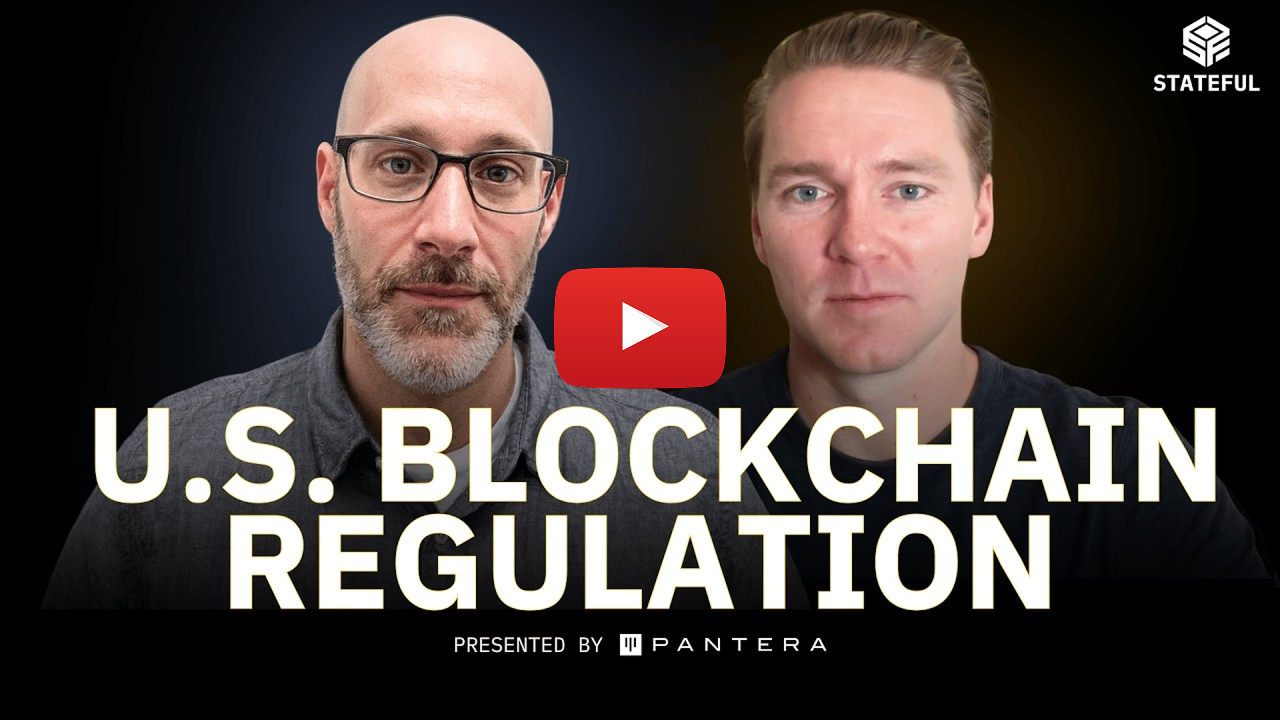
Jake Chervinsky, CEO of the Hyperliquid Policy Center and former chief policy officer at the Blockchain Association, put it simply:
“Perps are a better derivative. Prediction markets are a better product than sportsbooks. And Americans can’t access either onchain. That’s the problem I’m in Washington to fix.“
Jake joins Pantera’s Stateful Podcast hosted by Mason Nystrom to break down the three policy battles defining crypto’s next era: the CFTC’s crawl-walk-run path to regulated onchain perps, CME’s lawsuit to block perp trading on registered exchanges, and the CLARITY Act, which he pegs at 90-95% done with the August recess as the do-or-die deadline. Regulation moves slower than technology, but the gap between what’s built and what Americans can legally touch is exactly where the fight is happening.
Hear more from Jake Chervinsky on Pantera’s Stateful Podcast, where he explains why perps and prediction markets are better products than what traditional finance has built, and what it will take to bring them onchain in the US.
YouTube: https://youtu.be/-QxJqSIoMyM
Spotify: https://open.spotify.com/episode/4ueb5fiGvAj1EO8Bl0vJzA?si=badc38e89a244cef
Apple Podcasts: https://podcasts.apple.com/us/podcast/the-state-of-u-s-blockchain-regulation/id1843681425?i=1000776902608
Sincerely,

|
|
PANTERA FUND V
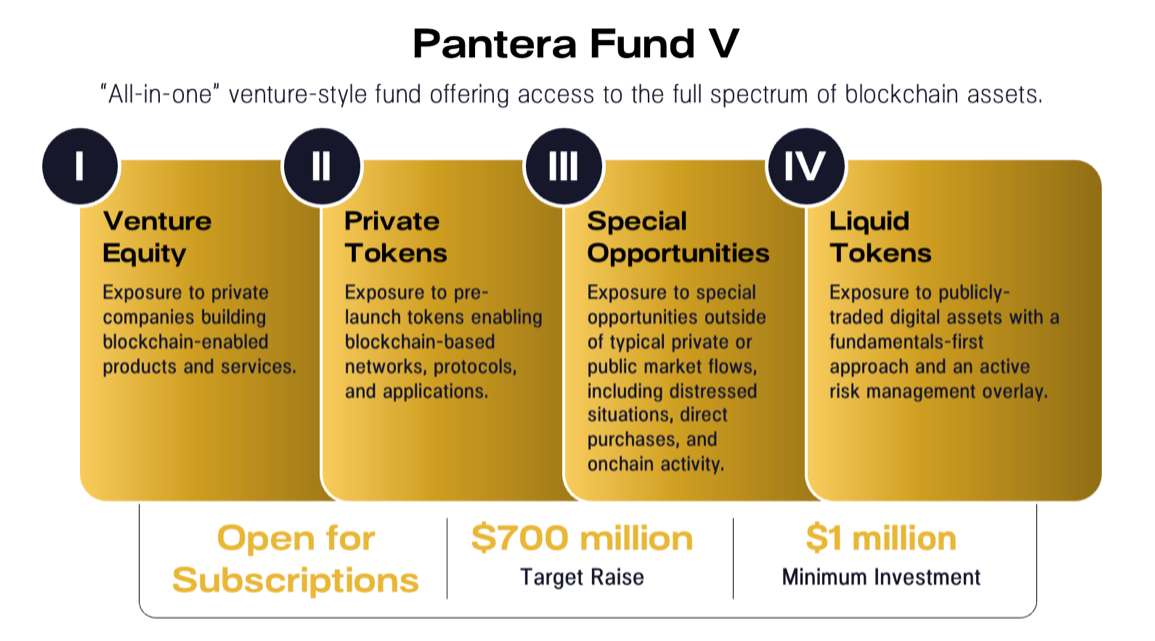
We’ve found that most investors view blockchain as an asset class and would prefer to have a manager allocate amongst the various asset types. This compelled us to create Pantera Blockchain Fund (IV) in 2021, a wrapper for the entire spectrum of blockchain assets. Its successor — Pantera Fund V — is now open for subscriptions.
Similar to its predecessor, we believe this new fund is the most efficient way to get exposure to blockchain as an asset class. It is a continuation of the strategies we have employed at Pantera for twelve years across twelve venture and hedge funds.
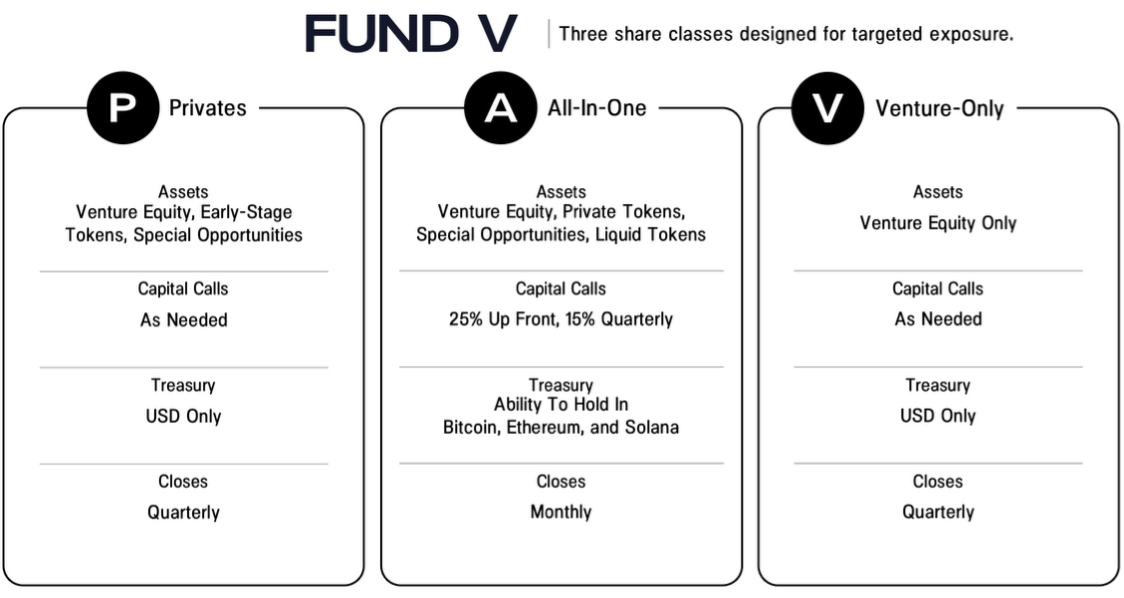
Limited Partners have the flexibility to invest in just venture (Class V for “Venture”), or in venture, private tokens, and locked-up treasury tokens (Class P for “Privates”), or the all-in-one Class A.[1],[2]
As in all previous Pantera venture funds, we strongly support helping our LPs get access to private deals in this fund. Fund LPs with capital commitments of $25mm or more will have the option to collectively co-invest in at least 10% of each venture equity, private token, and special opportunity deal that the Fund invests over $10mm in. There is no management fee or carried interest on co-investments for those with co-investment rights.
We will endeavor to offer co-investment opportunities, on a capacity available-basis, to other LPs as well. These co-investment opportunities are subject to 1/10% fees.
We are now accepting subscriptions for Fund V. If you’re ready to invest, please click the button below to begin the process.

If you are new to Fund V and would like to receive additional information, click here. We also invite you to join our next call on Pantera Fund V on Tuesday, August 11, at 12:00pm Eastern Time. You may register here.

Pantera donates 1% of revenue from all new funds to 1% For The Planet.
This letter is an informational document that primarily provides educational content and general market commentary. Except for certain sections specifically marked in this letter, no statements included herein relate specifically to investment advisory services provided by Pantera Capital Partners LP or its affiliates (“Pantera”), nor does any content herein reflect or contain any offer of new or additional investment advisory services. Nothing contained herein constitutes an investment recommendation, investment advice, an offer to sell, or a solicitation to purchase, any securities in Funds managed by Pantera (the “Funds”) or any entity organized, controlled, or managed by Pantera and therefore may not be relied upon in connection with any offer or sale of securities. Any offer or solicitation may only be made pursuant to a confidential private offering memorandum (or similar document) which will only be provided to qualified offerees and should be carefully reviewed by any such offerees prior to investing.
This letter aims to summarize certain developments, articles, and/or media mentions with respect to Bitcoin and other cryptocurrencies that Pantera believes may be of interest. The views expressed in this letter are the subjective views of Pantera personnel, based on information that is believed to be reliable and has been obtained from sources believed to be reliable, but no representation or warranty is made, expressed, or implied, with respect to the fairness, correctness, accuracy, reasonableness, or completeness of the information and opinions. Analyses and opinions contained herein (including market commentary, statements or forecasts) reflect the authors’ judgment as of the date this letter was published, and may contain elements of subjectivity (including certain assumptions) or be based on incomplete information. The information contained in this letter is current as of the date indicated at the front of the letter. Pantera does not undertake to update the information contained herein.
This letter is not intended to provide, and should not be relied on for accounting, legal, or tax advice, or investment recommendations. Pantera and its principals have made investments in some of the instruments discussed in this communication and may in the future make additional investments in connection with such instruments without further notice.
Certain information contained in this letter constitutes “forward-looking statements” (including predictions), which can be identified by the use of forward-looking terminology such as “may”, “will”, “should”, “expect”, “anticipate”, “target”, “project”, “estimate”, “intend”, “continue”, “believe”, or the negatives thereof or other variations thereon or comparable terminology. Due to various risks and uncertainties, actual events or results or the actual policies, procedures, and processes of Pantera and the performance of the Funds may differ materially from those reflected or contemplated in such forward-looking statements, and no undue reliance should be placed on these forward-looking statements, nor should the inclusion of these statements be regarded as Pantera’s representation that the Funds will achieve any strategy, objectives, or other plans. Past performance is not necessarily indicative of or a guarantee of future results. There is no guarantee that investments in any instrument or type of instrument described herein will be profitable – all investments carry the inherent risk of total loss.
It is strongly suggested that any prospective investor obtain independent advice in relation to any investment, financial, legal, tax, accounting, or regulatory issues discussed herein. Analyses and opinions contained herein may be based on assumptions that if altered can change the analyses or opinions expressed. Nothing contained herein shall constitute any representation or warranty as to future performance of any financial instrument, credit, currency rate, or other market or economic measure.
All information presented prior to an index’s Launch Date is hypothetical (back-tested), not actual performance. The back-test calculations are based on the same methodology that was in effect on the index Launch Date. However, when creating back-tested history for periods of market anomalies or other periods that do not reflect the general current market environment, index methodology rules may be relaxed to capture a large enough universe of securities to simulate the target market the index is designed to measure or strategy the index is designed to capture. For example, market capitalization and liquidity thresholds may be reduced. Past performance of the Index is not an indication of future results. Back-tested performance reflects application of an index methodology and selection of index constituents with the benefit of hindsight and knowledge of factors that may have positively affected its performance, cannot account for all financial risk that may affect results and may be considered to reflect survivor/look ahead bias. Actual returns may differ significantly from, and be lower than, back-tested returns. Past performance is not an indication or guarantee of future results. Please refer to the methodology for the Index for more details about the index, including the manner in which it is rebalanced, the timing of such rebalancing, criteria for additions and deletions, as well as all index calculations. Back-tested performance is for use with institutions only; not for use with retail investors.