Genchi Genbutsu: Hardware, Software and Everything In Between
November 10, 2026 | Cosmo Jiang, Cody Poh
Introduction
At 2 a.m., our Cathay Pacific flight finally touched down in Hong Kong after a six-hour delay in Singapore. With barely three hours of sleep, we found ourselves in a car heading straight to Shenzhen, China’s hardware capital and home to tech giants such as Huawei, BYD and DJI. Genchi Genbutsu. Go and see for yourself. We have met with numerous US-based robotics companies and invested in a select few, and through this we think we know that China is a critical cog in the global robotics industry, but can we really know from afar?
Robotics has been a focus for us over the last couple of years. Breakthroughs in embodied AI have created a step function change in the industry’s potential. Models can now see, plan and act in the physical world, while the hardware required to run them keeps getting better and cheaper. In the bull case, robots will disrupt a much broader share of the world’s physical labor, which consists of 2.2bn humans worldwide and an annual wage pool of over $20tn1. Even 1% penetration would rival the revenue generated by today’s largest technology companies.
China is indispensable to the embodied AI industry. Global manufacturers rely heavily on Chinese supply chains, and Chinese manufacturers accounted for over 90% of global humanoid production in 20252. At the same time, recent FCC restrictions on foreign-produced advanced robotic devices underscore how geopolitics is increasingly shaping the robotics industry. As fundamental investors, we need to understand and navigate this rapidly evolving landscape, and the best way to do so is to get on the ground and see the reality for ourselves.
And so began our trip to Shenzhen, where we got a firsthand look at China’s rapidly evolving robotics ecosystem. We visited companies spanning much of the robotics value chain, from vertically integrated humanoid manufacturers and model developers to data collection equipment providers to dexterous hand specialists. Along the way, we spoke with founders, senior executives across sales, manufacturing, and research, as well as junior employees fresh out of college.
Our objective was simple: to understand where China stands in the global robotics race, where its competitive advantages lie, and, more importantly, where the investible gaps remain.
Hardware: China Leads the Race
One thing became clear throughout our trip: China leads the robotics hardware race, underpinned by its unmatched manufacturing scale and supply chain integration. This is particularly visible in Shenzhen, the beating heart of China’s manufacturing engine. Decades of development as the world’s manufacturing hub have created a deeply entrenched ecosystem, with readily available raw materials, cost-efficient logistics, established high-volume production facilities, and a large workforce skilled in precision manufacturing. This is a structural moat that other emerging manufacturing hubs will find difficult to replicate.
This advantage translates directly not only into cost competitiveness but, more importantly, innovation speed. A humanoid startup in Shenzhen can have a new idea in the morning, communicate it to their supplier, and have a new part delivered to their office by noon. This allows Chinese manufacturers to supply better, cutting-edge hardware at lower prices. The caricature that China creates low-quality copycat or commodity goods is an anachronism. As model labs scale their training efforts, they require increasingly large volumes of specialized data collection equipment, much of which China is uniquely positioned to manufacture at scale and at low cost. Leading US robotics companies we’ve spoken with make big claims about what they design and manufacture in-house, but talk to the companies in Shenzhen and they will tell you which Mag7 or multi-billion-dollar venture startup they’re selling into. This is true from critical components, such as dexterous hands and actuators, to the mass cameras and headsets used for data collection.
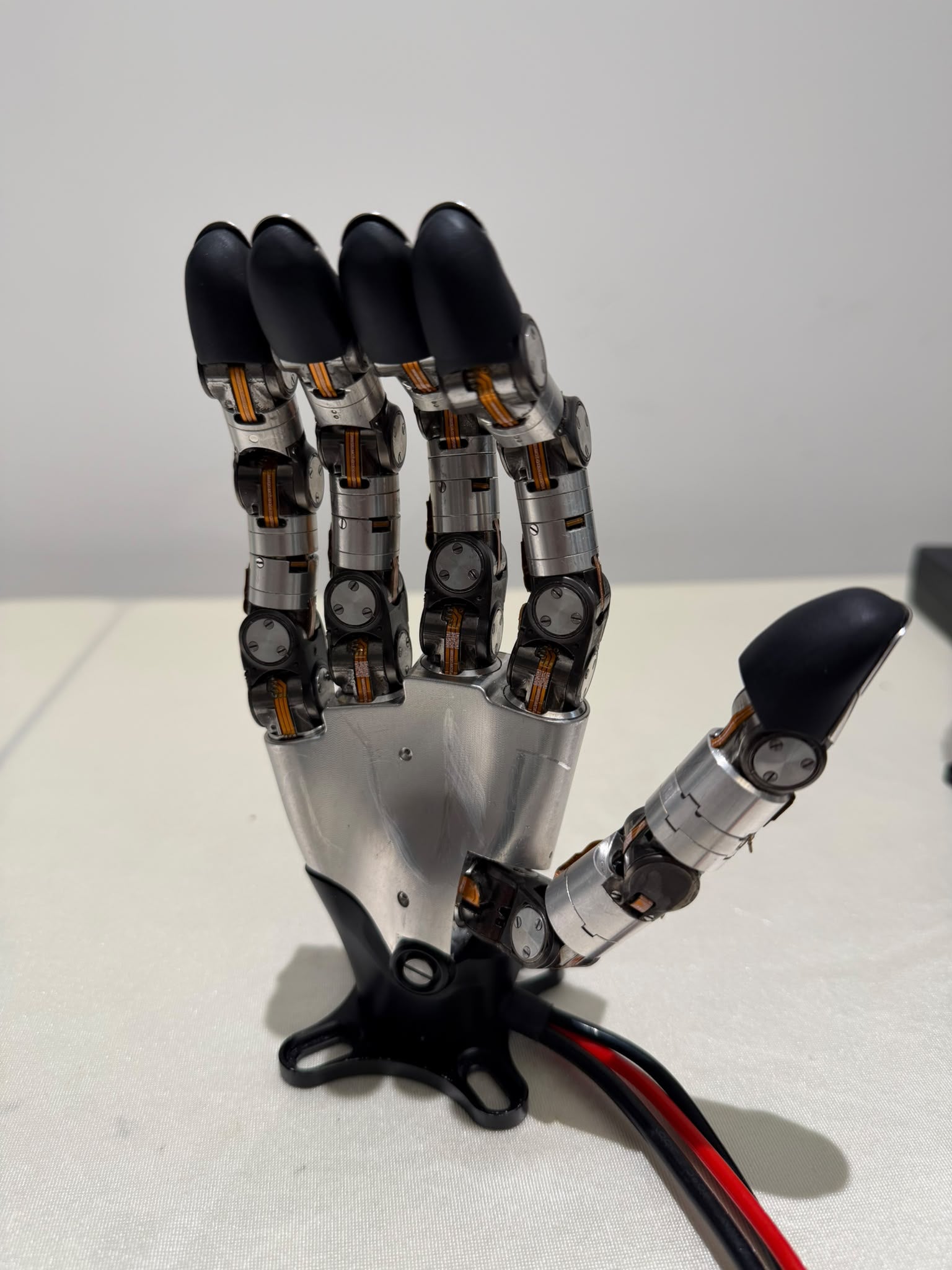
The dexterous hand manufactured by Wuji Tech, which integrates over 1,800 components into a human-sized form factor, was better than any hand we have seen in the US – perhaps unsurprisingly, they are quietly the supplier for many of the large US tech companies. Each finger is designed to bend backward, improving durability (a key battleground in hands currently) and resilience to collisions. We watched the hands separate a single card from a deck (teleoperated) – a seemingly simple task for humans but a significant challenge for robotic manipulation because of the precise control of force and friction required. Another wow moment, but in a weird way, was seeing the UBTECH humanoids with human skins that give off Battlestar Galactica Cylon vibes.

Another characteristic of the Chinese market is the extreme level of competition and how that drives pricing lower and margins to zero. One startup spent an hour talking us through all the incredible technical advances they had made on their next generation actuators. However, when we asked them about how ultimately they compete with others, they would say, “well, of course, price is most important”. This was not the only one that said this. At lunch, an owner of a retail chain lamented how it’s so hard to make a profit because there’s always someone willing to sacrifice this year’s margins to take market share in hopes of making money the next year – only to find next year that there’s a new someone willing to undercut and do the same thing. A deep-rooted Chinese cultural concept is to “eat bitterness” (吃苦). That willingness to endure hardship prevents companies from making outsized profits, making life tough for individual companies but benefiting the broader national industry.
Beyond cost and scale, China’s position upstream in the robotics value chain gives it another underappreciated advantage: a front-row seat to emerging technological trends. Robotics labs are constantly experimenting with new data collection methods, from tactile and force-sensing gloves to vision-capture headsets equipped with eight cameras for wider-angle recording. As effectively the only suppliers capable of provisioning such equipment quickly and cost-effectively, Chinese manufacturers gain early visibility into the evolving requirements of frontier robotics labs, potentially identifying emerging trends three to six months ahead of the broader market.

Whether Chinese companies can effectively translate their manufacturing dominance and these early insights into proprietary technological advantages is a separate question, about which we developed doubts over the course of our time.
Data: Collection Is the Bottleneck, Not the Moat
Every robotics company has told us that China has large data collection efforts and is exporting that data globally. At surface level, it makes sense that companies might ask their workers to strap on headsets and capture egocentric data to make an extra buck. As we talked to startups in the China ecosystem, it turns out it runs much deeper than that and involves, as is often the case in China’s version of capitalism, explicit government direction.
Multiple sources told us that local Chinese governments are the primary driver of data collection efforts. After the national government unleashed incentives for robotics development and job creation, local governments realized subsidizing data collection was a relatively easy way to create net new robotics-related jobs. China’s governing system features centralized political control, where Beijing sets national priorities, but provincial and local governments are expected to figure out the implementation and execution. Local government officials are incentivized to maximize measurable performance targets, which can come at the expense of the broader strategic initiatives.
Millions of dollars are being spent on training data of questionable value. Across China, there are data farms where workers repeatedly perform the same tasks to generate hours of “robotics training data.” Yet these repetitive, homogeneous datasets offer limited incremental value for improving model capabilities after the first few copies. Despite quality concerns, this data continues to successfully sell overseas, reflecting a more fundamental challenge: data availability remains one of the biggest bottlenecks in robotics model development. Unlike LLMs, which can leverage vast amounts of text scraped from the internet, robotics lacks an equivalent readily available data corpus. Moreover, useful robotics training data comes in many forms, and the types of data required to unlock the next leap in model performance may not even exist at meaningful scale.
The real moat, therefore, is not data collection itself, but the ability to turn raw data into meaningful training signals. Encouragingly, emerging evidence suggests that scaling laws also apply to robotics models, with performance improving as training data volumes increase. This points to sustained demand for high-quality heterogeneous robotics training data that can meet the continuously evolving data requirements and standards across modalities, collection methods, and training approaches.
In an environment where the definition of “high-quality data” is constantly shifting, the more defensible competitive advantage lies in being viewed as a trusted research partner to the frontier labs. Having a high degree of taste in data annotation, curation, and evaluation rather than collection capacity alone is how you can win that credibility. Rather than those who collect the most data, the winners will likely be teams with true embodied AI research backgrounds that enable them to adapt the most quickly with the frontier robotics companies, much like Scale AI and Mercor led with research to embed into the major frontier LLM labs.
Software: The Elephant in the Room
Robotic automation has been around for decades. For example, Amazon has heavily integrated robots into its warehouses since acquiring Kiva in 2012 and surpassed 1 million operational robots in 20253, with ever new form factors and capabilities. So, making ever-more advanced hardware is just a natural evolution. The revolution in robotics is around embodied AI, which changes the paradigm for robotics by broadening its capabilities and moving beyond machines narrowly programmed for specific tasks.
AI software was the elephant in the room throughout all our robotics meetings in Shenzhen. Most humanoids and robots we encountered demonstrated limited autonomy or generalization, relying heavily on teleoperation or pre-programmed routines. Senior executives candidly acknowledged the lack of advanced AI in their robots, and that their software lagged that of overseas competitors by at least one to two years. The more junior employees, from whom you will often receive less of the party line and more of the dirty truth, jokingly admitted that their software simply did not work and that any attempts were halfhearted. This is partially due to us seeing just the slice of robotics that exists in Shenzhen, which veers more toward hardware, as opposed to the more software dominant hubs in Hangzhou and Shanghai. But there is a broader truth here.
China’s dominance in hardware manufacturing and data collection, key ingredients to robotics, has not translated into a lead in software. Many Chinese humanoid manufacturers continue to rely on open-source models developed by US labs as the foundation of their software capabilities, in particular OpenAI, Nvidia and Physical Intelligence, rather than building their own foundation models.
Our conversations with industry researchers suggest that Chinese robotics companies may be content to not invest the capital in foundational model development, instead focusing on fine-tuning existing open-source models in post-training. For US model labs, this does open up a wedge where open-sourcing can serve as a powerful distribution strategy, encouraging adoption and building ecosystems around their models. As these models become increasingly capable, Chinese manufacturers may have even less incentive to develop alternatives.
Distillation is not a practice the Chinese companies try that hard to hide, and it is clear part of their bet is that they can do the same in robotics. However, unlike LLMs, where model distillation can leverage large volumes of synthetically generated text, robotics presents a more complex challenge. Distilling robotics models requires not only the models but also substantial physical interaction data, hardware infrastructure, and real-world validation. This makes replicating frontier model capabilities considerably more difficult, even for companies with strong hardware manufacturing capabilities.
China Plays by Different Rules
The scar tissue of a country that was lifted out of poverty within a typical senior executive’s lifetime was readily visible. There is a strong “hustle” culture in China, as is common in many areas with a large newly rich population, where people are looking to make money quickly in fear of returning to the starvation visible in their rearview mirror. This sounds obvious at first blush, but what surprised us was how deeply that impacted the startup ecosystem.
A consistent wistful refrain we heard from the Chinese startups we met with was that “US startups don’t have to worry about making money”, when referencing the pressure they receive from their investors to reach commercialization immediately. We heard that this divergence stems from the shorter-term return expectations embedded in China’s venture capital ecosystem. Many startups are expected to generate meaningful revenue within two to three years of founding, and those demonstrating early traction face pressure from investors to pursue a public listing immediately. Our hypothesis is that Chinese venture capital firms’ relatively lower appetite for duration has a few reasons – from lower return expectations due to weak alternatives (a stock market that has been range-bound for the last decade, 1% cap rates in tier 1 city residential real estate, exacerbated by capital controls) to a lower concentration of endowment-like limited partners. This creates a strong incentive to prioritize hardware manufacturing and data collection services, where revenue is more immediate and payback periods shorter, over foundational software development, where the path to commercialization is longer and far less certain.
Additionally, there is a different attitude toward intellectual property rights. Despite us walking through many hallways proudly displaying patents, it is an open secret that there are no IP protections. This compels companies to monetize every incremental innovation, lest it be copied and monetized by someone else quicker.
The result is a structural misalignment of incentives: China has built formidable advantages in the physical layers of robotics, yet the capital and policy environment may be discouraging the long-term investment needed to translate those advantages into software leadership.
Our View on Robotics
We left Shenzhen with a clearer, more informed view of where the robotics industry stands today and where the key gaps lie as they evolve.
Robotics is still very early, and China plays a critical role
- Our visits to Shenzhen and conversations with executives at Chinese robotics companies reinforced our view that the embodied AI industry remains in its infancy. The hardware is getting better but, at least as perceived in China, the software is nowhere close to prime time.
- China’s role in the robotics industry is more important than ever. Chinese manufacturers are key suppliers of data collection equipment and critical robot components. Data remains a key bottleneck to unlocking model capabilities, and if scaling laws continue to hold, collecting more diverse, high-quality data will be essential to improving performance. China’s manufacturing ecosystem is uniquely positioned to produce data collection hardware at scale and supply critical components such as dexterous hands and actuators to the global market.
- How China chooses to participate in the global robotics ecosystem will be critical to the pace of industry development. China’s hardware leadership is likely to persist, keeping it a key supplier to global robotics companies (FCC ban on humanoid robots notwithstanding; note it doesn’t apply to components).
- If Chinese models eventually catch up in capability, Chinese companies could gain significant leverage over the industry by raising prices or restricting access to critical hardware. While a low probability scenario, this is a key risk when underwriting investments in US robotics companies.
The economic case for robotics usage is not as compelling in China
- Humanoid sales in China are strong, but they’re not used for any meaningful economic work. Today, robots in China are primarily deployed in low-value commercial settings and entertainment, such as showrooms and exhibitions where they give simple instructions to visitors or perform dancing and kung fu routines. Quadrupeds and even bipedal robots are still largely sold to university research labs and hobbyists.
- This contrasts with the US, where robots are increasingly being deployed in industrial and logistics settings, with companies securing multi-million-dollar, long-term contracts4. A key difference is the cost and availability of labor in the West: much higher labor costs and a shrinking appetite among younger workers for blue-collar jobs create a stronger economic incentive to automate.
- That said, technological progress outpaces widespread commercialization. A Chinese founder shared the following analogy: humanoids today are like automobiles in the era of horse-drawn carriages, when people questioned the need for cars because horses already served their transportation needs. What they could not foresee was how automobiles would fundamentally reshape mobility and create entirely new markets.
- We believe the same could hold true for humanoids. Consumers and businesses may struggle to understand why they need general-purpose robots today simply because they have yet to experience what these machines could eventually enable. Additionally, there is less immediate economic incentive in China to ideate novel commercial use cases. That makes the startup ecosystem potentially more close-minded.
General purpose humanoids will be the cheapest form of labor in the future
- There is a reasonable debate to be had around why the world needs general-purpose humanoids when specialized robots can perform specific tasks more efficiently and reliably. Our observations in China also confirm the view that specialized robots are currently far more capable than their general-purpose counterparts. By focusing on narrowly defined, quantifiable tasks, specialized robots also offer a faster path to commercialization.
- However, we believe specialization has its limits when it comes to scalability. A company cannot realistically deploy a different robot for every task across its operations. Similarly, a household is unlikely to purchase one robot to wash dishes, another to clean tables, a third to do laundry, and yet another to fold clothes. While specialized robots may outperform general-purpose humanoids on individual tasks, the economics become less compelling when multiple machines are required to automate everyday activities.
- We believe general-purpose humanoids will eventually become the cheapest form of labor, not because they can perform one specific task with 99.9% accuracy, but because they can perform hundreds of different tasks with 99% accuracy. A humanoid does not need to be the best at washing dishes, folding clothes, or doing laundry. It simply needs to be good enough at all three, and many more. As model capabilities improve, the same hardware platform could take on an expanding range of tasks without requiring additional specialized machines.
- Ultimately, the economic advantage of general-purpose humanoids lies not in maximizing performance on any single task, but in maximizing the number of tasks a single machine can perform. We believe this versatility, combined with improving reliability and declining hardware costs, could fundamentally reshape the economics of physical labor.
Data collection is a huge market, with value accruing to data intelligence
- We believe robotics data collection will become an enormous market, supported by emerging evidence that scaling laws extend to physical AI. Figure AI’s recent release of Helix 2.5 provides encouraging evidence that robotics models can improve predictably as training data volumes increase. Much like LLMs, where greater data and compute have driven significant improvements in model capabilities, robotics appears to be following a similar trajectory. This suggests that demand for robotics training data will continue to grow as model labs race to develop increasingly generalizable intelligence.
- However, more data does not necessarily mean better data. Our visits to Chinese robotics companies reinforced this distinction. While large scale data farms can produce thousands of hours of training footage, the incremental value of such homogeneous datasets to model performance remains questionable. As the industry scales, we believe the bottleneck will increasingly shift from collecting more hours of data to identifying which hours actually matter.
- The real opportunity, therefore, lies not in data collection alone, but in turning raw training hours into measurable improvements in model capabilities. This requires more sophisticated data annotation, filtering, curation, and evaluation to distinguish valuable training signals from redundant or low-quality data. As robotics models evolve and their data requirements continue to change, the ability to consistently identify and deliver high-value datasets could become a far more defensible competitive advantage than collection capacity itself.
The model layer is increasingly commoditized, but the US will stay ahead of China
- We believe the robotics model layer is becoming increasingly competitive and faces the risk of being commoditized over time. Over the past few months, leading US robotics labs, including Physical Intelligence, Generalist, Dyna Robotics, and Figure AI, have independently announced significant advances in model capabilities and generalization. The fact that multiple players are achieving meaningful breakthroughs within a relatively short period suggests that frontier robotics intelligence may not remain the exclusive domain of two companies, like it is with Anthropic and OpenAI in LLMs.
- Most blue collar work doesn’t require 200 IQ. It just requires modest intelligence and good post-training. As training methodologies mature and data volumes scale, we believe competition moves from developing capable robotics foundation models to deployment and post-training. In that world, it is increasingly difficult for any company focused only on the foundation model to sustain a differentiated advantage.
- We believe the US will maintain its software lead over China for the foreseeable future, partly because Chinese robotics companies are more incentivized to prioritize near-term revenue from hardware sales and data collection than to commit capital to long-term, research-intensive development. Continued breakthroughs in frontier robotics models by US labs will likely reinforce China’s reliance on overseas open-source models.
- Unlike LLMs, where model capabilities can be more readily distilled, robotics model distillation is more challenging. Model intelligence must be complemented by physical interaction data across diverse environments and robot embodiments. China’s manufacturing advantages alone cannot overcome these barriers. We believe the resulting gap between the US and China could prove more persistent than the gap observed in LLMs.
We believe there is a “latecomer” advantage in robotics.
- There is a tremendous amount of capital being deployed to answer some of the big debates in robotics (e.g. model architecture, form factor, verticalization), and many robotics startups will end up having started down the wrong path. New companies today can leverage those learnings, not having to spend the money to solve those debates, and start with fresh architecture reflecting the latest meta.
Conclusion
At 8 p.m. on our last day, the team hopped into the same car, this time bound for Hong Kong International Airport and our flight back to New York. After a thorough trip through Shenzhen’s robotics hub, we left with a refreshed and more informed view of the global robotics industry. Genchi Genbutsu. This trip reinforced our belief that, in an age of information overload, seeing things with our own eyes remains one of the best ways to form independent views as fundamental investors.
China will undoubtedly shape the future of robotics, and we are watching closely how hardware, software, and everything in between will evolve. Decades of manufacturing expertise give China an enormous, perhaps insurmountable, lead in hardware. However, government intervention in data collection has its drawbacks, and the short-termism of Chinese capital hobbles longer horizon innovation relative to US companies.
One thing is clearer than ever: we left Shenzhen more constructive on robotics than ever before and strongly believe this is an exciting time to invest in the industry. Significant gaps remain, particularly in robotics data collection, annotation, and intelligence, before software can achieve the generalization needed to make humanoid robots truly productive. We are always on the lookout for great builders developing solutions across robotics data and intelligence. If you are building in this space, our team would love to connect and learn more
1US Bureau of Labor Statistics, Occupational Employment and Wage Statistics & Pantera estimates
3Amazon official press release
4Recent examples of commercial traction among US robotics companies include Agility Robotics, which secured over $300 million in multi-year orders for its Digit humanoid robots; Path Robotics and GrayMatter Robotics, which signed agreements with HII for up to $900 million in shipbuilding automation work over seven years; and Gecko Robotics, whose US Navy contract ceiling was expanded to $300 million in October 2026.
Disclaimers
This report is an informational document that primarily provides educational content and general market commentary. No statements included herein relate specifically to investment advisory services provided by Pantera Capital Partners LP or its affiliates (“Pantera”), nor does any content herein reflect or contain any offer of new or additional investment advisory services. Nothing contained herein constitutes an investment recommendation, investment advice, an offer to sell, or a solicitation to purchase, any securities in Funds managed by Pantera (the “Funds”) or any entity organized, controlled, or managed by Pantera and therefore may not be relied upon in connection with any offer or sale of securities. Any offer or solicitation may only be made pursuant to a confidential private offering memorandum (or similar document) which will only be provided to qualified offerees and should be carefully reviewed by any such offerees prior to investing.
The views expressed in this report are the subjective views of Pantera personnel, based on information that is believed to be reliable and has been obtained from sources believed to be reliable, but no representation or warranty is made, expressed, or implied, with respect to the fairness, correctness, accuracy, reasonableness, or completeness of the information and opinions. Analyses and opinions contained herein (including market commentary, statements or forecasts) reflect the authors’ judgment as of the date this letter was published, and may contain elements of subjectivity (including certain assumptions) or be based on incomplete information. The information contained in this report is current as of the date indicated at the front of the letter. Pantera does not undertake to update the information contained herein.
This report is not intended to provide, and should not be relied on for accounting, legal, or tax advice, or investment recommendations. Pantera and its principals have made investments in some of the instruments discussed in this communication and may in the future make additional investments in connection with such instruments without further notice.
Certain information contained in this letter constitutes “forward-looking statements” (including predictions), which can be identified by the use of forward-looking terminology such as “may”, “will”, “should”, “expect”, “anticipate”, “target”, “project”, “estimate”, “intend”, “continue”, “believe”, or the negatives thereof or other variations thereon or comparable terminology. Due to various risks and uncertainties, actual events or results or the actual policies, procedures, and processes of Pantera and the performance of the Funds may differ materially from those reflected or contemplated in such forward-looking statements, and no undue reliance should be placed on these forward-looking statements, nor should the inclusion of these statements be regarded as Pantera’s representation that the Funds will achieve any strategy, objectives, or other plans. Past performance is not necessarily indicative of or a guarantee of future results. There is no guarantee that investments in any instrument or type of instrument described herein will be profitable – all investments carry the inherent risk of total loss.
It is strongly suggested that any prospective investor obtain independent advice in relation to any investment, financial, legal, tax, accounting, or regulatory issues discussed herein. Analyses and opinions contained herein may be based on assumptions that if altered can change the analyses or opinions expressed. Nothing contained herein shall constitute any representation or warranty as to future performance of any financial instrument, credit, currency rate, or other market or economic measure.