Table of Contents
1. The CLARITY Act Did Not Pass Senate
2. State of Tokenization :: Q2 2026
3. S&P Pantera Digital Asset Index
THE CLARITY ACT DID NOT PASS SENATE. THE AGENCIES ARE NOW THE PATH FORWARD
By Katrina Paglia, Chief Legal Officer
Despite the Senate not passing CLARITY last month, the digital asset market has continued to gain market share. More importantly, both the SEC and the CFTC plan to introduce market structure regulations, and both parties know digital assets are here to stay.
The outcome wasn’t a shock, as prediction markets priced the bill at a low probability of passing before the executive session; after the vote, the odds of passage this year are in the single digits.
To learn more about what the CLARITY Act means, see August’s Blockchain Letter.
Good News: The Agencies Never Stopped Working
The SEC and the CFTC have been running in parallel with the legislation this entire time, and that parallel track is now the main track. The March interpretive release clarified how the securities laws apply to crypto assets. The two agencies have committed publicly to coordinated rulemaking. Both chairmen have said they will keep advancing crypto rules without Congress.
The SEC reinforced the point two days after the cloture vote failed. On September 17, the Commission issued the Innovation Exemption, a five-year conditional order, effective immediately, that permits qualifying venues to trade tokenized versions of publicly listed U.S. stocks through permissioned automated market makers and liquidity pools. The conditions carry the investor protections forward: token holders must receive the same rights as traditional shareholders, including dividends and voting, issuers have a 30-day window to object before their stock can trade as a token, and trading volume is capped while the market develops. Chairman Atkins described the order as a bridge and said it “must be followed by durable rulemaking.” The agency charged with protecting investors proposed a purpose-built offering framework in August and granted operative tokenization relief in September. The SEC is leading innovation in digital asset regulation rather than waiting for Congress to authorize it.
The most significant step is Regulation Crypto Assets (Reg CA), which the SEC proposed on August 18. It is the first purpose-built offering framework for digital assets under the federal securities laws, converting the March interpretation into operative rules.
Until now, a project raising capital in the U.S. has been limited to Reg D and Reg S: accredited investors, or offshore. An enormous pool of domestic capital was simply unreachable. Reg CA would change that, and it would do so without the qualification burden that made Regulation A impractical for token offerings.
What Reg CA Actually Does
The Core Distinction
Reg CA treats the investment contract as the security and the underlying token as the asset. This separation allows the contract arrangement to terminate while the token continues to trade. However, it does not apply to assets that are securities in their own right, such as tokenized shares or notes.
Capital Formation Exemptions
Issuers can use two non-exclusive exemptions:
1. Start-up Exemption: Up to $5 million over four years via simple website disclosures and initial/ending filings. Limited to once per asset.
2. Fundraising Exemption: Up to $75 million per 12-month period across two tiers ($20M for Tier 1; $75M for Tier 2 with audited financials). Requires SEC qualification and a strict U.S. nexus (U.S. entity, majority U.S. leadership and assets), effectively excluding offshore foundation models.
Tailored Disclosures
Proposed Rule 103 replaces traditional IPO disclosures with 10 token-specific principles, including tokenomics, smart contract permissions, code security, and managerial commitments. Importantly, public statements across whitepapers and social media carry securities law obligations, and initial promises establish the benchmark for future progress.
The Exit & Safe Harbor
Issuers that complete or permanently cease managerial efforts can file Form TR to have the asset deemed no longer subject to an investment contract.
Key Takeaways:
– The exit trigger is based on factual completion rather than a fixed timeline.
– The filing is a representation without formal staff review, though the SEC retains post-facto audit rights.
– Exiting investment-contract status does not automatically resolve broader regulatory jurisdiction (e.g., CFTC spot market authority).
– Reg CA preempts state blue sky laws for covered offerings and secondary trading, provided the issuer maintains current SEC filings.
What I Am Watching Next
Whether a future version of CLARITY passes depends on the midterms. Structurally, the trend favors us, since each cycle brings in members who have lived with this technology for more of their lives. But it turns on October, November, and the presidential race after that. Blockchain is close to a generational inflection point; the timing of it is now a political question.
Slightly adjacent, but the thing I’m most focused on: prediction markets. The Third Circuit held in April that sports event contracts are likely swaps subject to exclusive CFTC jurisdiction. The Ninth Circuit went the other way in August, finding they carry the hallmarks of sports betting and that states may regulate them. New Jersey has petitioned for certiorari. Meanwhile, the CFTC, under Chairman Selig, is asserting exclusive jurisdiction and litigating against multiple states. This is going to the Supreme Court, and how it resolves will matter well beyond prediction markets, because the underlying conflict is who gets to regulate a novel financial instrument when the states think it’s something else.

STATE OF TOKENIZATION :: Q2 2026
By Franklin Bi, General Partner; Danning Sui, Research Director; and Ally Zach, Research Engineer
The CLARITY Act failed to advance in the Senate on September 15, but Pantera Capital’s latest research points to a broader story already underway: tokenization is expanding across consumer trading, institutional funds, and collateral markets. The policy setback arrives as financial assets are finding more ways to reach investors and be put to work.
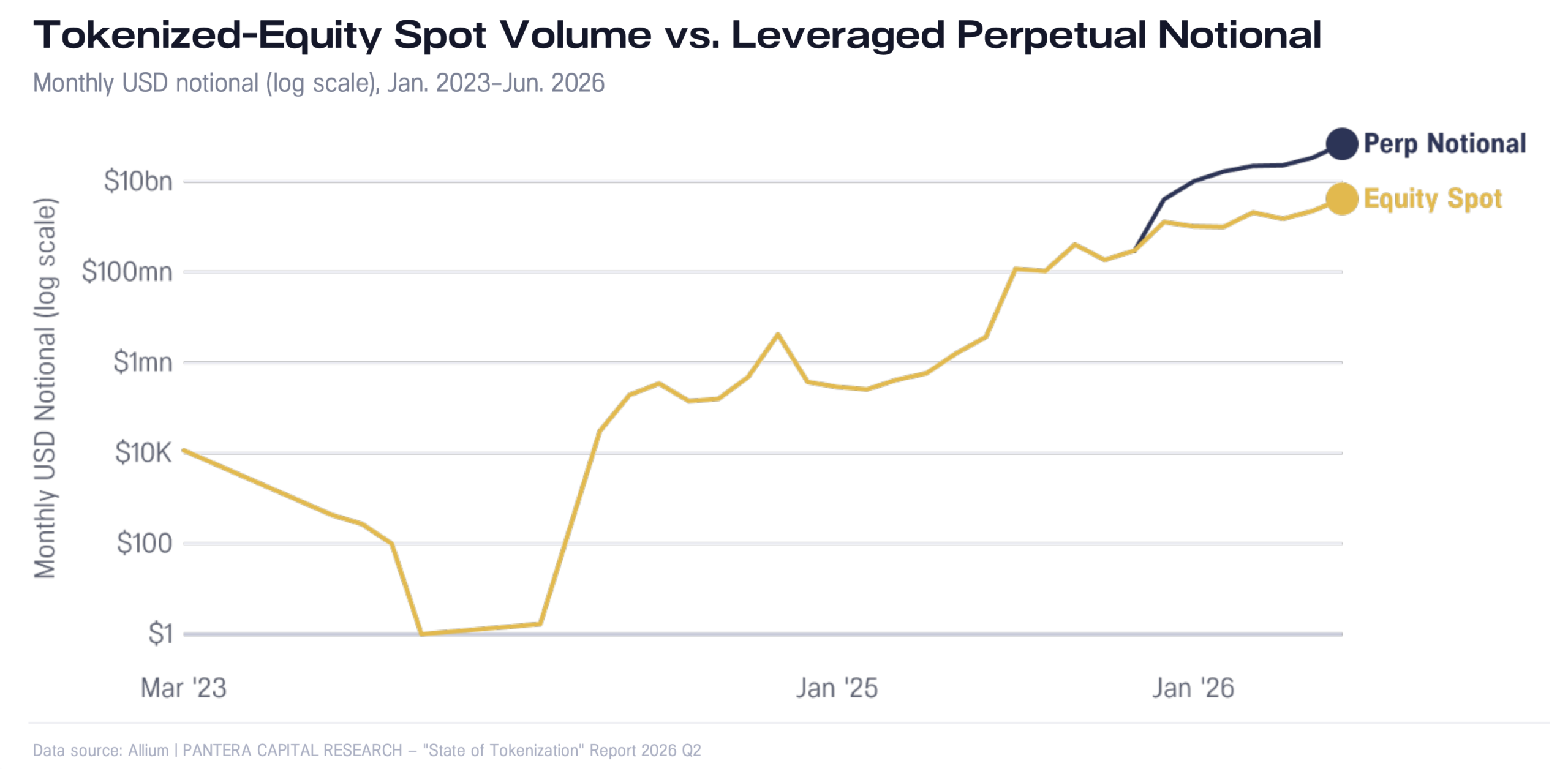
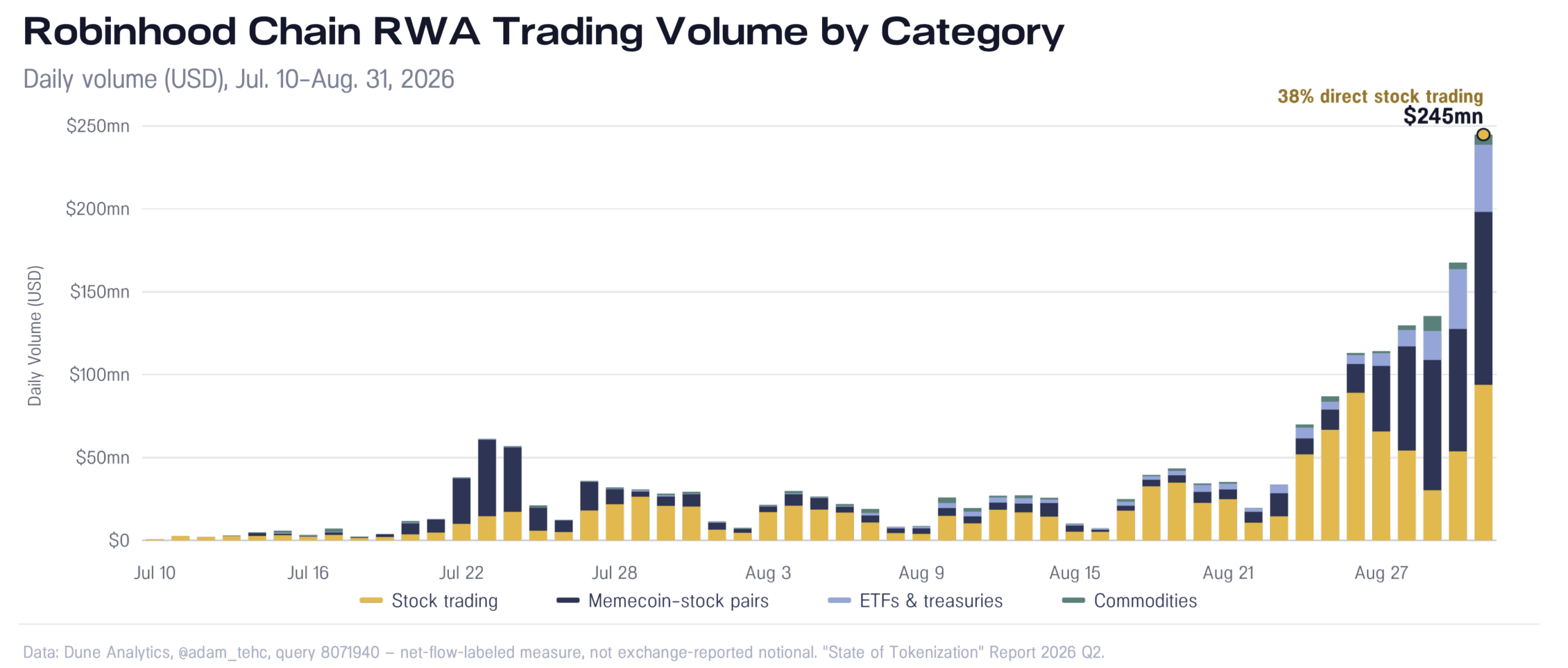
Our updated State of Tokenization finds $67.8bn of June equity-perpetual volume across Hyperliquid and Lighter combined, roughly 16 times the observed tokenized-equity spot volume of $4.2bn in the same month. On Robinhood Chain, weekly trading in real-world asset tokens rose from $5.0mn in the first measured week to $887.5mn in the last week of August. These are substantial signs of demand for onchain access, though trading volume does not establish the number of consumers participating or the capital they have invested.
The expansion also reaches established financial institutions. BlackRock and Franklin Templeton offer tokenized funds; J.P. Morgan launched JLTXX on Ethereum; HSBC expanded tokenized deposits to the U.S.; and Fidelity International launched its first tokenized product with Sygnum. New York Life Investment Management entered tokenization through a high-yield bond strategy with Centrifuge. Each addresses a different financial need, from cash management to credit investing.
The market data show that breadth: non-stablecoin tokenized value grew 13.26%, adding $4.25bn between March 25 and June 30. September brought another development when the SEC granted conditional relief for certain tokenized-stock venues and liquidity providers. That targeted step leaves room for further trading infrastructure to develop while broader legislation remains unresolved.
Equity Trading Shows Demand For Onchain Exposure
Hyperliquid and Lighter recorded $68bn of combined equity-perpetual volume in June versus $4bn of observed tokenized-equity spot trading. A reporting angle is whether this derivatives activity can support the market makers and hedging services needed for stronger spot markets. The 16x comparison measures trading notional, not equivalent capital invested, and the underlying asset sets differ.
Robinhood Shows How Distribution Can Accelerate Activity
RWA tokens’ share of Robinhood Chain DEX volume rose from 0.07% in the first measured week to 12.9% in the last week of August. Tracked tokenized value grew from $5.55mn at the June close to $28.35mn at the July close. The next story is whether this activity develops into repeat participation and broader funded holdings; the report’s address data still show concentrated ownership.
Institutional Adoption Is Expanding Into Market Services
Kraken Institutional added Janus Henderson’s JAAA to qualified custody through Centrifuge. Grove Basin provides a model for financing the settlement gap when eligible investors exit tokenized funds, with announced capacity of up to $1bn in daily liquidity and support for JTRSY. DTCC processed production trades using tokenized assets in July and has separately announced a planned Stellar connection. These developments extend the story into custody, redemption, and settlement.
Different Assets Can Succeed Through Different Uses
In the June cohort, open-access products generated 99.8% of observed spot trading while holding 41% of value. Access matters, but permissioned products also concentrate in yield-oriented funds. BlackRock’s BUIDL and Franklin Templeton’s fund products should be evaluated partly through holding and redemption needs; tokenized collateral on Morpho offers another form of use. The opportunity is to build the right market around each product.
Read the full State of Tokenization Report here.
S&P PANTERA DIGITAL ASSET INDEX :: POSITIVE IN A NEGATIVE YEAR
By Cosmo Jiang, General Partner
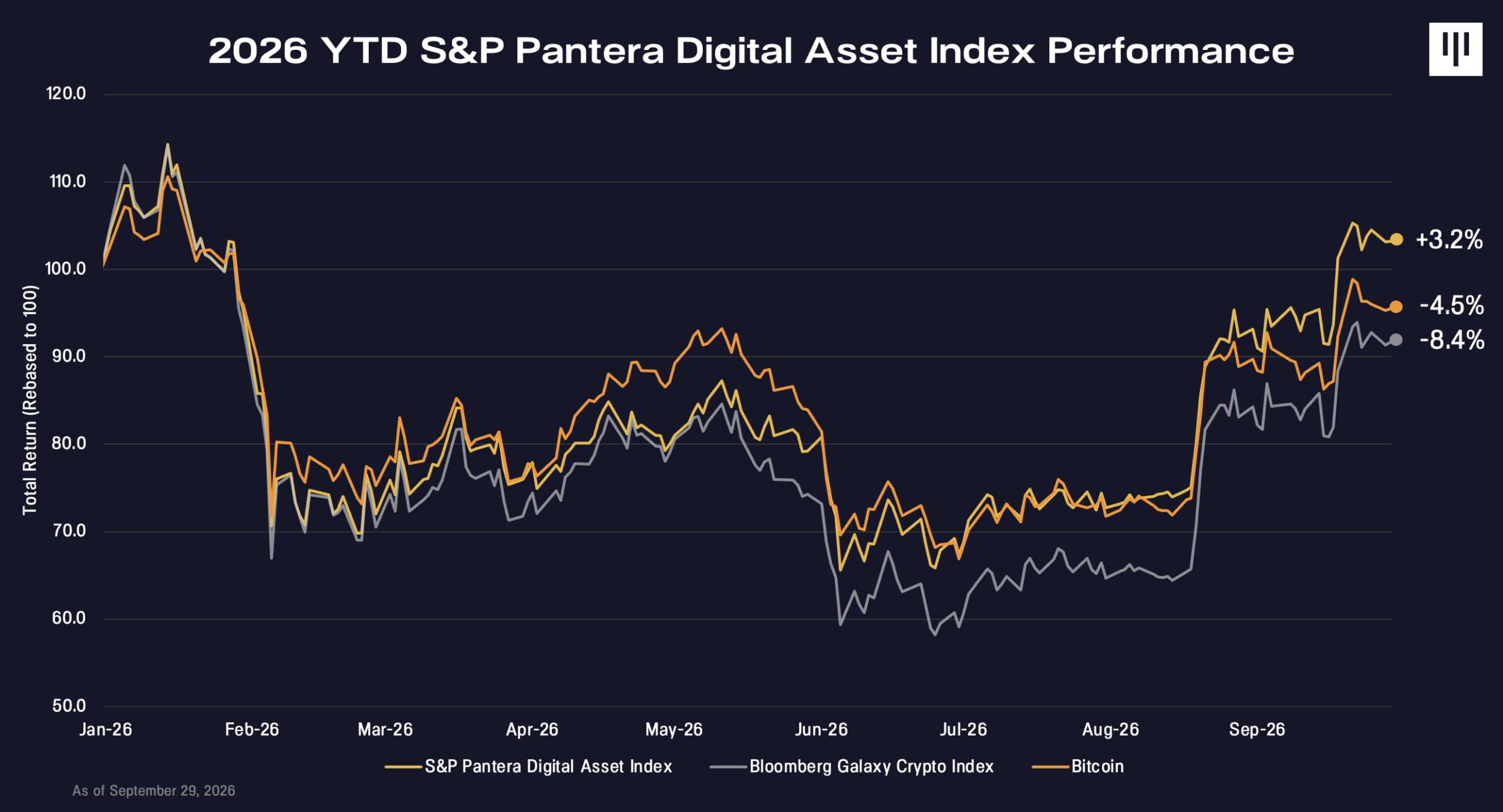
The S&P Pantera Digital Asset Index is back in positive territory this year. Bitcoin and the broader crypto indices are not.
As of September 29, the SPPDA index was up +3% year-to-date. Over the same period, Bitcoin was down 5% and the Bloomberg Galaxy Crypto Index was down 8%.
Index returns shown do not represent the results of actual trading of investable assets/securities. S&P Dow Jones Indices maintains the index and calculates the index levels and performance shown or discussed but does not manage actual assets. Index returns do not reflect payment of any sales charges or fees an investor may pay to purchase the assets underlying the Index or investment funds that are intended to track the performance of the Index. The index’s launch date was July 20, 2026. Please see additional disclosures at the end of this report relating to hypothetical index performance.
We believe that result is not a coincidence – it is the SPPDA index doing what it’s intended to do.
In July, we launched the S&P Pantera Digital Asset Index with S&P Dow Jones Indices. The reason was simple. Whenever we spoke with institutional allocators about liquid digital assets, we heard the same complaint: existing multi-asset indices aren’t something they can underwrite.
Those indices put Bitcoin, a monetary asset most allocators already have a policy for, in the same basket as memecoins and economically inactive chains. That isn’t an investible product for fundamental investors, nor is it a useful measuring stick for the industry.
The prevailing narrative this year has been a crypto bear market. That narrative is built on reporting and data that treat every token the same. If you measure just the productive part of the blockchain economy (e.g., tokenization, agentic finance, perps, DeFi), the picture is different.
The sell-off from the January highs hit everything. But when the market broke down again in June, the index held up meaningfully better than the broad basket. When risk appetite disappeared, the gap widened between tokens backed by real revenue and tokens backed by nothing. That is what you would expect. Revenue doesn’t make a token immune to a drawdown, but it gives investors something to anchor to when sentiment breaks. When the market turned in late August, the index participated in the recovery and continues its outperformance on the year, now back in positive territory.
Stablecoin issuance, onchain trading, and lending markets are generating real, verifiable fees. Protocols like Hyperliquid are routing those fees back to tokenholders through programmatic buybacks. Product-market fit exists. We need a benchmark that sees that for what it is and gives an accurate representation of this industry.
One quarter does not prove a thesis, and we won’t pretend otherwise. However, the direction is the one we would expect. Better measurement leads to better capital allocation. That rewards teams building durable value accrual, which in turn brings more institutional capital into the asset class.
We continue to work with asset managers on products linked to the index, and with financial data providers on adopting it as the industry’s benchmark. If you are interested in learning more, reach out.
“Put the alternative back in Alts”
PANTERA CONFERENCE CALLS[2]
Our investment team hosts monthly conference calls to help educate the community on blockchain. The team discusses important developments that are happening within the industry and will often invite founders and CEOs of leading blockchain companies to participate in panel discussions. Below is a list of upcoming calls for which you can register via this link.
Liquid Token Fund Investor Call
Tuesday, October 27, 2026 12:00pm Eastern Daylight Time / 17:00 Central European Time / 12:00am Singapore Standard Time (October 28)
Open only to Limited Partners of the fund.
Pantera Fund V Call
Tuesday, November 3, 2026 12:00pm Eastern Standard Time / 18:00 Central European Time / 1:00am Singapore Standard Time
Open to prospective investors. Register at panteracapital.com/future-conference-calls.
Join us in learning more about the industry, the opportunities we see on the horizon, and our funds.
PANTERA FUND V
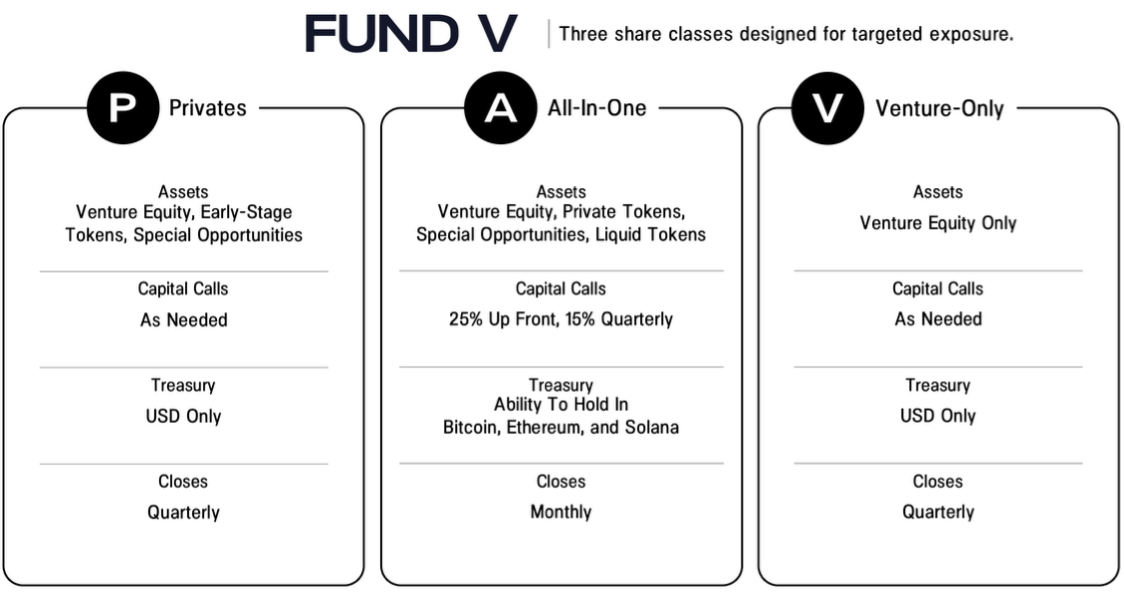
We’ve found that most investors view blockchain as an asset class and would prefer to have a manager allocate amongst the various asset types. This compelled us to create Pantera Blockchain Fund (IV) in 2021, a wrapper for the entire spectrum of blockchain assets. Its successor – Pantera Fund V – is now open for subscriptions.
Similar to its predecessor, we believe this new fund is the most efficient way to get exposure to blockchain as an asset class. It is a continuation of the strategies we have employed at Pantera for thirteen years across twelve venture and hedge funds.
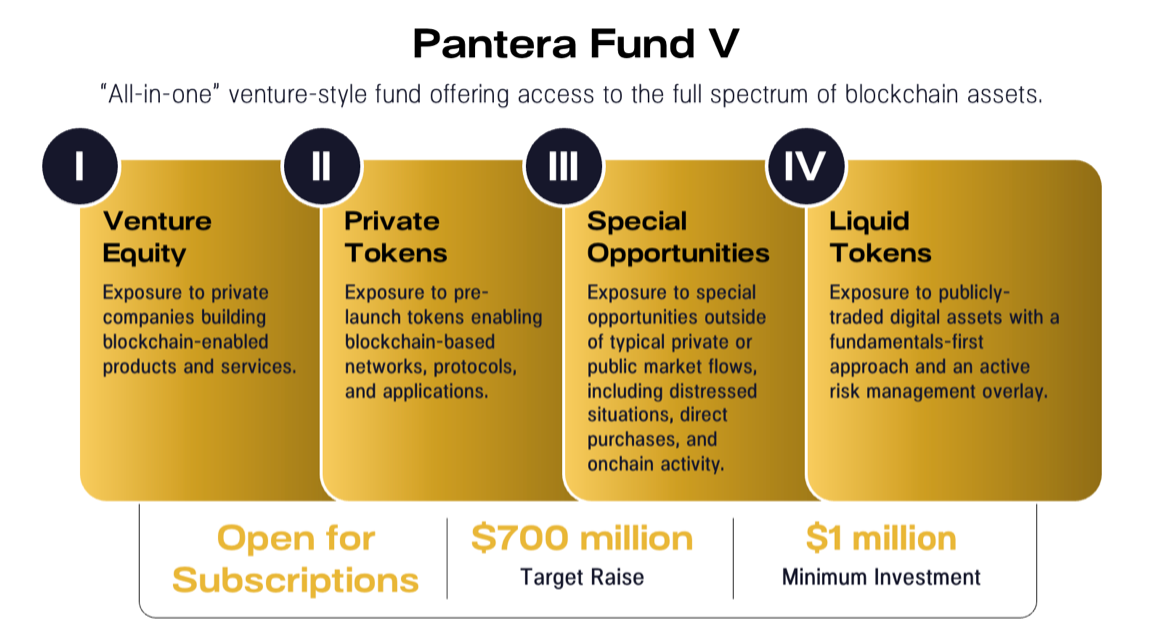
Limited Partners have the flexibility to invest in just venture (Class V for “Venture”), or in venture, private tokens, and locked-up treasury tokens (Class P for “Privates”), or the all-in-one Class A.
As in all previous Pantera venture funds, we strongly support helping our LPs get access to private deals in this fund. Fund LPs with capital commitments of $25mm or more will have the option to collectively co-invest in at least 10% of each venture equity, private token, and special opportunity deal in which the Fund invests over $10mm. There is no management fee or carried interest on co-investments for those with co-investment rights.
We will endeavor to offer co-investment opportunities, on a capacity available-basis, to other LPs as well. These co-investment opportunities are subject to 1/10% fees.
We are now accepting subscriptions for Fund V. If you’re ready to invest, please click the button below to begin the process.

If you are new to Fund V and would like to receive additional information, click here. We also invite you to join our next call on Pantera Fund V on Tuesday, November 3rd, at 12:00pm Eastern Time. You may register here.

Pantera donates 1% of revenue from all new funds to 1% For The Planet.
[1] Important Disclosures – Certain Sections of This Letter Discuss Pantera’s Advisory Services and Others Discuss Market Commentary. Certain sections of this letter discuss the investment advisory business of Pantera Capital Partners LP and its affiliates (“Pantera”), while other sections of the letter consist solely of general market commentary and do not relate to Pantera’s investment advisory business. Pantera has inserted footnotes throughout the letter to identify these differences. This section provides educational content and general market commentary. Except for specifically-marked sections of this letter, no statements included herein relate to Pantera’s investment advisory services, nor does any content herein reflect or contain any offer of new or additional investment advisory services. This letter is for information purposes only and does not constitute, and should not be construed as, an offer to sell or buy or the solicitation of an offer to sell or buy or subscribe for any securities. Opinions and other statements contained herein do not constitute any form of investment, legal, tax, financial, or other advice or recommendation.
[2] Important Disclosures – This Section Discusses Pantera’s Advisory Services. Information contained in this section relates to Pantera’s investment advisory business. Nothing contained herein should be construed as a recommendation to invest in any security or to undertake an investment advisory relationship, or as any form of investment, legal, tax, or financial advice or recommendation. Prospective investors should consult their own advisors prior to making an investment decision. Pantera has no duty to update these materials or notify recipients of any changes.
This letter is an informational document that primarily provides educational content and general market commentary. Except for certain sections specifically marked in this letter, no statements included herein relate specifically to investment advisory services provided by Pantera Capital Partners LP or its affiliates (“Pantera”), nor does any content herein reflect or contain any offer of new or additional investment advisory services. Nothing contained herein constitutes an investment recommendation, investment advice, an offer to sell, or a solicitation to purchase, any securities in Funds managed by Pantera (the “Funds”) or any entity organized, controlled, or managed by Pantera and therefore may not be relied upon in connection with any offer or sale of securities. Any offer or solicitation may only be made pursuant to a confidential private offering memorandum (or similar document) which will only be provided to qualified offerees and should be carefully reviewed by any such offerees prior to investing.
This letter aims to summarize certain developments, articles, and/or media mentions with respect to Bitcoin and other cryptocurrencies that Pantera believes may be of interest. The views expressed in this letter are the subjective views of Pantera personnel, based on information that is believed to be reliable and has been obtained from sources believed to be reliable, but no representation or warranty is made, expressed, or implied, with respect to the fairness, correctness, accuracy, reasonableness, or completeness of the information and opinions. Analyses and opinions contained herein (including market commentary, statements or forecasts) reflect the authors’ judgment as of the date this letter was published, and may contain elements of subjectivity (including certain assumptions) or be based on incomplete information. The information contained in this letter is current as of the date indicated at the front of the letter. Pantera does not undertake to update the information contained herein.
This letter is not intended to provide, and should not be relied on for accounting, legal, or tax advice, or investment recommendations. Pantera and its principals have made investments in some of the instruments discussed in this communication and may in the future make additional investments in connection with such instruments without further notice.
Certain information contained in this letter constitutes “forward-looking statements” (including predictions), which can be identified by the use of forward-looking terminology such as “may”, “will”, “should”, “expect”, “anticipate”, “target”, “project”, “estimate”, “intend”, “continue”, “believe”, or the negatives thereof or other variations thereon or comparable terminology. Due to various risks and uncertainties, actual events or results or the actual policies, procedures, and processes of Pantera and the performance of the Funds may differ materially from those reflected or contemplated in such forward-looking statements, and no undue reliance should be placed on these forward-looking statements, nor should the inclusion of these statements be regarded as Pantera’s representation that the Funds will achieve any strategy, objectives, or other plans. Past performance is not necessarily indicative of or a guarantee of future results. There is no guarantee that investments in any instrument or type of instrument described herein will be profitable – all investments carry the inherent risk of total loss.
It is strongly suggested that any prospective investor obtain independent advice in relation to any investment, financial, legal, tax, accounting, or regulatory issues discussed herein. Analyses and opinions contained herein may be based on assumptions that if altered can change the analyses or opinions expressed. Nothing contained herein shall constitute any representation or warranty as to future performance of any financial instrument, credit, currency rate, or other market or economic measure.
All information presented prior to an index’s Launch Date is hypothetical (back-tested), not actual performance. The back-test calculations are based on the same methodology that was in effect on the index Launch Date. However, when creating back-tested history for periods of market anomalies or other periods that do not reflect the general current market environment, index methodology rules may be relaxed to capture a large enough universe of securities to simulate the target market the index is designed to measure or strategy the index is designed to capture. For example, market capitalization and liquidity thresholds may be reduced. Past performance of the Index is not an indication of future results. Back-tested performance reflects application of an index methodology and selection of index constituents with the benefit of hindsight and knowledge of factors that may have positively affected its performance, cannot account for all financial risk that may affect results and may be considered to reflect survivor/look ahead bias. Actual returns may differ significantly from, and be lower than, back-tested returns. Past performance is not an indication or guarantee of future results. Please refer to the methodology for the Index for more details about the index, including the manner in which it is rebalanced, the timing of such rebalancing, criteria for additions and deletions, as well as all index calculations. Back-tested performance is for use with institutions only; not for use with retail investors.