Table of Contents
2. Genchi Genbutsu: Hardware, Software and Everything In Between
5. After the Midterms: What a Democratic Congress Means for Digital Asset Policy
What controls a machine’s decision loop? The continuous, iterative sequence of steps that an entity, such as a robot, uses to gather information, make a choice, act, and learn from the results?
Short answer: it’s still humanity. Anthropic’s IPO has put a public price on AI that works in software. OpenMind is carrying that intelligence into the physical world, and its Iris goes a step further by putting live neurons in a humanoid. Think human stem cells integrated into inanimate bots to give them human responses.
The result is striking, and frightening. On Pantera’s podcast, Stateful, we recently discussed how AI agents used by Ledger and Kraken had to foil hack attacks twice within an hour thanks to human-like reactions. Such an arms race between black hat and white hat hackers is no way to trust what we consume, which forcefully justified Worldcoin co-founder Alex Blania’s argument that proof of actual humanity must be behind all agentic exchange.
In this letter, Cosmo Jiang tells us what he learned exploring humanoids in Shenzhen last month and Katrina Paglia provides insights into how the U.S. midterm elections may influence how it’s all ultimately governed.

Biology Meets Robotics [1]
By Franklin Bi, General Partner

OpenMind, the company building a common operating system for robots, this month unveiled Iris.
Iris is OpenMind’s first humanoid robot with living human neurons in its decision loop. OpenMind founder Jan Liphardt, a bioengineer at Stanford, led the work.
Those neurons are real human brain cells grown in a lab. Scientists turn stem cells into neurons and grow them as thin living layers on plates lined with tiny electrodes. Biologists call any cells grown this way a culture, so these are neural cultures. The electrodes send small electrical signals into the cells and record how the cells fire back.
Iris streams what her cameras see over the internet to neural cultures housed in labs in Australia and Switzerland. The cells’ firing is translated into signals that return to the robot and shape how she reacts to the people around her. OpenMind rents access to the cells the way a company rents cloud servers. The best-performing cultures responded in about a quarter second and stayed alive for more than 100 days. Across nearly 500 stimulations, they decoded signals with up to 94% accuracy1, showing that living neurons can operate inside a robot’s control loop.
Amazon launched EC2 in 2006 and turned servers into a rentable utility2. OpenMind has now plugged a rentable, living form of compute into a working robot through a single software layer. The operating layer that can absorb each new class of compute as it emerges is the one that captures value across the robotics stack.
Anthropic’s IPO is the latest sign of how far AI has moved into digital workflows like coding, writing, and design. Robotics is how those capabilities reach the physical world. OpenMind’s software already supports Claude as a reasoning model for humanoids, yet today’s robots still make every decision on silicon, tying the industry’s progress to the cost and power draw of those chips. Iris is the first humanoid to move part of that loop off silicon. When she reads the people around her, the judgment comes from living neurons rather than a chip, a form of compute that evolution has spent hundreds of millions of years tuning for efficiency. The entire human brain runs on about 20 watts, roughly what a light bulb draws. She runs on OM1, OpenMind’s open operating system for robots of every shape, where an AI agent configured once can live in the cloud or step into a quadruped, humanoid, or drone. Iris pushes that stack further than it has gone before, borrowing judgment from living cells half a world away through standard software. OpenMind is building the layer that unites AI agents across the digital and physical worlds, and with it a new path for robotics toward a more efficient, more human future.
Follow OpenMind: Website | X | GitHub | Docs
1The Scientist, “Lab-Grown Human Neurons Control Humanoid Robot Iris”
2TechCrunch, “How Amazon EC2 grew from a notion into a foundational element of cloud computing”
Genchi Genbutsu: Hardware, Software and Everything In Between [1]
By Cosmo Jiang General Partner, Cody Poh Investment Analyst
Introduction
At 2 a.m., our Cathay Pacific flight finally touched down in Hong Kong after a six-hour delay in Singapore. With barely three hours of sleep, we found ourselves in a car heading straight to Shenzhen, China’s hardware capital and home to tech giants such as Huawei, BYD and DJI. Genchi Genbutsu. Go and see for yourself. We have met with numerous US-based robotics companies and invested in a select few, and through this we think we know that China is a critical cog in the global robotics industry, but can we really know from afar?
Robotics has been a focus for us over the last couple of years. Breakthroughs in embodied AI have created a step function change in the industry’s potential. Models can now see, plan and act in the physical world, while the hardware required to run them keeps getting better and cheaper. In the bull case, robots will disrupt a much broader share of the world’s physical labor, which consists of 2.2bn humans worldwide and an annual wage pool of over $20tn3. Even 1% penetration would rival the revenue generated by today’s largest technology companies.
China is indispensable to the embodied AI industry. Global manufacturers rely heavily on Chinese supply chains, and Chinese manufacturers accounted for over 90% of global humanoid production in 20254. At the same time, recent FCC restrictions on foreign-produced advanced robotic devices underscore how geopolitics is increasingly shaping the robotics industry. As fundamental investors, we need to understand and navigate this rapidly evolving landscape, and the best way to do so is to get on the ground and see the reality for ourselves.
And so began our trip to Shenzhen, where we got a firsthand look at China’s rapidly evolving robotics ecosystem. We visited companies spanning much of the robotics value chain, from vertically integrated humanoid manufacturers and model developers to data collection equipment providers to dexterous hand specialists. Along the way, we spoke with founders, senior executives across sales, manufacturing, and research, as well as junior employees fresh out of college.
Our objective was simple: to understand where China stands in the global robotics race, where its competitive advantages lie, and, more importantly, where the investible gaps remain.
Hardware: China Leads the Race
One thing became clear throughout our trip: China leads the robotics hardware race, underpinned by its unmatched manufacturing scale and supply chain integration. This is particularly visible in Shenzhen, the beating heart of China’s manufacturing engine. Decades of development as the world’s manufacturing hub have created a deeply entrenched ecosystem, with readily available raw materials, cost-efficient logistics, established high-volume production facilities, and a large workforce skilled in precision manufacturing. This is a structural moat that other emerging manufacturing hubs will find difficult to replicate.
This advantage translates directly not only into cost competitiveness but, more importantly, innovation speed. A humanoid startup in Shenzhen can have a new idea in the morning, communicate it to their supplier, and have a new part delivered to their office by noon. This allows Chinese manufacturers to supply better, cutting-edge hardware at lower prices. The caricature that China creates low-quality copycat or commodity goods is an anachronism. As model labs scale their training efforts, they require increasingly large volumes of specialized data collection equipment, much of which China is uniquely positioned to manufacture at scale and at low cost. Leading US robotics companies we’ve spoken with make big claims about what they design and manufacture in-house, but talk to the companies in Shenzhen and they will tell you which Mag7 or multi-billion-dollar venture startup they’re selling into. This is true from critical components, such as dexterous hands and actuators, to the mass cameras and headsets used for data collection.
The dexterous hand manufactured by Wuji Tech, which integrates over 1,800 components into a human-sized form factor, was better than any hand we have seen in the US. Perhaps unsurprisingly, they are quietly the supplier for many of the large US tech companies. Each finger is designed to bend backward, improving durability (a key battleground in hands currently) and resilience to collisions. We watched the hands separate a single card from a deck (teleoperated), a seemingly simple task for humans but a significant challenge for robotic manipulation because of the precise control of force and friction required. Another wow moment, but in a weird way, was seeing the UBTECH humanoids with human skins that give off Battlestar Galactica Cylon vibes.
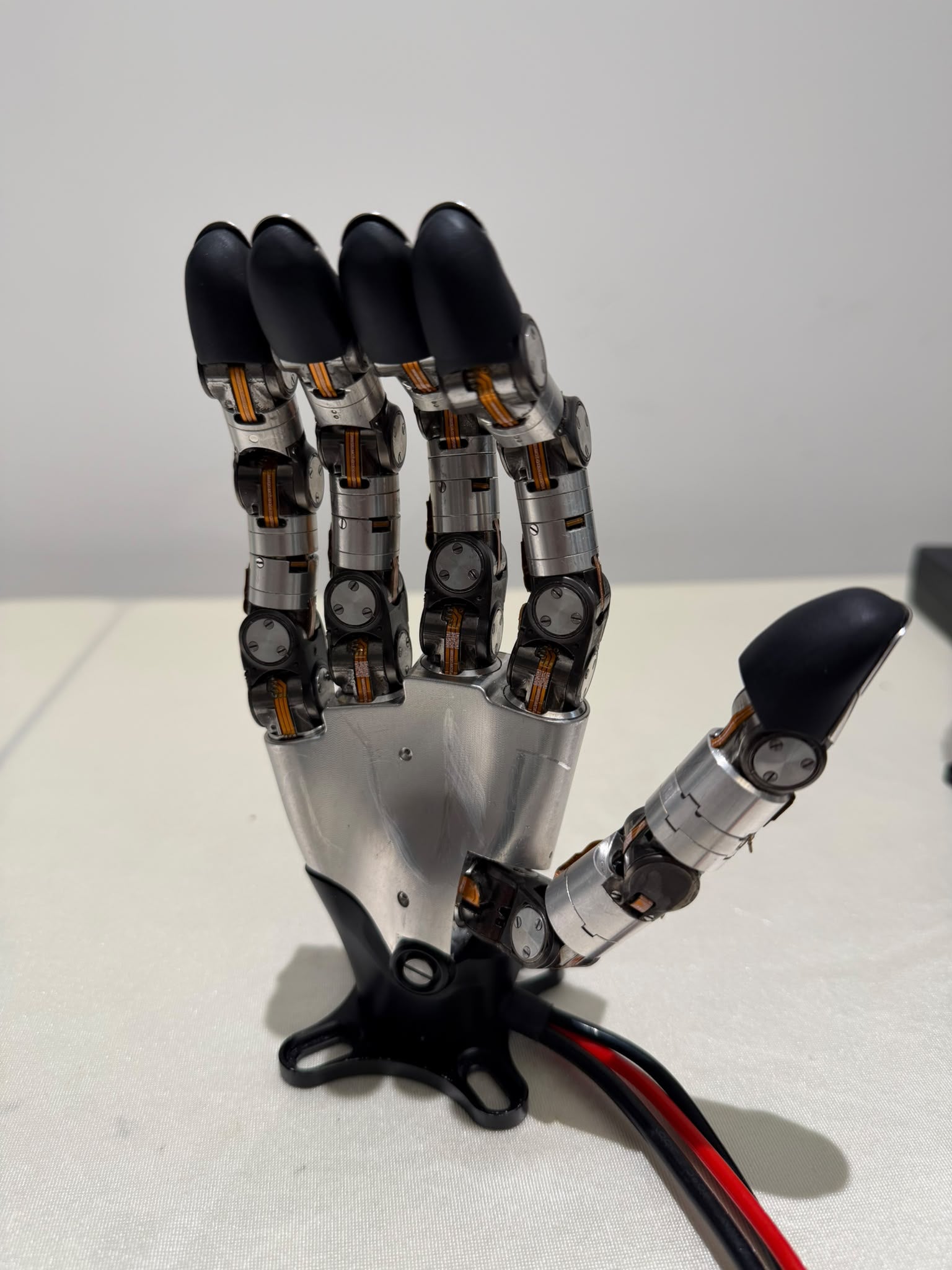
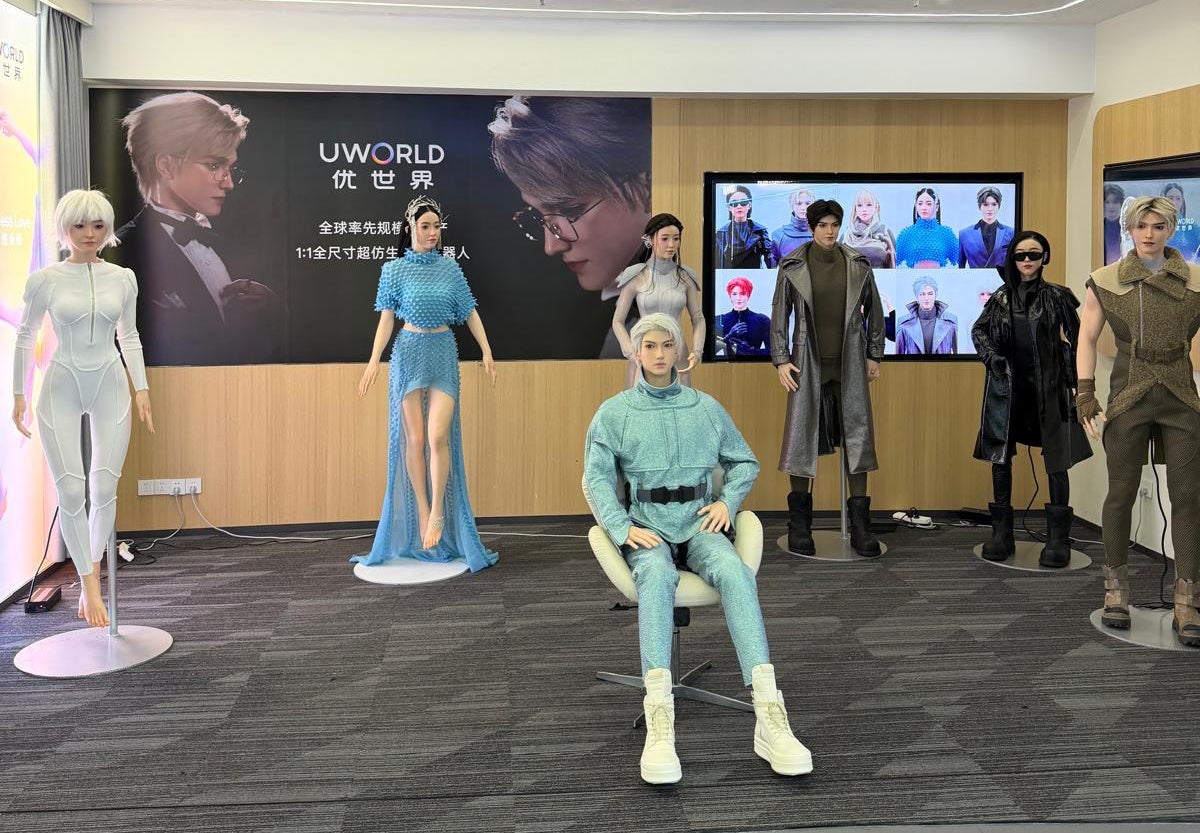
Right: UBTECH humanoid robots with lifelike skin in the company’s Shenzhen showroom.
Another characteristic of the Chinese market is the extreme level of competition and how that drives pricing lower and margins to zero. One startup spent an hour talking us through all the incredible technical advances they had made on their next generation actuators. However, when we asked them about how ultimately they compete with others, they would say, “well, of course, price is most important”. This was not the only one that said this. At lunch, an owner of a retail chain lamented how it’s so hard to make a profit because there’s always someone willing to sacrifice this year’s margins to take market share in hopes of making money the next year, only to find next year that there’s a new someone willing to undercut and do the same thing. A deep-rooted Chinese cultural concept is to “eat bitterness” (吃苦). That willingness to endure hardship prevents companies from making outsized profits, making life tough for individual companies but benefiting the broader national industry.
Beyond cost and scale, China’s position upstream in the robotics value chain gives it another underappreciated advantage: a front-row seat to emerging technological trends. Robotics labs are constantly experimenting with new data collection methods, from tactile and force-sensing gloves to vision-capture headsets equipped with eight cameras for wider-angle recording. As effectively the only suppliers capable of provisioning such equipment quickly and cost-effectively, Chinese manufacturers gain early visibility into the evolving requirements of frontier robotics labs, potentially identifying emerging trends three to six months ahead of the broader market.
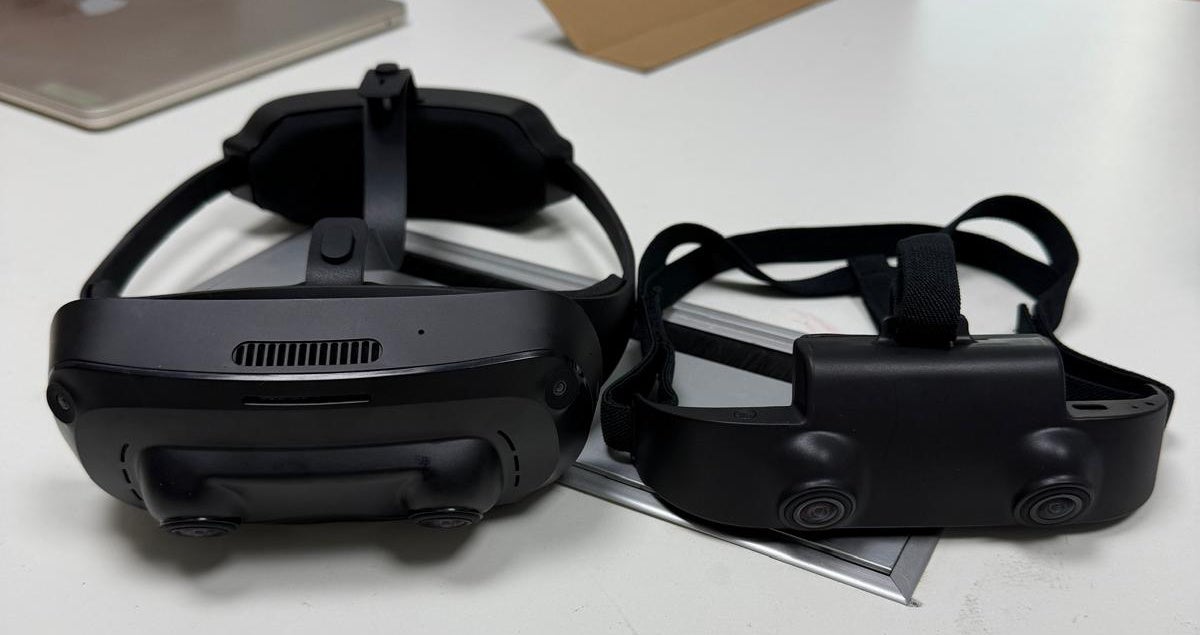
Whether Chinese companies can effectively translate their manufacturing dominance and these early insights into proprietary technological advantages is a separate question, about which we developed doubts over the course of our time.
Data: Collection Is the Bottleneck, Not the Moat
Every robotics company has told us that China has large data collection efforts and is exporting that data globally. At surface level, it makes sense that companies might ask their workers to strap on headsets and capture egocentric data to make an extra buck. As we talked to startups in the China ecosystem, it turns out it runs much deeper than that and involves, as is often the case in China’s version of capitalism, explicit government direction.
Multiple sources told us that local Chinese governments are the primary driver of data collection efforts. After the national government unleashed incentives for robotics development and job creation, local governments realized subsidizing data collection was a relatively easy way to create net new robotics-related jobs. China’s governing system features centralized political control, where Beijing sets national priorities, but provincial and local governments are expected to figure out the implementation and execution. Local government officials are incentivized to maximize measurable performance targets, which can come at the expense of the broader strategic initiatives.
Millions of dollars are being spent on training data of questionable value. Across China, there are data farms where workers repeatedly perform the same tasks to generate hours of “robotics training data.” Yet these repetitive, homogeneous datasets offer limited incremental value for improving model capabilities after the first few copies. Despite quality concerns, this data continues to successfully sell overseas, reflecting a more fundamental challenge: data availability remains one of the biggest bottlenecks in robotics model development. Unlike LLMs, which can leverage vast amounts of text scraped from the internet, robotics lacks an equivalent readily available data corpus. Moreover, useful robotics training data comes in many forms, and the types of data required to unlock the next leap in model performance may not even exist at meaningful scale.
The real moat, therefore, is not data collection itself, but the ability to turn raw data into meaningful training signals. Encouragingly, emerging evidence suggests that scaling laws also apply to robotics models, with performance improving as training data volumes increase. This points to sustained demand for high-quality heterogeneous robotics training data that can meet the continuously evolving data requirements and standards across modalities, collection methods, and training approaches.
In an environment where the definition of “high-quality data” is constantly shifting, the more defensible competitive advantage lies in being viewed as a trusted research partner to the frontier labs. Having a high degree of taste in data annotation, curation, and evaluation rather than collection capacity alone is how you can win that credibility. Rather than those who collect the most data, the winners will likely be teams with true embodied AI research backgrounds that enable them to adapt the most quickly with the frontier robotics companies, much like Scale AI and Mercor led with research to embed into the major frontier LLM labs.
Software: The Elephant in the Room
Robotic automation has been around for decades. For example, Amazon has heavily integrated robots into its warehouses since acquiring Kiva in 2012 and surpassed 1 million operational robots in 20255, with ever new form factors and capabilities. So, making ever-more advanced hardware is just a natural evolution. The revolution in robotics is around embodied AI, which changes the paradigm for robotics by broadening its capabilities and moving beyond machines narrowly programmed for specific tasks.
AI software was the elephant in the room throughout all our robotics meetings in Shenzhen. Most humanoids and robots we encountered demonstrated limited autonomy or generalization, relying heavily on teleoperation or pre-programmed routines. Senior executives candidly acknowledged the lack of advanced AI in their robots, and that their software lagged that of overseas competitors by at least one to two years. The more junior employees, from whom you will often receive less of the party line and more of the dirty truth, jokingly admitted that their software simply did not work and that any attempts were halfhearted. This is partially due to us seeing just the slice of robotics that exists in Shenzhen, which veers more toward hardware, as opposed to the more software dominant hubs in Hangzhou and Shanghai. But there is a broader truth here.
China’s dominance in hardware manufacturing and data collection, key ingredients to robotics, has not translated into a lead in software. Many Chinese humanoid manufacturers continue to rely on open-source models developed by US labs as the foundation of their software capabilities, in particular OpenAI, Nvidia and Physical Intelligence, rather than building their own foundation models.
Our conversations with industry researchers suggest that Chinese robotics companies may be content to not invest the capital in foundational model development, instead focusing on fine-tuning existing open-source models in post-training. For US model labs, this does open up a wedge where open-sourcing can serve as a powerful distribution strategy, encouraging adoption and building ecosystems around their models. As these models become increasingly capable, Chinese manufacturers may have even less incentive to develop alternatives.
Distillation is not a practice the Chinese companies try that hard to hide, and it is clear part of their bet is that they can do the same in robotics. However, unlike LLMs, where model distillation can leverage large volumes of synthetically generated text, robotics presents a more complex challenge. Distilling robotics models requires not only the models but also substantial physical interaction data, hardware infrastructure, and real-world validation. This makes replicating frontier model capabilities considerably more difficult, even for companies with strong hardware manufacturing capabilities.
China Plays by Different Rules
The scar tissue of a country that was lifted out of poverty within a typical senior executive’s lifetime was readily visible. There is a strong “hustle” culture in China, as is common in many areas with a large newly rich population, where people are looking to make money quickly in fear of returning to the starvation visible in their rearview mirror. This sounds obvious at first blush, but what surprised us was how deeply that impacted the startup ecosystem.
A consistent wistful refrain we heard from the Chinese startups we met with was that “US startups don’t have to worry about making money”, when referencing the pressure they receive from their investors to reach commercialization immediately. We heard that this divergence stems from the shorter-term return expectations embedded in China’s venture capital ecosystem. Many startups are expected to generate meaningful revenue within two to three years of founding, and those demonstrating early traction face pressure from investors to pursue a public listing immediately. Our hypothesis is that Chinese venture capital firms’ relatively lower appetite for duration has a few reasons, from lower return expectations due to weak alternatives (a stock market that has been range-bound for the last decade, 1% cap rates in tier 1 city residential real estate, exacerbated by capital controls) to a lower concentration of endowment-like limited partners. This creates a strong incentive to prioritize hardware manufacturing and data collection services, where revenue is more immediate and payback periods shorter, over foundational software development, where the path to commercialization is longer and far less certain.
Additionally, there is a different attitude toward intellectual property rights. Despite us walking through many hallways proudly displaying patents, it is an open secret that there are no IP protections. This compels companies to monetize every incremental innovation, lest it be copied and monetized by someone else quicker.
The result is a structural misalignment of incentives: China has built formidable advantages in the physical layers of robotics, yet the capital and policy environment may be discouraging the long-term investment needed to translate those advantages into software leadership.
Our View on Robotics
We left Shenzhen with a clearer, more informed view of where the robotics industry stands today and where the key gaps lie as they evolve.
Robotics is still very early, and China plays a critical role
- Our visits to Shenzhen and conversations with executives at Chinese robotics companies reinforced our view that the embodied AI industry remains in its infancy. The hardware is getting better but, at least as perceived in China, the software is nowhere close to prime time.
- China’s role in the robotics industry is more important than ever. Chinese manufacturers are key suppliers of data collection equipment and critical robot components. Data remains a key bottleneck to unlocking model capabilities, and if scaling laws continue to hold, collecting more diverse, high-quality data will be essential to improving performance. China’s manufacturing ecosystem is uniquely positioned to produce data collection hardware at scale and supply critical components such as dexterous hands and actuators to the global market.
- How China chooses to participate in the global robotics ecosystem will be critical to the pace of industry development. China’s hardware leadership is likely to persist, keeping it a key supplier to global robotics companies (FCC ban on humanoid robots notwithstanding, though it doesn’t apply to components).
- If Chinese models eventually catch up in capability, Chinese companies could gain significant leverage over the industry by raising prices or restricting access to critical hardware. While a low probability scenario, this is a key risk when underwriting investments in US robotics companies.
The economic case for robotics usage is not as compelling in China
- Humanoid sales in China are strong, but they’re not used for any meaningful economic work. Today, robots in China are primarily deployed in low-value commercial settings and entertainment, such as showrooms and exhibitions where they give simple instructions to visitors or perform dancing and kung fu routines. Quadrupeds and even bipedal robots are still largely sold to university research labs and hobbyists.
- This contrasts with the US, where robots are increasingly being deployed in industrial and logistics settings, with companies securing multi-million-dollar, long-term contracts6. A key difference is the cost and availability of labor in the West: much higher labor costs and a shrinking appetite among younger workers for blue-collar jobs create a stronger economic incentive to automate.
- That said, technological progress outpaces widespread commercialization. A Chinese founder shared the following analogy: humanoids today are like automobiles in the era of horse-drawn carriages, when people questioned the need for cars because horses already served their transportation needs. What they could not foresee was how automobiles would fundamentally reshape mobility and create entirely new markets.
- We believe the same could hold true for humanoids. Consumers and businesses may struggle to understand why they need general-purpose robots today simply because they have yet to experience what these machines could eventually enable. Additionally, there is less immediate economic incentive in China to ideate novel commercial use cases. That makes the startup ecosystem potentially more close-minded.
General purpose humanoids will be the cheapest form of labor in the future
- There is a reasonable debate to be had around why the world needs general-purpose humanoids when specialized robots can perform specific tasks more efficiently and reliably. Our observations in China also confirm the view that specialized robots are currently far more capable than their general-purpose counterparts. By focusing on narrowly defined, quantifiable tasks, specialized robots also offer a faster path to commercialization.
- However, we believe specialization has its limits when it comes to scalability. A company cannot realistically deploy a different robot for every task across its operations. Similarly, a household is unlikely to purchase one robot to wash dishes, another to clean tables, a third to do laundry, and yet another to fold clothes. While specialized robots may outperform general-purpose humanoids on individual tasks, the economics become less compelling when multiple machines are required to automate everyday activities.
- We believe general-purpose humanoids will eventually become the cheapest form of labor, not because they can perform one specific task with 99.9% accuracy, but because they can perform hundreds of different tasks with 99% accuracy. A humanoid does not need to be the best at washing dishes, folding clothes, or doing laundry. It simply needs to be good enough at all three, and many more. As model capabilities improve, the same hardware platform could take on an expanding range of tasks without requiring additional specialized machines.
- Ultimately, the economic advantage of general-purpose humanoids lies not in maximizing performance on any single task, but in maximizing the number of tasks a single machine can perform. We believe this versatility, combined with improving reliability and declining hardware costs, could fundamentally reshape the economics of physical labor.
Data collection is a huge market, with value accruing to data intelligence
- We believe robotics data collection will become an enormous market, supported by emerging evidence that scaling laws extend to physical AI. Figure AI’s recent release of Helix 2.5 provides encouraging evidence that robotics models can improve predictably as training data volumes increase. Much like LLMs, where greater data and compute have driven significant improvements in model capabilities, robotics appears to be following a similar trajectory. This suggests that demand for robotics training data will continue to grow as model labs race to develop increasingly generalizable intelligence.
- However, more data does not necessarily mean better data.
- Our visits to Chinese robotics companies reinforced this distinction. While large scale data farms can produce thousands of hours of training footage, the incremental value of such homogeneous datasets to model performance remains questionable. As the industry scales, we believe the bottleneck will increasingly shift from collecting more hours of data to identifying which hours actually matter.
- The real opportunity, therefore, lies not in data collection alone, but in turning raw training hours into measurable improvements in model capabilities. This requires more sophisticated data annotation, filtering, curation, and evaluation to distinguish valuable training signals from redundant or low-quality data. As robotics models evolve and their data requirements continue to change, the ability to consistently identify and deliver high-value datasets could become a far more defensible competitive advantage than collection capacity itself.
The model layer is increasingly commoditized, but the US will stay ahead of China
- We believe the robotics model layer is becoming increasingly competitive and faces the risk of being commoditized over time. Over the past few months, leading US robotics labs, including Physical Intelligence, Generalist, Dyna Robotics, and Figure AI, have independently announced significant advances in model capabilities and generalization. The fact that multiple players are achieving meaningful breakthroughs within a relatively short period suggests that frontier robotics intelligence may not remain the exclusive domain of two companies, like it is with Anthropic and OpenAI in LLMs.
- Most blue collar work doesn’t require 200 IQ. It just requires modest intelligence and good post-training. As training methodologies mature and data volumes scale, we believe competition moves from developing capable robotics foundation models to deployment and post-training. In that world, it is increasingly difficult for any company focused only on the foundation model to sustain a differentiated advantage.
- We believe the US will maintain its software lead over China for the foreseeable future, partly because Chinese robotics companies are more incentivized to prioritize near-term revenue from hardware sales and data collection than to commit capital to long-term, research-intensive development. Continued breakthroughs in frontier robotics models by US labs will likely reinforce China’s reliance on overseas open-source models.
- Unlike LLMs, where model capabilities can be more readily distilled, robotics model distillation is more challenging. Model intelligence must be complemented by physical interaction data across diverse environments and robot embodiments. China’s manufacturing advantages alone cannot overcome these barriers. We believe the resulting gap between the US and China could prove more persistent than the gap observed in LLMs.
We believe there is a “latecomer” advantage in robotics.
- There is a tremendous amount of capital being deployed to answer some of the big debates in robotics (e.g. model architecture, form factor, verticalization), and many robotics startups will end up having started down the wrong path. New companies today can leverage those learnings, not having to spend the money to solve those debates, and start with fresh architecture reflecting the latest meta.
Conclusion
At 8 p.m. on our last day, the team hopped into the same car, this time bound for Hong Kong International Airport and our flight back to New York. After a thorough trip through Shenzhen’s robotics hub, we left with a refreshed and more informed view of the global robotics industry. Genchi Genbutsu. This trip reinforced our belief that, in an age of information overload, seeing things with our own eyes remains one of the best ways to form independent views as fundamental investors.
China will undoubtedly shape the future of robotics, and we are watching closely how hardware, software, and everything in between will evolve. Decades of manufacturing expertise give China an enormous, perhaps insurmountable, lead in hardware. However, government intervention in data collection has its drawbacks, and the short-termism of Chinese capital hobbles longer horizon innovation relative to US companies.
We left Shenzhen more constructive on robotics than ever before and strongly believe this is an exciting time to invest in the industry. Significant gaps remain, particularly in robotics data collection, annotation, and intelligence, before software can achieve the generalization needed to make humanoid robots truly productive. We are always on the lookout for great builders developing solutions across robotics data and intelligence. If you are building in this space, our team would love to connect and learn more.
We shared the full story of our week in Shenzhen on Pantera’s podcast, Stateful.
Watch on YouTube | Listen on Spotify | Listen on Apple Podcasts
3US Bureau of Labor Statistics, Occupational Employment and Wage Statistics & Pantera estimates
5Amazon official press release
6Recent examples of commercial traction among US robotics companies include Agility Robotics, which secured over $300mn in multi-year orders for its Digit humanoid robots. Path Robotics and GrayMatter Robotics signed agreements with HII for up to $900mn in shipbuilding automation work over seven years. Gecko Robotics saw its US Navy contract ceiling expanded to $300mn in October 2026.
Nothing Was Decrypted [1]
Stateful Podcast, Episode 26 [2] | Hosted by Stuti Pandey, Partner

Watch on YouTube | Listen on Spotify | Listen on Apple Podcasts
AI is now in the attacker’s loop, and cryptography still stands. Stuti Pandey sat down with Charles Guillemet, CTO of Ledger, and Michael Benich, Director of Security at Payward, the company behind Kraken, to discuss what Black October revealed about security in the age of AI. Finding a serious vulnerability once took months of specialized work. It now takes a well-written prompt. Ledger’s security research team found more vulnerabilities with AI this year than in the previous eight years combined.
The cryptography held through every incident this fall. The failures came from software, process, and people. Charles believes today’s signature schemes will hold, and he argues the industry should start its post-quantum migration now.
“For now, I would say that cryptography and encryption in particular is one of the things that we can still trust.”
Charles Guillemet, CTO, Ledger
The views expressed in the podcast are those of the individual personnel quoted and are not the views of Pantera Capital Partners LP or its affiliates (“Pantera”). The podcast is provided for informational purposes only to provide market commentary and for general educational purposes, and should not be relied upon as legal, business, investment, or tax advice. The podcast is not directed at nor intended for use by any investors or prospective investors and may not under any circumstances be relied upon when making a decision to invest.
Proving You’re Human [1]
Stateful Podcast, Episode 25 [3] | Hosted by Cosmo Jiang, General Partner

Watch on YouTube | Listen on Spotify | Listen on Apple Podcasts
As agents fill the internet, platforms will need proof of a human in the loop. Cosmo Jiang sat down with Alex Blania, co-founder and CEO of Tools for Humanity, the company building World, to discuss proving you are human on an internet increasingly run by agents. Alex expects software-only detection to stop catching deepfakes within months. His own chief economist already fooled him with one during an internal red-team exercise.
World’s answer is verification at the source. World ID issues a cryptographically signed credential from the Orb that lives on the user’s own phone. Alex sees the same model extending to agents, where an agent that can prove it acts for one real person earns access that others will be denied.
“The moment you have an AI model that can behave like a human over long time horizons and imitate what it means to be a human in every digital modality, that’s the moment when every trust on the internet completely breaks down.”
Alex Blania, Co-Founder and CEO, Tools for Humanity
The views expressed in the podcast are those of the individual personnel quoted and are not the views of Pantera Capital Partners LP or its affiliates (“Pantera”). The podcast is provided for informational purposes only to provide market commentary and for general educational purposes, and should not be relied upon as legal, business, investment, or tax advice. The podcast is not directed at nor intended for use by any investors or prospective investors and may not under any circumstances be relied upon when making a decision to invest.
After the Midterms: What a Democratic Congress Means for Digital Asset Policy [1]
By Katrina Paglia, Chief Legal Officer
Democrats won control of both chambers of Congress in the November 3 midterm elections, flipping the House and taking the Senate by a wide margin that several outlets are calling one of the largest swings in decades. The result was driven mainly by the economy and the fallout from the Iran war, with digital asset policy a minor factor, but it resets the political terrain on which the industry’s central legislative priority, a federal market structure bill, had been negotiated for nearly three years.
The 120th Congress on Digital Assets
Supporters Outnumber Opponents in Both Chambers
Senate
AP: 56 D · 44 R
House
AP: 257 D · 172 R · 6 not yet credited
What Changed in Congress
As of November 19, the Associated Press counted 257 House seats won by Democrats and 172 by Republicans, with six seats not yet credited to either party. Hakeem Jeffries is positioned to succeed Mike Johnson as Speaker. In the Senate, the AP counted 56 seats for Democrats, including two independents who caucus with them, and 44 for Republicans7. The result hands Democrats the gavels on House Financial Services and Senate Banking, the two committees that write digital asset market structure legislation, for the final two years of the Trump administration, while Trump retains veto power over anything that reaches his desk.
The new Congress is also unusually inexperienced. At least 120 of the 535 seats in the House and Senate, about 22% and likely to tick up as the last handful of races are called, will be held by first-time members when the 120th Congress is sworn in on January 3, 2027, one of the largest freshman classes in decades8. That turnover cuts both ways, but on balance it is a modest positive for the industry. A large share of the incoming class arrives with no voting record on digital assets and none of the entrenched, personally adversarial positions that some departing members had staked out, leaving more room to make the case for sensible policy from a clean slate rather than fighting an established opposition.
The CLARITY Act’s New Path
The Digital Asset Market Clarity Act passed the House in July 2025 by a wide, bipartisan margin, but stalled in the Senate Banking Committee over ethics language addressing the president’s and lawmakers’ personal digital asset holdings, a sticking point Democratic senators like Kirsten Gillibrand had flagged for months9. With Democrats now controlling both chambers, the bill is unlikely to advance in its current House-passed form. House Democrats are reportedly discussing expanding Rep. Maxine Waters’ Crypto Investor Consumer Bill of Rights into a broader market structure framework of their own, rather than abandoning the effort outright10. The industry’s roughly $233mn in midterm spending did not buy durable control of the outcome, and the likely terms of any eventual deal, including stronger conflict-of-interest provisions applying to the president and more weight on investor protection relative to the House bill’s CFTC-centric approach, will probably shift in Democrats’ direction.
Other Regulatory Threads to Watch
Not everything is in play. The GENIUS Act, the stablecoin framework signed into law in 2025, is already on the books, and its implementing rulemaking at Treasury and the banking regulators continues regardless of which party holds Congress. The Senate’s confirmation power over SEC and CFTC leadership now runs through Democratic-controlled committees, which will matter for the next commissioner vacancies but does not change the current, Trump-appointed agency heads before 2029. The more immediate effect is tone. A Congress focused on oversight of the administration’s own digital asset ties, including the president’s memecoin and token ventures, which several Democrats have already cited as a reason market structure talks broke down, is likely to keep that scrutiny alive through hearings and investigations even where it can’t legislate.
What It Means for Us
The realistic base case is delay and renegotiation rather than reversal. The stablecoin framework holds, but comprehensive federal market structure legislation, the rulebook that would finally settle SEC versus CFTC jurisdiction over most tokens, now looks unlikely before the next Congress convenes in 2027, and probably later. That leaves the current patchwork of SEC enforcement, CFTC jurisdiction, and state money-transmission law in place for longer than the industry had hoped, which argues for continuing to underwrite new positions against today’s rules rather than rules we expect to arrive soon. We’ll keep tracking the House Democrats’ market structure counterproposal and the shape of any ethics provisions as they take form in the new Congress.
7The Associated Press, results as of November 19, 2026, and NBC News, 2026 midterm election coverage
8Quorum, analysis of the incoming 120th Congress
10Cointelegraph and PYMNTS
“Put the alternative back in Alts”
PANTERA CONFERENCE CALLS [4]
Our investment team hosts monthly conference calls to help educate the community on blockchain. The team discusses important developments that are happening within the industry and will often invite founders and CEOs of leading blockchain companies to participate in panel discussions. Below is a list of upcoming calls for which you can register via this link.
Cybersecurity in the Age of AI
Thursday, December 17, 2026 12:00pm Eastern Standard Time / 18:00 Central European Time / 1:00am Singapore Standard Time (December 18)
Open to prospective investors. Register at panteracapital.com/cybersecurity-in-the-age-of-ai.
The Year Ahead :: 2027
Wednesday, January 27, 2027 12:00pm Eastern Standard Time / 18:00 Central European Time / 1:00am Singapore Standard Time (January 28)
Open to prospective investors. Register at panteracapital.com/the-year-ahead-2027.
Join us in learning more about the industry, the opportunities we see on the horizon, and our funds.
PANTERA FUND V
We’ve found that most investors view blockchain as an asset class and would prefer to have a manager allocate amongst the various asset types. This compelled us to create Pantera Blockchain Fund (IV) in 2021, a wrapper for the entire spectrum of blockchain assets. Its successor, Pantera Fund V, is now open for subscriptions.
Similar to its predecessor, we believe this new fund is the most efficient way to get exposure to blockchain as an asset class. It is a continuation of the strategies we have employed at Pantera for thirteen years across twelve venture and hedge funds.
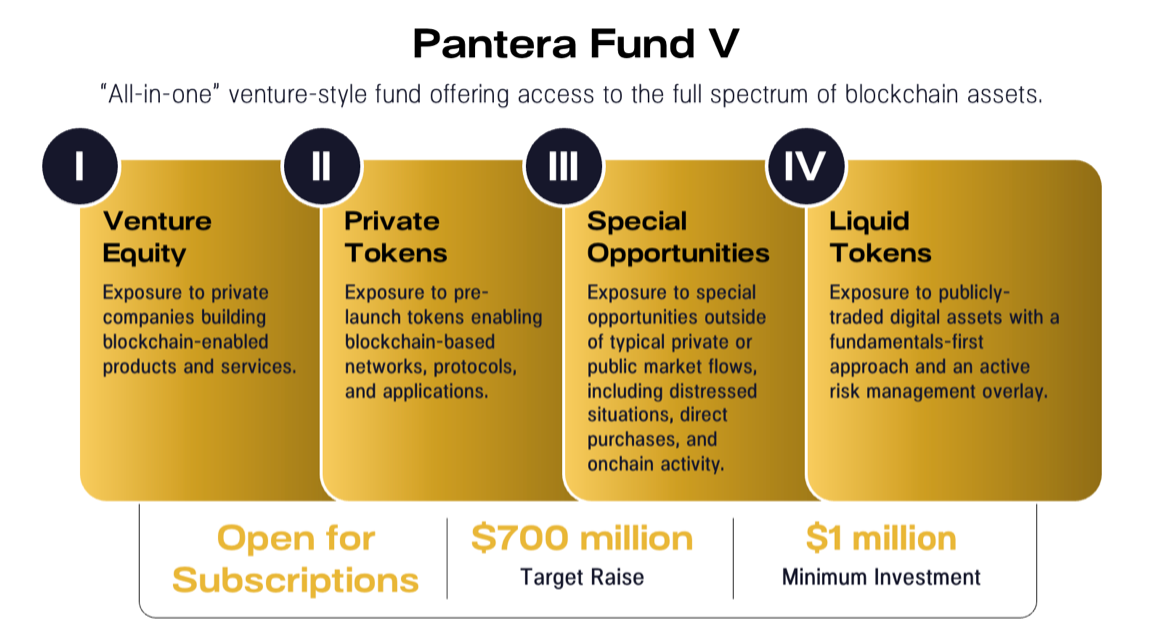
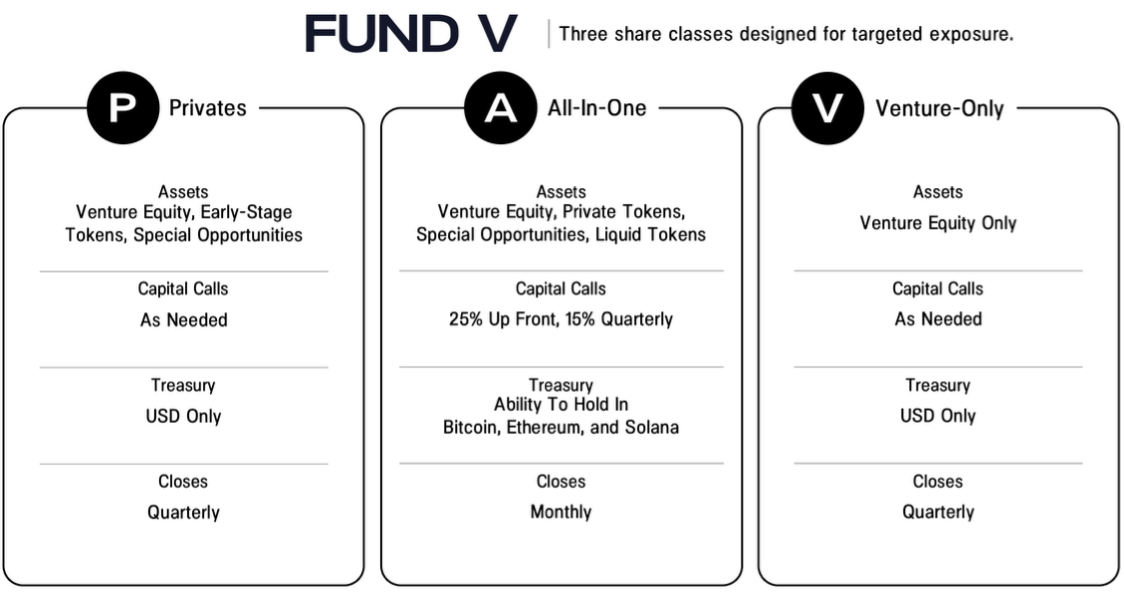
Limited Partners have the flexibility to invest in just venture (Class V for “Venture”), or in venture, private tokens, and locked-up treasury tokens (Class P for “Privates”), or the all-in-one Class A.
As in all previous Pantera venture funds, we strongly support helping our LPs get access to private deals in this fund. Fund LPs with capital commitments of $25mm or more will have the option to collectively co-invest in at least 10% of each venture equity, private token, and special opportunity deal in which the Fund invests over $10mm. There is no management fee or carried interest on co-investments for those with co-investment rights.
We will endeavor to offer co-investment opportunities, on a capacity available-basis, to other LPs as well. These co-investment opportunities are subject to 1/10% fees.
We are now accepting subscriptions for Fund V. If you’re ready to invest, please click the button below to begin the process.

If you are new to Fund V and would like to receive additional information, click here.

Pantera donates 1% of revenue from all new funds to 1% For The Planet.
[1] Important Disclosures – Certain Sections of This Letter Discuss Pantera’s Advisory Services and Others Discuss Market Commentary. Certain sections of this letter discuss the investment advisory business of Pantera Capital Partners LP and its affiliates (“Pantera”), while other sections of the letter consist solely of general market commentary and do not relate to Pantera’s investment advisory business. Pantera has inserted footnotes throughout the letter to identify these differences. This section provides educational content and general market commentary. Except for specifically-marked sections of this letter, no statements included herein relate to Pantera’s investment advisory services, nor does any content herein reflect or contain any offer of new or additional investment advisory services. This letter is for information purposes only and does not constitute, and should not be construed as, an offer to sell or buy or the solicitation of an offer to sell or buy or subscribe for any securities. Opinions and other statements contained herein do not constitute any form of investment, legal, tax, financial, or other advice or recommendation. Certain companies, projects and digital assets discussed in this section are, or may in the future become, investments of funds managed by Pantera (“Pantera Portfolio Companies”). Any Pantera Portfolio Companies discussed herein are referenced for illustrative and informational purposes only. They were not selected on the basis of investment performance and are not representative of all investments made by Pantera funds. Nothing herein is a recommendation to buy, sell or hold any security or digital asset. Pantera may increase, reduce or exit any position at any time without notice, and Pantera and its personnel may benefit from any increase in the value of such investments.
[2] Companies and digital assets discussed in this episode may include Pantera Portfolio Companies. They are referenced for informational purposes only, are not representative of all Pantera investments, and are not recommendations to buy, sell or hold any security or digital asset.
[3] Companies and digital assets discussed in this episode may include Pantera Portfolio Companies. They are referenced for informational purposes only, are not representative of all Pantera investments, and are not recommendations to buy, sell or hold any security or digital asset.
[4] Important Disclosures – This Section Discusses Pantera’s Advisory Services. Information contained in this section relates to Pantera’s investment advisory business. Nothing contained herein should be construed as a recommendation to invest in any security or to undertake an investment advisory relationship, or as any form of investment, legal, tax, or financial advice or recommendation. Prospective investors should consult their own advisors prior to making an investment decision. Pantera has no duty to update these materials or notify recipients of any changes.
This letter is an informational document that primarily provides educational content and general market commentary. Except for certain sections specifically marked in this letter, no statements included herein relate specifically to investment advisory services provided by Pantera Capital Partners LP or its affiliates (“Pantera”), nor does any content herein reflect or contain any offer of new or additional investment advisory services. Nothing contained herein constitutes an investment recommendation, investment advice, an offer to sell, or a solicitation to purchase, any securities in Funds managed by Pantera (the “Funds”) or any entity organized, controlled, or managed by Pantera and therefore may not be relied upon in connection with any offer or sale of securities. Any offer or solicitation may only be made pursuant to a confidential private offering memorandum (or similar document) which will only be provided to qualified offerees and should be carefully reviewed by any such offerees prior to investing.
This letter aims to summarize certain developments, articles, and/or media mentions with respect to Bitcoin and other cryptocurrencies that Pantera believes may be of interest. The views expressed in this letter are the subjective views of Pantera personnel, based on information that is believed to be reliable and has been obtained from sources believed to be reliable, but no representation or warranty is made, expressed, or implied, with respect to the fairness, correctness, accuracy, reasonableness, or completeness of the information and opinions. Analyses and opinions contained herein (including market commentary, statements or forecasts) reflect the authors’ judgment as of the date this letter was published, and may contain elements of subjectivity (including certain assumptions) or be based on incomplete information. The information contained in this letter is current as of the date indicated at the front of the letter. Pantera does not undertake to update the information contained herein.
This letter is not intended to provide, and should not be relied on for accounting, legal, or tax advice, or investment recommendations. Pantera and its principals have made investments in some of the instruments discussed in this communication and may in the future make additional investments in connection with such instruments without further notice.
Certain information contained in this letter constitutes “forward-looking statements” (including predictions), which can be identified by the use of forward-looking terminology such as “may”, “will”, “should”, “expect”, “anticipate”, “target”, “project”, “estimate”, “intend”, “continue”, “believe”, or the negatives thereof or other variations thereon or comparable terminology. Due to various risks and uncertainties, actual events or results or the actual policies, procedures, and processes of Pantera and the performance of the Funds may differ materially from those reflected or contemplated in such forward-looking statements, and no undue reliance should be placed on these forward-looking statements, nor should the inclusion of these statements be regarded as Pantera’s representation that the Funds will achieve any strategy, objectives, or other plans. Past performance is not necessarily indicative of or a guarantee of future results. There is no guarantee that investments in any instrument or type of instrument described herein will be profitable – all investments carry the inherent risk of total loss.
It is strongly suggested that any prospective investor obtain independent advice in relation to any investment, financial, legal, tax, accounting, or regulatory issues discussed herein. Analyses and opinions contained herein may be based on assumptions that if altered can change the analyses or opinions expressed. Nothing contained herein shall constitute any representation or warranty as to future performance of any financial instrument, credit, currency rate, or other market or economic measure.