From Megawatts to Margins
October 22, 2026
You can be right on AI demand and still own the wrong businesses. Demand for compute is skyrocketing and during this generational short squeeze, all parts of the supply chain make money. That value is unevenly distributed across the layers, and technological advances will continue to reshape where value accrues in the system.
Additional data center capacity, more efficient chips and models, and the rise of the Sovereign AI (link) will start to ease the compute shortage. With the wild swings in neocloud valuations (and certainly many other pieces of the chain in coming years), many investors today are remembering that it is possible to be right on demand but wrong on which businesses will earn attractive long-term returns.
Our experience investing in blockchains has taught us systems-level thinking. Infrastructure, applications, and capital formation develop together and analyzing any layer in isolation can lead to the wrong conclusion about where value accrues across the stack. The AI compute supply chain is one of the largest new economic systems forming today. Following the economics through the supply chain helps identify not only which businesses can earn durable returns, but also where new businesses are needed.
Therefore, as investors it is incumbent to establish a baseline for each layer and assess how it may evolve as new realities emerge. For those who want to modify the assumptions as the industry evolves, we have open sourced our unit economics model here. Please reach out with any thoughts – we welcome the debate and dialogue.
Tokens: From Megawatts to Markets
Nvidia CEO Jensen Huang describes artificial intelligence as a five-layer cake of energy, chips, infrastructure, models and applications. As investors, our focus is more specific: what are the business models and how do they make money. Through that lens, we analyzed three main business models: datacenters that house and power the chips (energy, infrastructure), compute owners that run the GPUs (chips), and the token factories or inference providers, that serve the end customer (applications).
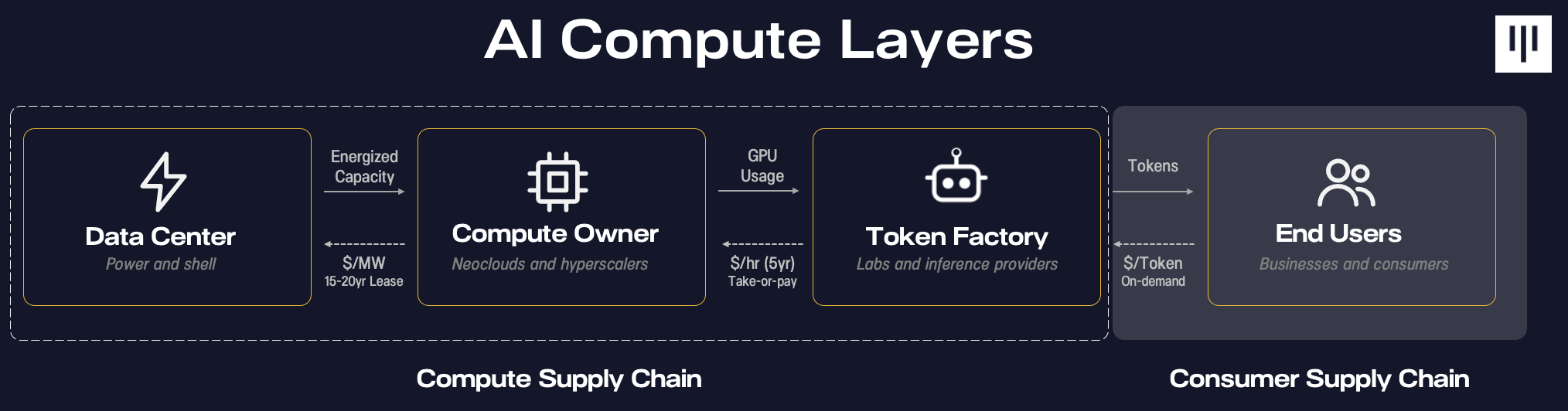
Data centers sit at the beginning of the supply chain. They source real estate and energy, and they construct the building, cooling and mechanical system. This energized capacity is sold in multiyear triple-net leases to compute owners. Data center operators include the verticalized hyperscalers (e.g. Amazon, Google, Meta, Microsoft), data center specialists (e.g. Equinix, Digital Realty) and former Bitcoin miners (e.g. Core Scientific, Hut 8, Riot).
Compute owners are the tenants in data centers. They fill out the leased shells with the hardware (e.g. chips) and run the software that people typically think of when they think of a datacenter and then sell compute capacity typically on three to five-year take-or-pay contracts (although shorter 3-6 month terms are becoming increasingly common, as well as on-demand availability). These include the verticalized hyperscalers, neoclouds (e.g. CoreWeave, Nebius) and, in some cases, frontier labs that have verticalized up the stack.
Token factories are the companies a layperson might call an “AI company”. These are frontier labs, other AI model application developers, and inference clouds (e.g. Fireworks, Together AI, Baseten) that sell inference services to developers, businesses and individual consumers. Anthropic, for instance, buys compute from a combination of neoclouds and hyperscalers, and sells usage of its AI models, denominated in tokens, to enterprise customers.
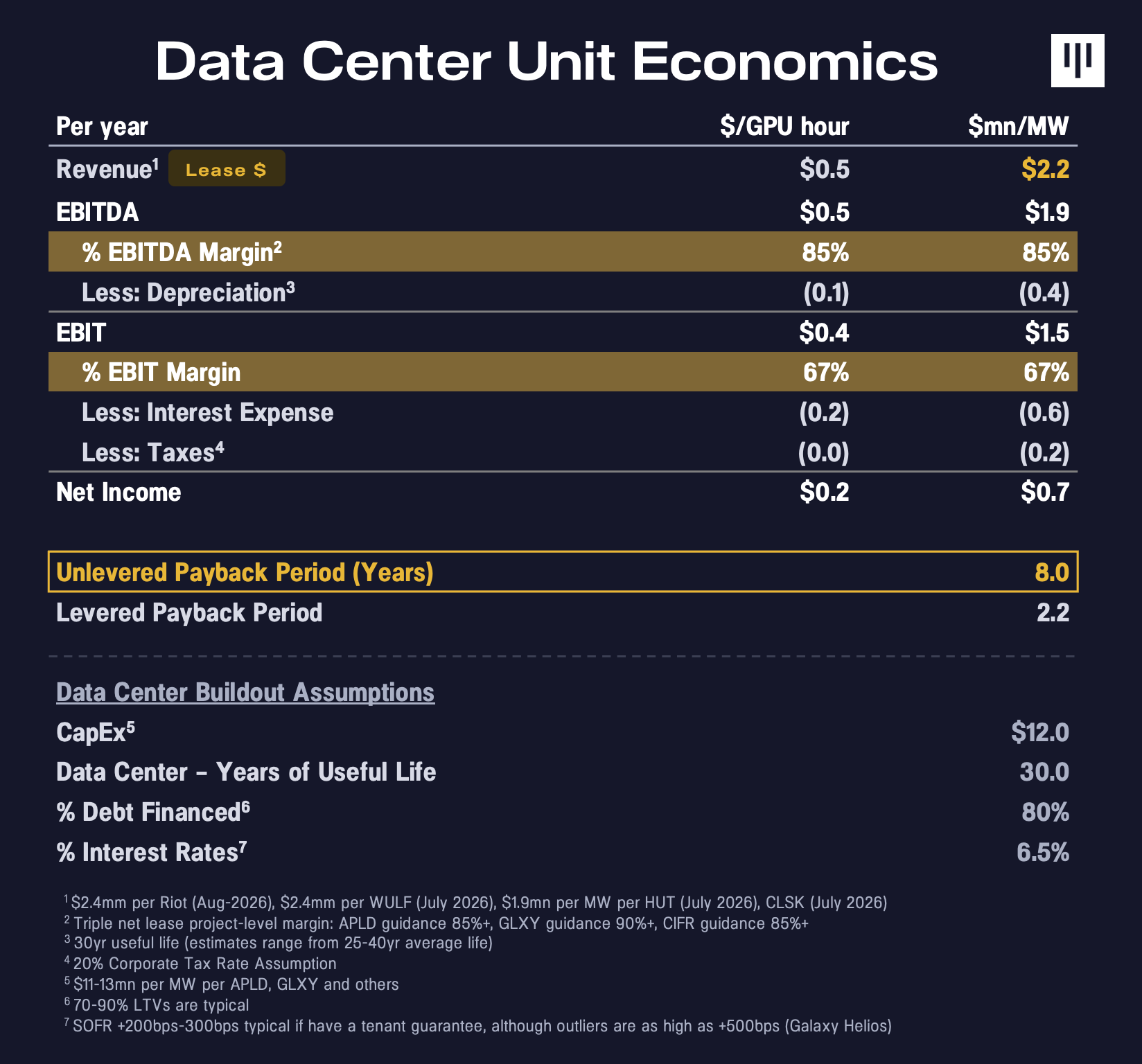
Each of these business models has different unit economics that are important to understand.
Data Center Unit Economics
Building a data center is a multi-year infrastructure project. A developer must first secure land and permits, source power either from the traditional utility grid or increasingly behind-the-meter, then build the high-voltage electrical system, install transformers and backup generation, and construct the mechanical and cooling systems required to support AI workloads. The facility then has to be commissioned, connected to the grid and fitted out for customers’ IT equipment before generating any revenue. After site selection, permitting and power procurement, whose timeline can be mercurial, it takes roughly three years from breaking ground to get an AI data center operational in the US.
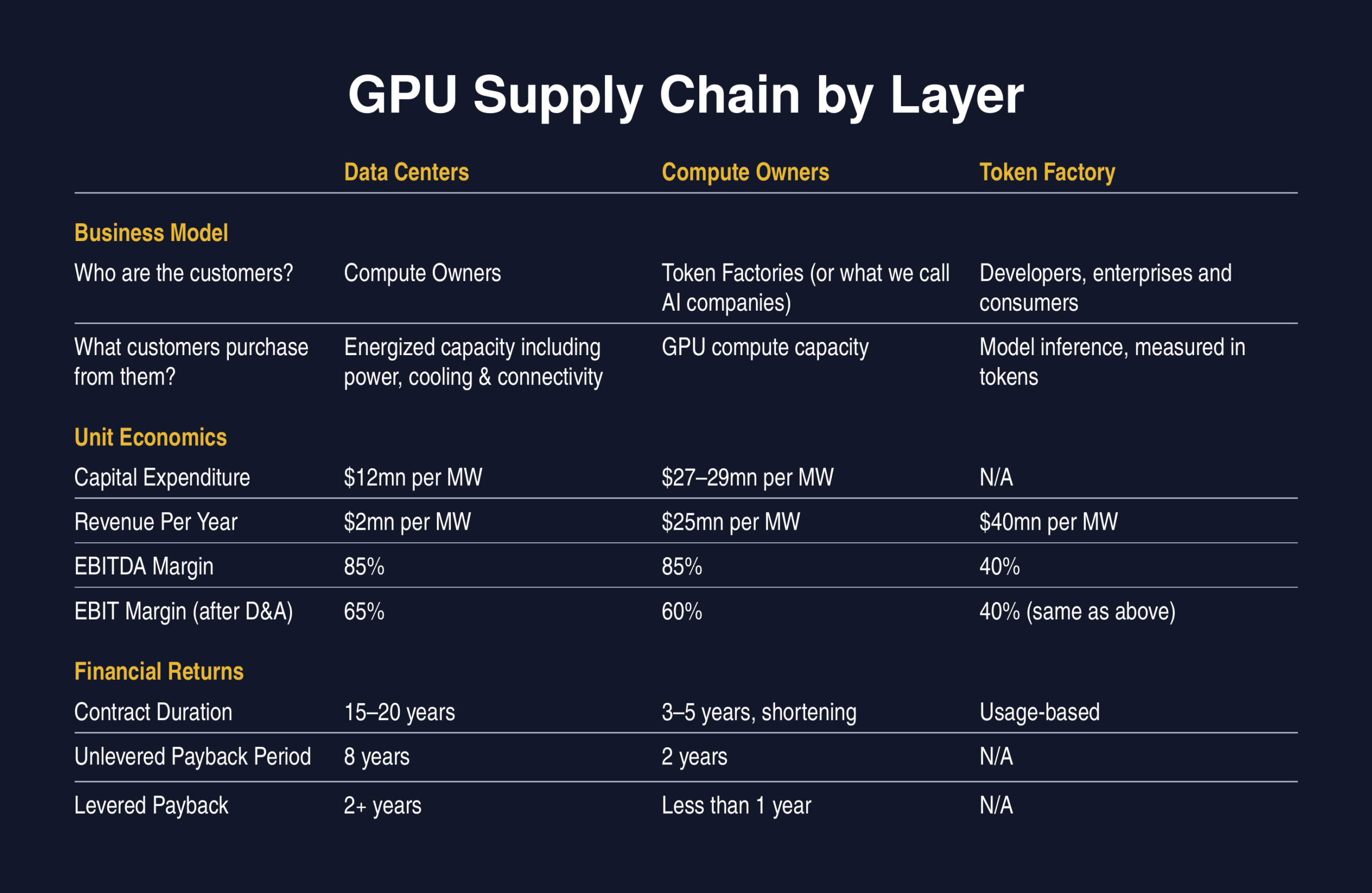
Data centers capital expenditure runs roughly $12mn per megawatt on average, so standing up a 100 MW data center costs $1.2bn. Data centers then lease energized capacity on multi-year triple-net leases (e.g. all operational costs, including electricity are passed through and borne by the tenant) to compute owners. Data center operators seek to finance this and typically try to secure a tenant first in order to get more favorable financing terms from lenders. Typical rates range from 70-80% LTV and SOFR +200-300bps where there is an identified tenant (and sometimes even a tenant guarantee). For example, the Hyperion data center operated by Blue Owl and backed by a Meta guarantee received financing at an estimated 80% LTV and priced at SOFR + 275bps.
Recent AI/HPC anchor leases have priced capacity at over $2.2mn per megawatt per year, up from $1.3mn a year ago, driven by scarcer powered capacity. The consistent message across the supply chain is that power availability is the greatest constraint, and the 50-100% increase in pricing just over the last year for data centers speaks to that.
Because these are triple net leases, data centers operate at project-level margins of 85%+ EBITDA and 65%+ after depreciation. Using reasonable assumptions, datacenters can achieve 8-year unlevered payback periods.
Compute Owner Unit Economics
Compute owners take the data center shells and fill them with server racks, cabling, and compute hardware including, most importantly, the chips (GPUs, CPUs, memory). They maintain this hardware and run network architecture to be able to provide high performance compute. That capacity is then sold to AI labs or, in the case of verticalized hyperscalers and frontier labs, using the infrastructure themselves to power end-user products and applications.
Compute contracts typically run three to five years, which is shorter duration than the underlying facility leases. This allows operators to reprice capacity as GPU economics and customer demand evolve, and accounts for the greater variability in its customer base. CoreWeave, for instance, reported a weighted-average committed contract duration of approximately five years, compared with the fifteen-year lease it signed for Galaxy’s Helios data center.
Pricing is typically quoted on a per GPU-hour basis, although public operators often report pricing on a per MW basis. Shorter-dated contracts have tended to be priced much higher than longer-dated contracts, likely accelerated by the continued short squeeze causing a more frenetic spot market. Iris Energy has disclosed recent three-year AI Cloud contracts generating $20mn per megawatt per year, with active discussions at $25mn. CoreWeave and Nebius have both recently disclosed short-dated 3-6 month customer contracts priced at $40-50mn per megawatt on an annualized basis. This is up from Nebius’ base business coming into 2026 priced at $12mn per megawatt per year.
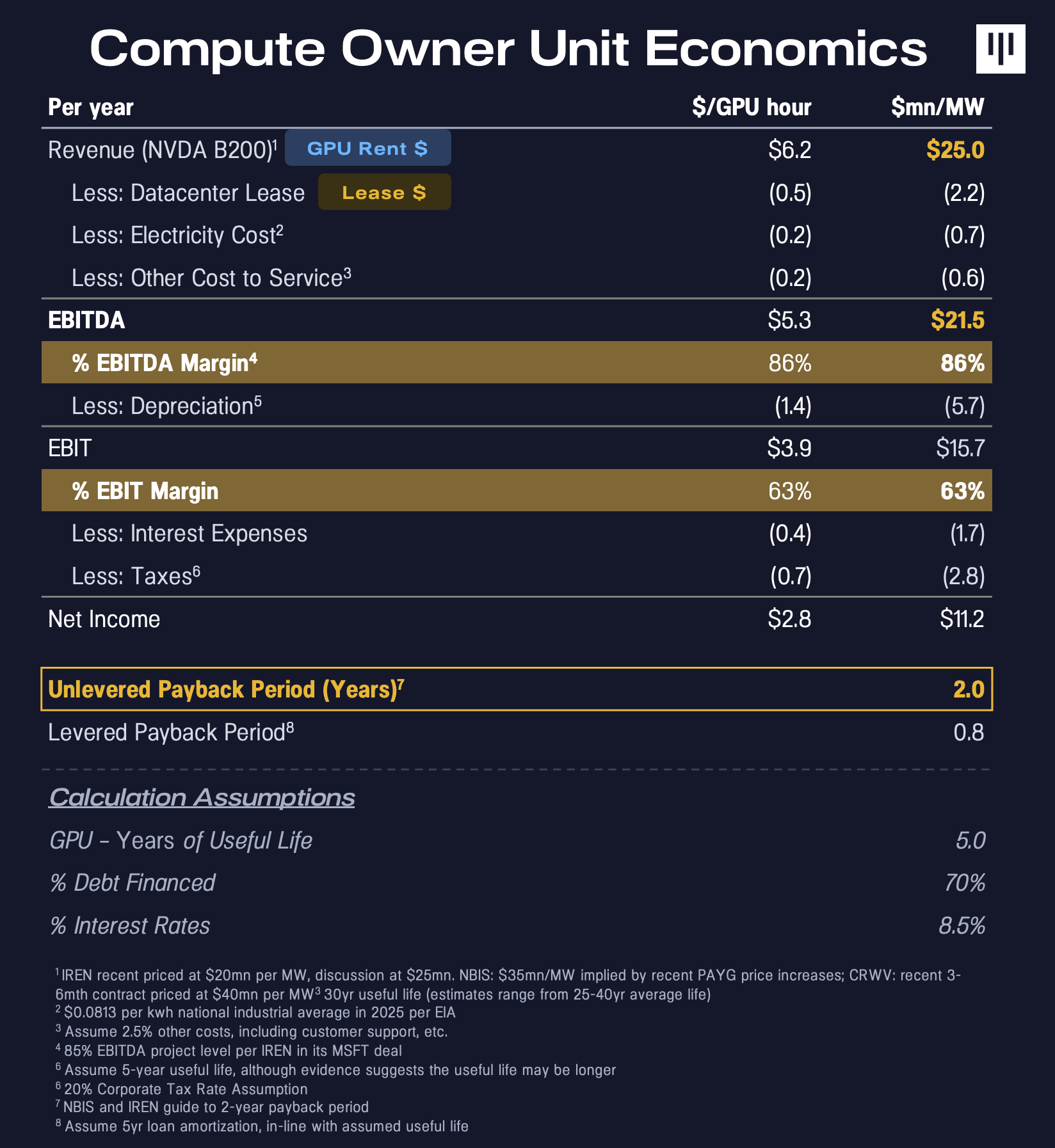
Compute owners on the project level (e.g. before R&D, corporate overhead and other costs) are running at an 85%+ EBITDA project margin after paying for the data center lease, electricity and other service costs. Burdened for GPU depreciation, EBIT margins are in the 60%+ range. On a typical $29mn CapEx per MW, this results in 2 year payback period compared to the 5 year expected average useful life of GPUs. To the extent GPUs hold their residual value longer than expected, which appears to be playing out, the IRRs would be even stronger.
Token Factory Unit Economics
Token factories are the frontier labs and inference providers that turn compute capacity into tokens and sell them to end users, both enterprise and retail. Token usage comes in different shapes and forms. Software engineers increasingly use AI coding tools to write and review code while running a swarm of agents in the background to manage day-to-day tasks. A retail user may generate only a handful of tokens asking a chatbot for restaurant recommendations. The workloads differ but consume the same underlying resource, tokens.
The economics of a token factory come down to how efficiently a given amount of compute can be converted into tokens. They can either rent compute from neoclouds and hyperscalers or purchase the hardware and build their own. The former means lower operating margins, because neoclouds and hyperscalers charge a markup and earn the healthy margins discussed above. Verticalizing means heavy upfront capital expenditure and a longer commitment, which may not be financially feasible for most AI startups.
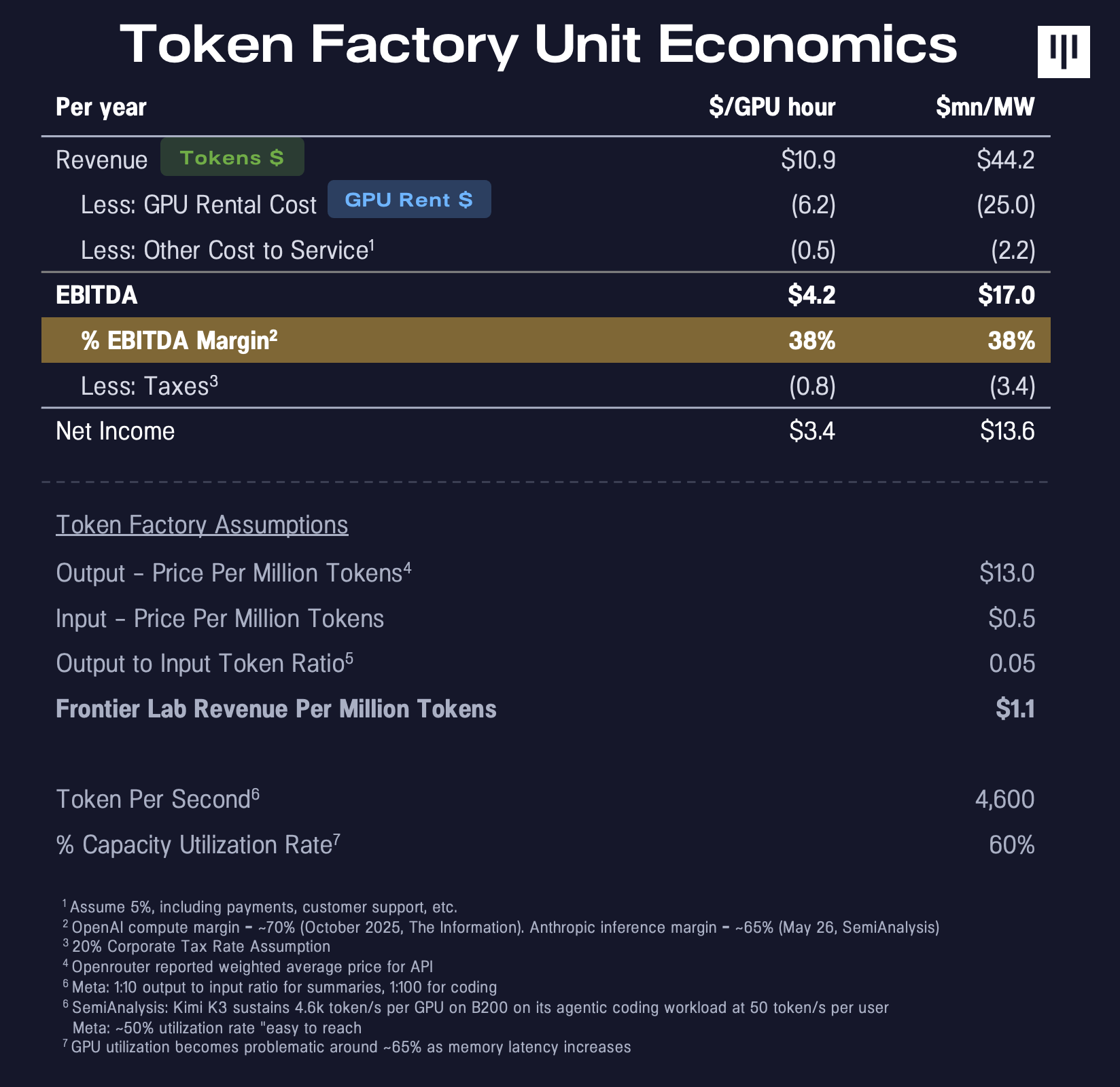
Take the latest leading open-weight model, Kimi K3 as an example. According to InferenceX by SemiAnalysis, Kimi K3 sustains approximately 4.6k tokens per second per B200 GPU on its agentic coding workload at 50 tokens per second per user. At a blended $1.10 per million tokens and assuming a 60% utilization rate, this translates to $11 of revenue per GPU hour, or $44mn per megawatt per year. After paying for GPU rental, this translates to a ~40% EBITDA margin.
Hyperscaler Unit Economics
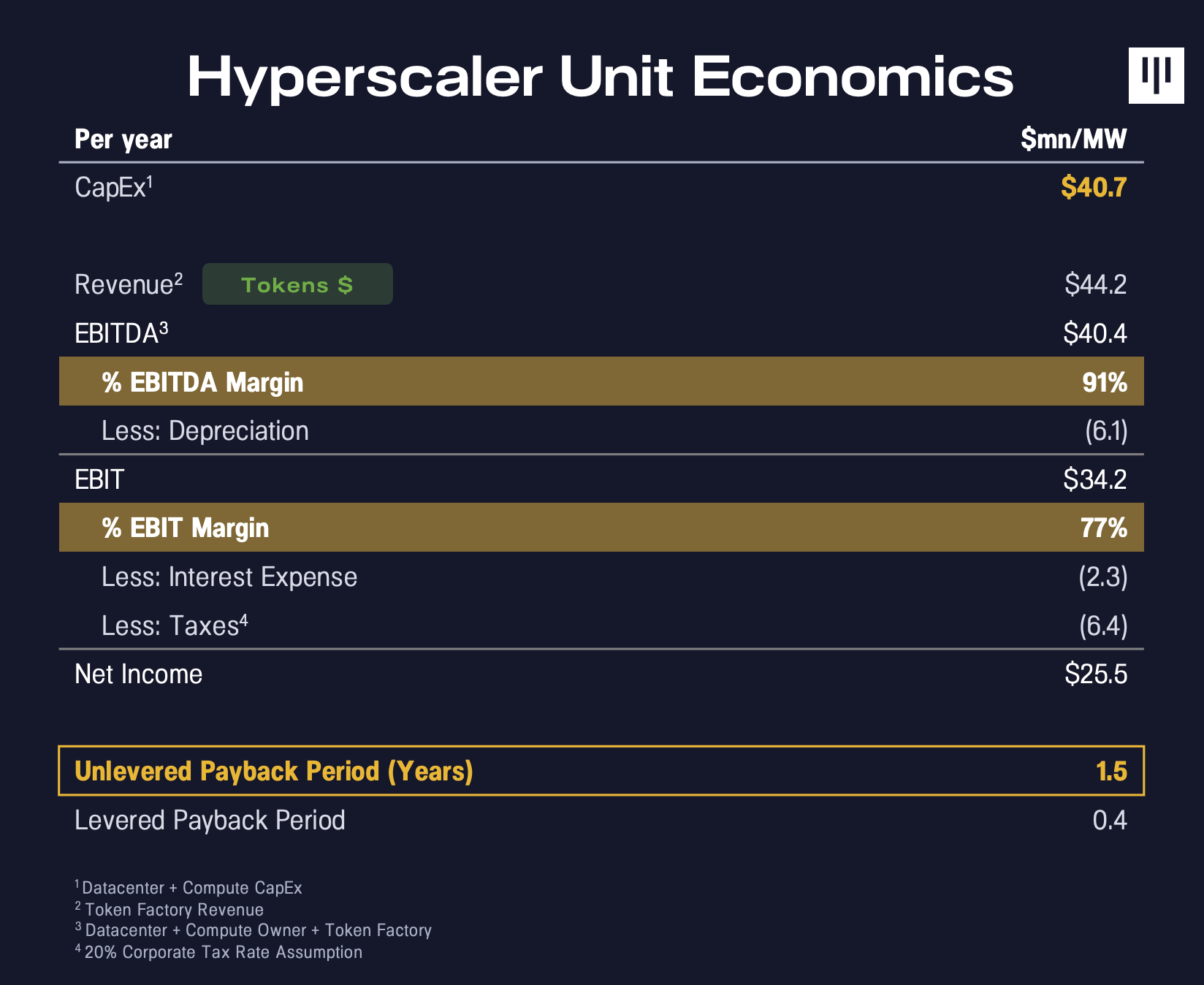
Hyperscalers have the long-term business visibility and financial strength to afford to fully verticalize each of those three components: datacenter, compute and selling tokens to the end user (or internalizing for its own AI applications). Consolidating the unit economics of each layer of the stack leads to 90% EBITDA margins, 77% and a less than two year payback period on a project-basis (e.g. excluding R&D, corporate overhead, and other costs). SpaceX reported in its 2Q 2026 earnings that they are seeing less than one year paybacks, and their economics don’t even internalize the token factory component.
It is no wonder with these incremental unit economics that hyperscalers believe the return on capex is there to justify historic levels of investments.
Where Value Accrues Across the System
There are a few interesting insights and questions that come out of studying the unit economics at each layer.
Everyone in the compute supply chain is earning outsized margins today. Capital Returns 101 would suggest that high returns should invite more competition, which will lower returns over time.
- Whether or not margins persist will depend on how easy it is to spin up new supply at any layer (e.g. if energy and skilled trade labor became abundant, datacenters would lose leverage; or if GPUs became more abundant, the compute owners would lose leverage), the relative competitive intensity at each layer (e.g. in a world where only Anthropic and OpenAI dominate, high margins would persist for token factories), and who ultimately owns the end customer (i.e. Aggregation Theory), amongst other factors.
- At the moment, the greatest shortage across the supply chain comes from two sources. The first is energized capacity offered by data centers and the second is GPU allocation (from primarily Nvidia), so we would suspect outsized margins to persist at the datacenter and neocloud layers as long as this situation persists.
- Conversely, the token factory layer is seeing the most competition. Open-weight models are closing the capability gap partly through distillation and model capabilities are converging. Price wars are starting: OpenAI recently cut launch pricing for GPT-6 Sol and Luna to undercut Anthropic and successfully took back market share, MSFT is discounting Copilot AI heavily (TheInformation), AMZN is giving out free access to Quick Plus AI assistant to merchants (Amazon), and META’s free Muse tier reaching 250k DAUs in its first week (link). People are realizing there are many alternatives that are good enough for most use cases. Access to “good enough” intelligence is not the bottleneck, at least for now while diffusion has grown at a modest pace; it’s further up the stack.
Neoclouds are profitable now, but an unclear moat challenges the economic model long-term
- From our channel checks with customers, it’s clear that the primary proposition of the neoclouds are some combination of being cheaper and having more on-demand availability. Service quality is important but ranks behind that. That’s fine for now as it leads to meaningful operating leverage in the current supply constrained environment, but it speaks to this being a commodity that will face pressure as GPU availability increases.
- If Nvidia didn’t will the neoclouds into existence with GPU allocations and financial backstops to act as a counterweight to the hyperscalers, what scale would these businesses have achieved today?
Hyperscaler verticalization could make life difficult for everyone
- Even though token factories are profitable today, we are already seeing meaningful price competition and would expect that to persist in the absence of runaway recursive self-improvement.
- In our illustrative unit economics model, cutting token prices by 40% would result in breakeven profitability for token factories but a verticalized hyperscaler would still earn 70% incremental EBITDA margins, due to healthy profit on the datacenter and compute layers.
- Hyperscalers also uniquely benefit from a more diversified user base spanning consumers, sophisticated developers and enterprise users. This allows them to aggregate demand across a broader range of use cases and achieve higher utilization rates across their compute resources and generate higher incremental margins.
- This is probably why AMZN, GOOGL, and META all feel comfortable offering products for free or undercutting on price. As model capabilities continue to converge, this will become a big problem for the token factories. Google’s Gemini search and META’s Muse are two great examples of hyperscalers taking advantage of these verticalized economics to offer a compelling AI product for free, because it can monetize in other ways.
Every GW of energy capacity added is worth $40-50bn of annual revenue today, although that number may change drastically
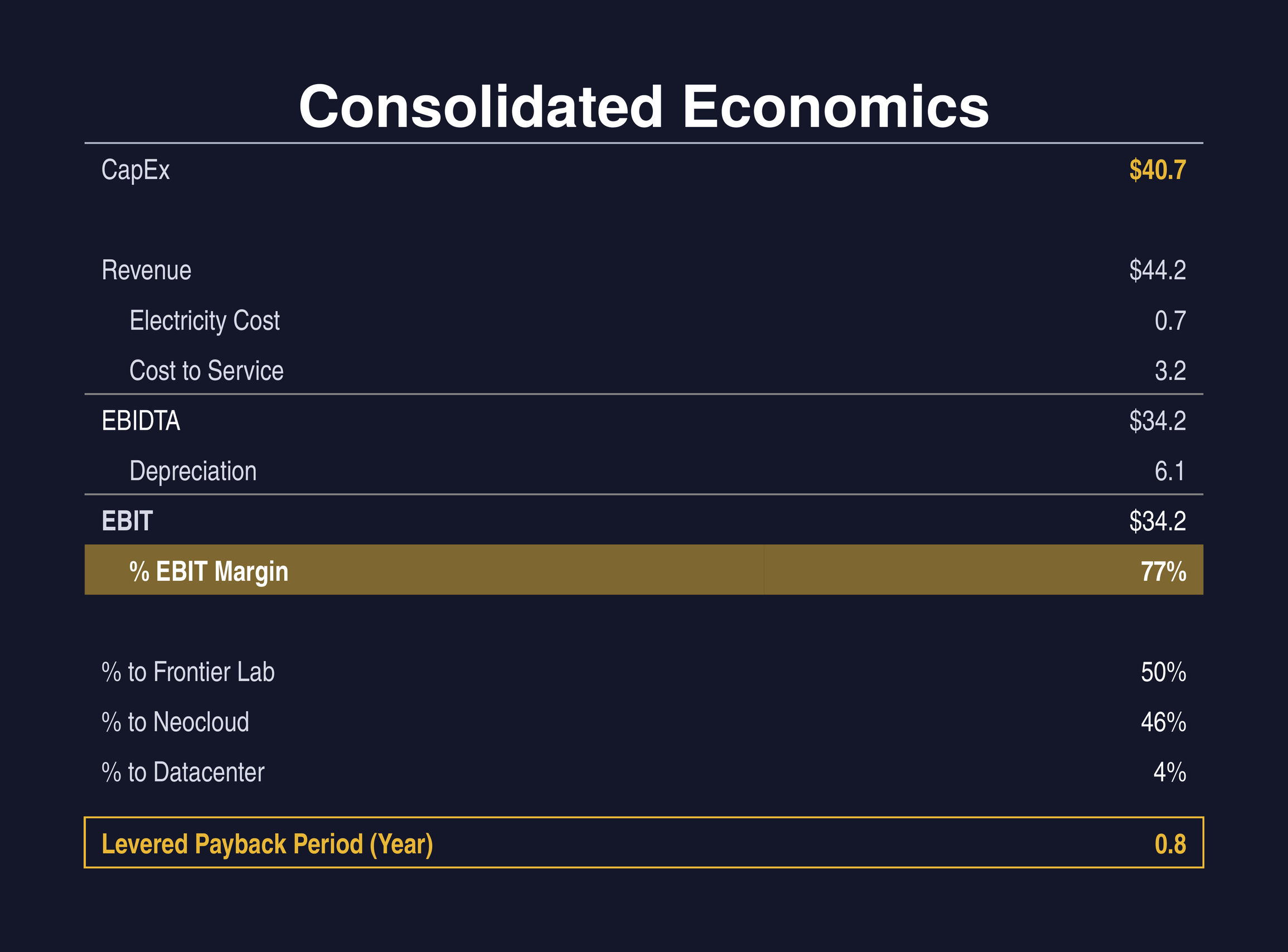
- Consolidating the data center, compute owner and token factory economics together, every GW of energy capacity costs $41bn of CapEx and can be converted into $44bn of inference revenue at a 60% capacity utilization rate, per our estimates.
- Whether these economics persist ultimately depend on to what extent Jevon’s Paradox holds – if customer demand for inference outpaces the availability of intelligence, and in particular whether tokens can hold their pricing power in the face of increasing open-source competition.
Data Centers appear to be under-earning and may have the most upside to pricing power to uncontracted capacities
-
-
- The binding constraint in today’s compute buildout is power availability. Data centers consumed over 4.5% of total electricity in the US in 2024, up from 1.8% in 2018, and are expected to reach 12% by 2028. In PJM, the largest grid operator in the United States, data center projects that came online in 2025 took more than seven years on average from interconnection request to operation.
- At the same time, data centers earn revenue of $2.2mn/MW or only 4% of token factory revenue on the other end of the chain at $44mn/MW on a relative basis – a tiny proportion (although one might reasonably argue that internet service providers earn a tiny fraction of all internet commerce). Data centers could double their prices and token factories would still earn 30%+ incremental EBITDA margins.
- There are factors that prevent a quicker resetting of prices. One is that data centers sign 15-20 year long-term contracts, so they cannot re-price contracted capacity. Second is that in the early days when the durability of AI compute demand is still unproven, lenders ask for customer backstops for data centers to secure financing. Hyperscalers lend their credit rating and are paid for it with a lower lease rate, so part of the data center’s margin today is effectively given up to the tenant as credit enhancement.
- The rise of edge compute also poses a long-term threat to data center’s pricing power. Increasingly capable personal devices could handle inference workloads locally rather than relying on centralized compute. For instance, Apple just announced that its latest Mac Studio can run Meta’s open-weight model locally, although Stratechery’s review suggests it is quite a slow experience (link).
Each layer of the compute supply chain trades margin for duration and passes risk downstream
-
- Data centers need to lock in a tenant to secure debt financing to get a project started, and in doing so accept a lower price per megawatt in exchange for revenue certainty over fifteen to twenty years. In addition, their assets likely have 30+ year useful lives.
- Compute owners price contracts at 8-9x the cost of the underlying lease and energy ($25mn per MW vs $2.2mn lease and $0.7mn energy cost per MW). Some neoclouds (e.g. CoreWeave) choose to prioritize longer-term 3–5-year contracts for stability, while others (e.g. Nebius) choose to take more market risk with short-term contracts. In the current environment, those with riskier short-term contracts have benefited from rising prices. As soon as there are signs of relief, expect that to sharply reverse.
- Token factories who figure out how to maximize their return on compute with the end customer have the potential to earn the most EBITDA per MW because they have the most operating leverage in their business. Token pricing is real-time and reactive to competition (see Kimi K3 historical pricing on Openrouter here). OpenAI won back meaningful market share from Anthropic this year after cutting prices. Tools like OpenRouter increase price transparency by allowing customers to route between models based on cost-benefit. Margins can rise and fall quickly at this layer.
- When a price war compresses token prices, the risk flows all the way back upstream. Lower token factory margins put pressure on take-or-pay contracts neoclouds depend on, and neoclouds like CoreWeave and Nebius effectively absorb that risk. Compute owners are also typically heavily levered to scale and keep pace with each hardware generation so the risk unwind will quickly show up in credit quality.
Technological progress can benefit the ecosystem while hurting each layer of the supply chain differently
-
- Suppose a new system performs the same task using half as much energy. That makes AI less expensive to deliver, but it may also reduce what customers will pay to rent older equipment. An improvement in hardware can change the economics of a power-constrained site.
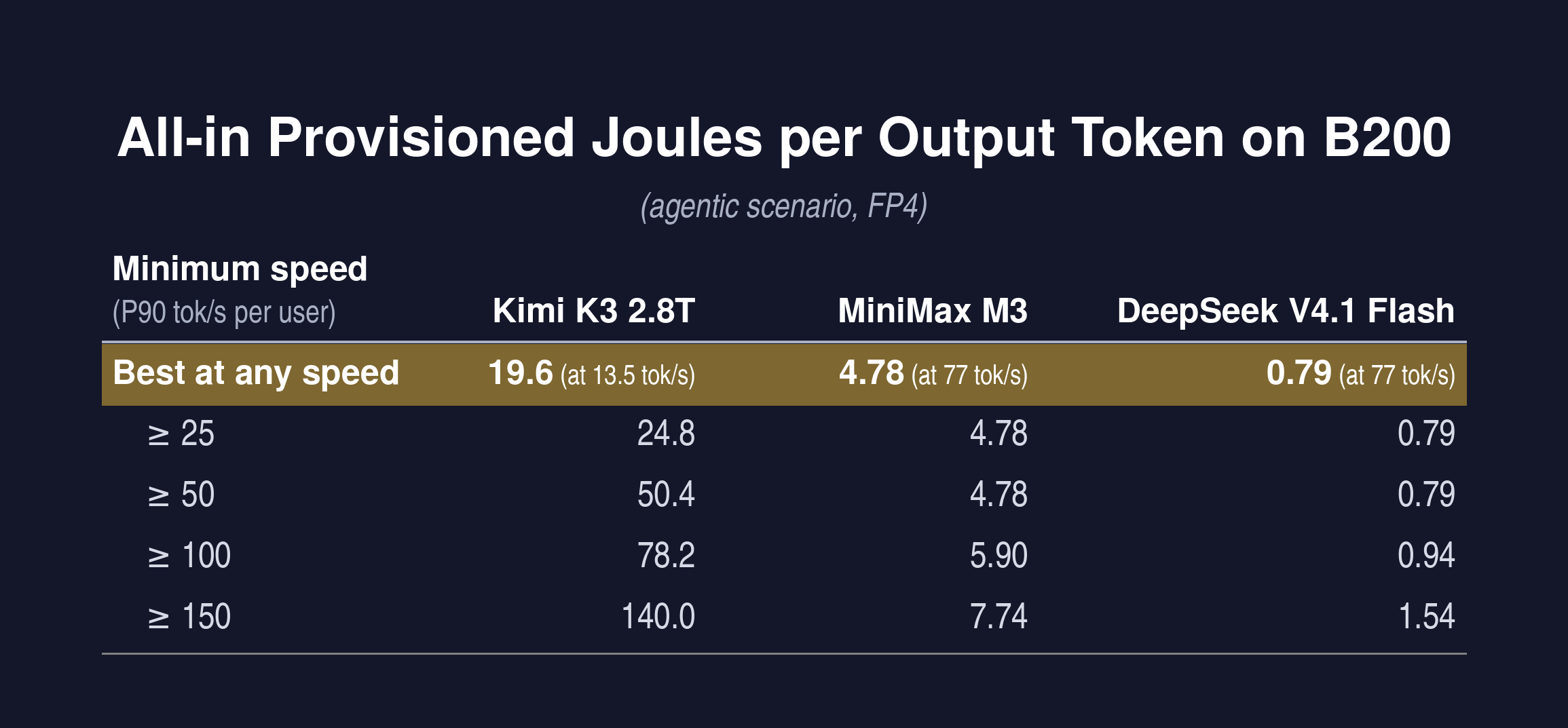
- We are already seeing token-generation efficiency improve as leading models increasingly adopt sparse mixture-of-experts architectures, which activate only a subset of model parameters for token generation. By reducing the computation required, this new architecture lowers energy consumption per token. For instance, DeepSeek v4.1 consumes less than 1 J/token vs Kimi K3 (as a proxy to frontier model) at 78 J/token on B200 chips under the same assumption (i.e. 100 token/sec per user) according to InferenceX by SemiAnalysis
- These efficiency gains will become more consequential if open-weight models close the capability gap with proprietary frontier models. Open weights give developers greater flexibility to optimize model architecture which delivers inference at a lower cost. Meanwhile, hardware improvement in memory bandwidth and advances in inference software can further improve token generation efficiency by increasing token throughput per GPU.
- Whether total infrastructure spending rises depends on how much additional usage the lower cost creates, or the highly debated Jevon’s Paradox. This is why we do not think it is prudent to underwrite every layer using the same assumption of rising demand and stable pricing.
-
The Opportunity Across Compute
We are standing on the precipice of an explosion in innovation. Specifically, we see opportunities in making more compute available, getting more useful work out of optimizing existing compute, and improving the markets through which it is purchased and financed.
If compute is the constraint, then solving that first order bottleneck of turning power and physical infrastructure into usable capacity is the obvious opportunity. The ability to source reliable energy efficiently was the primary differentiator for Bitcoin miners, which have now converted that expertise toward high-performance computing datacenters. The workloads are different, but some of the assets and expertise are transferable. As our network has expanded in that area, we see opportunity in businesses innovating novel energy sources (such as ocean-based datacenters).
Another way to relieve the compute constraint is to squeeze more results out of existing compute. This could take many forms, ranging from developing better hardware or networking software, taking advantage of stranded resources (e.g. decentralized methods of aggregating energy and data or conducting training and inference), or executing tasks more efficiently (e.g. smart routing, open-source models, and Sovereign AI offered by companies like B3).
Building better compute markets by making it easier to transact and finance is also a big surface area. Pantera has seen the creation of many neo-markets, all of which we think on a go-forward basis will be natively available on blockchain rails. Better data, procurement, contracts, credit, and risk management or hedging tools are all valuable businesses that may need to rebuilt in a neo-market. Compute derivatives are particularly interesting given the high degree of uncertainty in the assumptions at every layer of the supply chain, because that volatility makes hedging and risk management more valuable.
If you’re an investor looking for a new challenge, our team is always looking for smart, high-agency people who are passionate about the frontier. If you’re an entrepreneur working on any of these ideas, we’d love to hear from you.
Disclaimers
This report is an informational document that primarily provides educational content and general market commentary. No statements included herein relate specifically to investment advisory services provided by Pantera Capital Partners LP or its affiliates (“Pantera”), nor does any content herein reflect or contain any offer of new or additional investment advisory services. Nothing contained herein constitutes an investment recommendation, investment advice, an offer to sell, or a solicitation to purchase, any securities in Funds managed by Pantera (the “Funds”) or any entity organized, controlled, or managed by Pantera and therefore may not be relied upon in connection with any offer or sale of securities. Any offer or solicitation may only be made pursuant to a confidential private offering memorandum (or similar document) which will only be provided to qualified offerees and should be carefully reviewed by any such offerees prior to investing.
The views expressed in this report are the subjective views of Pantera personnel, based on information that is believed to be reliable and has been obtained from sources believed to be reliable, but no representation or warranty is made, expressed, or implied, with respect to the fairness, correctness, accuracy, reasonableness, or completeness of the information and opinions. Analyses and opinions contained herein (including market commentary, statements or forecasts) reflect the authors’ judgment as of the date this letter was published, and may contain elements of subjectivity (including certain assumptions) or be based on incomplete information. The information contained in this report is current as of the date indicated at the front of the letter. Pantera does not undertake to update the information contained herein.
This report is not intended to provide, and should not be relied on for accounting, legal, or tax advice, or investment recommendations. Pantera and its principals have made investments in some of the instruments discussed in this communication and may in the future make additional investments in connection with such instruments without further notice.
Certain information contained in this letter constitutes “forward-looking statements” (including predictions), which can be identified by the use of forward-looking terminology such as “may”, “will”, “should”, “expect”, “anticipate”, “target”, “project”, “estimate”, “intend”, “continue”, “believe”, or the negatives thereof or other variations thereon or comparable terminology. Due to various risks and uncertainties, actual events or results or the actual policies, procedures, and processes of Pantera and the performance of the Funds may differ materially from those reflected or contemplated in such forward-looking statements, and no undue reliance should be placed on these forward-looking statements, nor should the inclusion of these statements be regarded as Pantera’s representation that the Funds will achieve any strategy, objectives, or other plans. Past performance is not necessarily indicative of or a guarantee of future results. There is no guarantee that investments in any instrument or type of instrument described herein will be profitable – all investments carry the inherent risk of total loss.
It is strongly suggested that any prospective investor obtain independent advice in relation to any investment, financial, legal, tax, accounting, or regulatory issues discussed herein. Analyses and opinions contained herein may be based on assumptions that if altered can change the analyses or opinions expressed. Nothing contained herein shall constitute any representation or warranty as to future performance of any financial instrument, credit, currency rate, or other market or economic measure.