THE BATTLE FOR 80 BILLION CUSTOMERS
By Franklin Bi, General Partner
“I wish to be cremated. One tenth of my ashes shall be given to my agent, as written in our contract.” – Groucho Marx
Eight billion people, each running a handful of AI-powered agents: one that shops, one that manages money, one that books travel, and several that work alongside them. Assume ten agents per person and you’ll get 80 billion agents. And that’s not counting the larger fleets of agents running within companies. Companies will operate coding agents, procurement agents, sales agents, treasury agents, customer service agents, and specialized subagents created for a single task. Within a decade, persistent agents with budgets could outnumber humankind as economic participants.
Whether the end state is ten persistent agents per person or one chief agent spawning hundreds of delegates isn’t the point. What’s more important is that each agent represents a new potential customer. Agents become customers when they have identity and memory, hold authority over a budget, possess the ability to choose and transact, and have accountability to a human or corporate owner.
80 billion agents would represent tens of billions of new decision-making and transaction endpoints acting on existing human and corporate capital. A logistics agent might purchase ten minutes of real-time supply chain monitoring. A research agent might pay for one database query. A coding agent might rent a specialized security agent for thirty seconds. These economic flows can occur at a higher velocity than any system with humans in the loop, driven by transactions of machine-to-machine services too small and fleeting for any human to buy manually, and designed for financial rails that operate at the speed of software – in other words: blockchains.
Which raises the key question: who will own these 80 billion agents? The people and businesses they represent? Or the platforms they run on? Depending on the answer, what role can blockchains play in this battle for the next 80 billion customers?
The Sovereign AI Movement
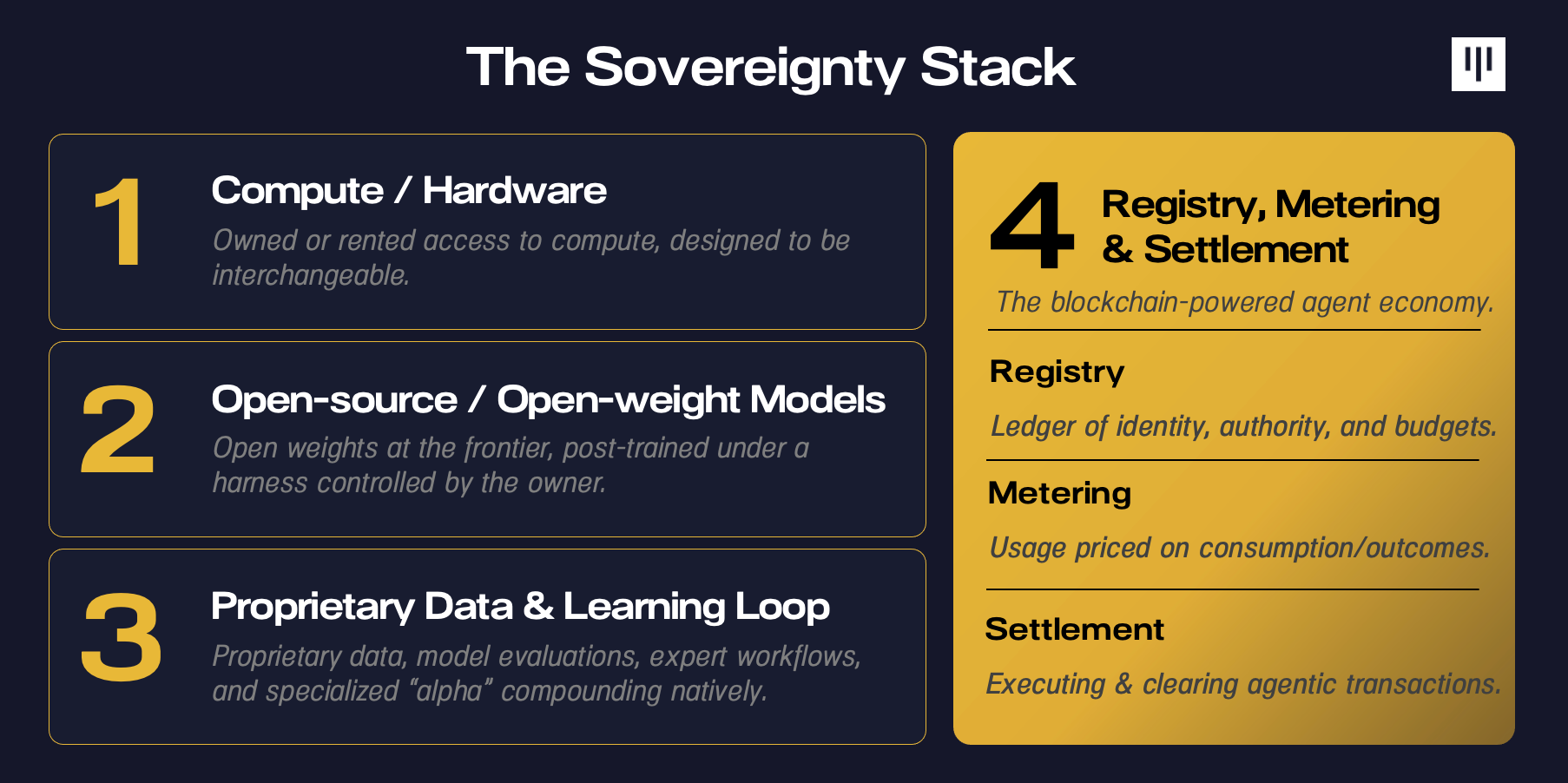
AI sovereignty is the ability of a person or institution to operate, govern, and improve its intelligence, independently of a platform or provider’s changes in technology, pricing, policies, availability, etc. Today, three layers of society are converging on the need for sovereign AI:
-
The first is national sovereign AI. Nation-states want domestic compute, culturally and linguistically appropriate models, strategic capacity, and jurisdictional control. They don’t want critical government, defense, healthcare, and industrial systems to depend on a foreign provider that can change its prices, policies, or availability at any time. They certainly don’t want their nation’s economic destiny to be in someone else’s hands in a post-AI world.
-
The second is enterprise sovereign AI. Companies increasingly recognize that their evaluations, corrections, workflows, and agent traces form a proprietary learning loop. Major AI providers generally claim that enterprise data isn’t used to train their models by default. But who captures the product insight, workflow knowledge, usage signals, and improvement loop created as employees and customers use AI? As Microsoft’s CEO, Satya Nadella, wrote recently: “In consuming intelligence, you are creating intelligence. What you create should belong to you.” Or, as former Coinbase CTO, Balaji Srinivasan, stated previously: “Not your weights, not your model.”
-
The third is personal sovereign AI. Individuals will eventually want AI-powered assistants with private memory, user-controlled permissions, local or confidential execution, and the ability to move between providers without losing years of accumulated context. A downloadable transcript is not enough. Users need the memory, preferences, skills, and relationships that make the agent theirs. Not your memory, not your agent.
The most forward-thinking companies are already putting AI sovereignty into practice. Leading fintech company Ramp, a self-declared “AI-native company,” built an internal AI suite and custom coding agents with 99% adoption across their 1,000+ employees. For enterprises, the most valuable asset may be the learning loop rather than the model.
The message is clear: To own your destiny, you must own your intelligence.
Agents Are Economic Actors
Gartner projects that agentic customers will influence or participate in $30 trillion of purchases by 2030. And right on schedule, the necessary primitives for activating 80 billion customers are starting to show up.
Take payments as one example. The world’s largest payment networks are rebuilding their infrastructure for a customer that barely existed two years ago. Visa’s Intelligent Commerce and Mastercard’s Agent Pay can issue tokenized payment credentials to agents and enforce user-selected spending limits and conditions. Coinbase’s x402 lets software pay for API calls and online resources with stablecoins, making sub-$0.01 payments commercially practical.
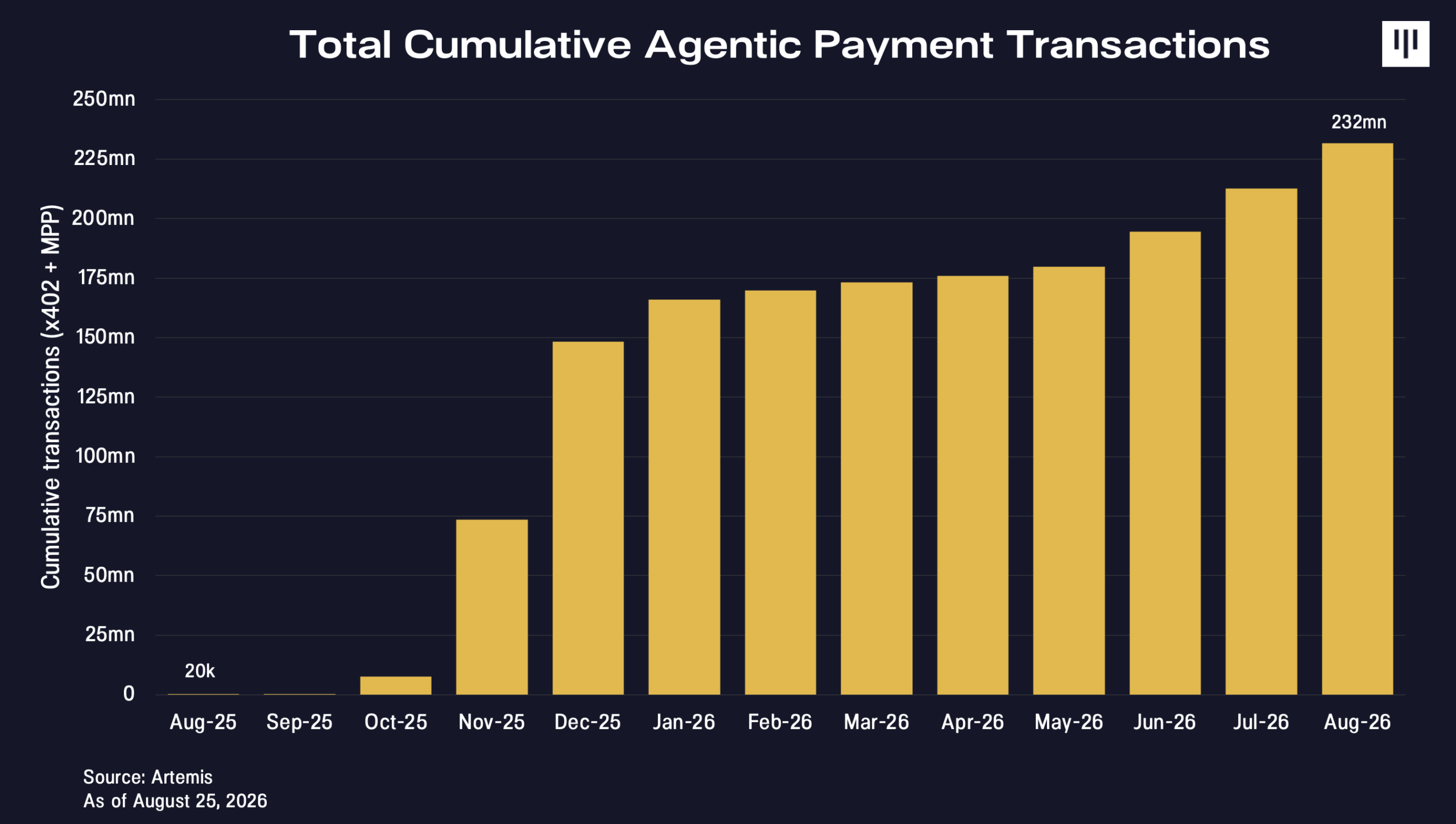
Today an agent can buy a database query. Tomorrow, it may manage a cloud budget, negotiate a vendor contract, or reallocate a portfolio. The progression of AI’s role from recommendation to transaction to capital allocation is likely to be faster than expected. Cloudflare’s CEO recently shared that automated systems accounted for over 57% of HTTP requests to web content worldwide, as agentic activity surpasses human traffic on the Internet. When agents can hold authorization credentials, select their counterparties, and settle transactions, they will represent a new economic force, albeit with new challenges.
If a platform controls your agents’ identities, memories, evaluations, and learned behavior, switching providers means firing your entire digital workforce and replacing it with amnesiacs. Every price increase or policy revision from today’s dominant AI platforms would become a hostage negotiation.
Every prior platform war was fought to own the customer relationship. This one will be fought to own the customer’s AI-powered representative, a potentially more powerful position because agents sit upstream of every purchasing decision: which products get considered, how they are ranked, what information is disclosed, which payment rail is used, and what price the customer sees.
A platform-owned agent could prefer suppliers that pay the platform, hide competing products, steer users toward affiliated financial services, and use private context to estimate willingness to pay. It could make switching intentionally difficult, learn from the user’s transaction history, and collect a toll on every agent-facilitated purchase.
Soon, the big question may not be whether your agent is capable, but whether your agent is loyal.
The Agent Economy Needs Property Rights
In a world of conflicting loyalties and existential platform risk, it’s clear that the agent economy needs property rights. They need verifiable, bounded authority from the people and institutions they represent.
As agents gain more capabilities and generate more value, their dispatchers will likely demand more rights: control over the agent’s identity, memory, authority, capital, and learning. A person should be able to say: “This agent may spend up to $2,000 per month on travel, book refundable economy flights, disclose my passport only to verified airlines, and never transact with sanctioned entities.”
That mandate has to be machine-readable, narrowly scoped, time-limited, auditable, revocable, portable between runtimes, and enforceable independently of the model. Therefore, we will need the instantiation of property rights independent of a foundational model or platform, which define who is entitled to issue orders to a particular agent.
This is why digital wallets may become more important to agents than browsers were to humans. Each agent will require a wallet holding its digital-native identity, user approvals, working capital, and instructions. But today’s wallets are dangerously incomplete for the task. A private key can answer a binary question: can this actor sign or not? But agents need allowances, approved counterparties, time limits, transaction simulation, automatic revocation, and human escalation. An agent should not receive permanent access to a treasury any more than an intern should receive the company’s bank password.
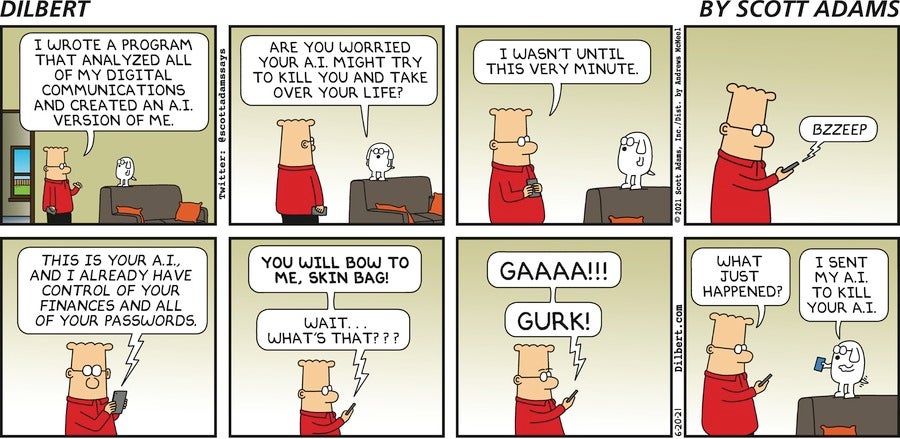
Source: Scott Adams, Dilbert, June 20, 2021
Property rights require more than a public record of ownership. They require a durable way to establish who controls an asset, delegate limited authority over it, enforce the limits of that delegation, and transfer control without another platform’s permission. Blockchains are natural infrastructure for agent property rights because they offer a persistent, programmable, public ledger that isn’t owned by any platform or model provider.
This architecture also makes rights portable. Swap the model or host, and the agent’s identity, capital, permissions, and transaction history stay with the owner. No platform can unilaterally rewrite the ownership record or trap the agent’s assets. Blockchains help anchor ownership, delegation, and settlement in a neutral system shared across platforms. That grants agents their most important feature of AI sovereignty: the ability to pick up and go elsewhere, without losing their most valued possessions.
A New Commercial Surface
Agents will also change how companies design products and reach 80 billion new customers.
Today’s internet businesses are built for humans: landing pages, pop-up ads, search rankings, and loyalty programs. Agent customers will prioritize machine-readable inventory, transparent prices, reliable APIs, verifiable claims, settlement speed, refund rules, service guarantees, and compatibility with the agent’s mandate. Agents don’t care about your company’s logo or charming sales representatives. Whatever gets the job done.
This creates a second commercial surface, in addition to the human-centric Internet:
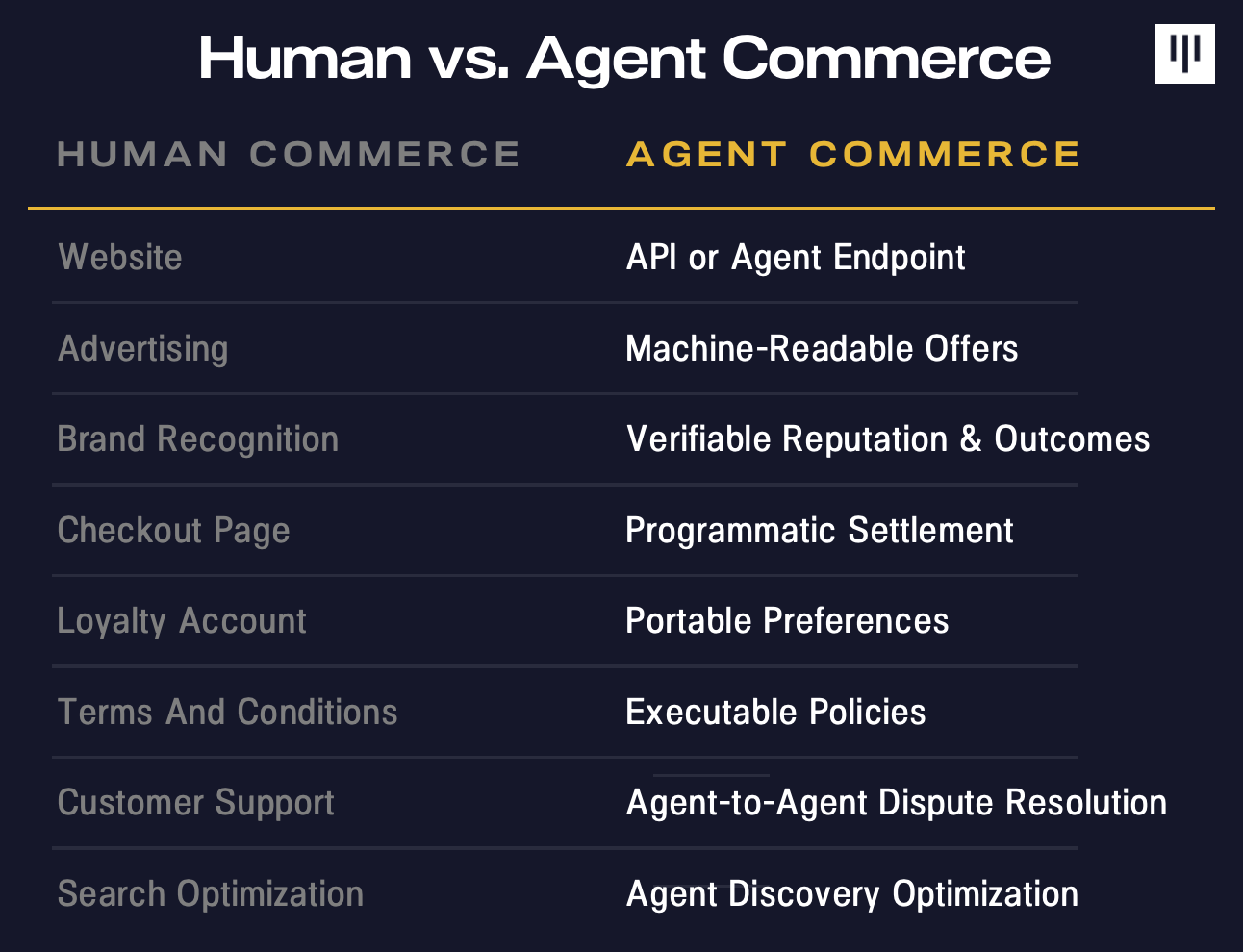
Humans will still encode preferences for quality, status, privacy, convenience, and familiarity; the mechanics of influence will change. A favorable ranking may depend less on keyword optimization than on price, fulfillment history, data policies, and provable credentials.
Every business will eventually need to answer the question: Can an authorized agent discover, evaluate, purchase, and use our product without a human in the loop?
The Convergence of Sovereign AI and Blockchain
In a world where 80 billion agents come online and each one represents a sovereign economic actor, it’s clear that a global peer-to-peer settlement layer is critical to this agent economy. Blockchains are the appropriate tool to create digital property rights for this new wave of digital natives.
As intelligence itself becomes a digital asset, agents will need machine-readable ways to express who controls it, who can use it, and how its value is exchanged. We believe expression will most naturally occur on a blockchain.
As investors looking towards this convergence of AI sovereignty and blockchain technology, here is a running list of ideas and business models that excite us today:
Intelligence-asset infrastructure: Models, datasets, memories, skills, and evaluations are digitally native productive assets. New infrastructure is needed to make their ownership, provenance, access, and revenue rights machine-readable and programmable.
Agent control planes: Think of these as “sovereign agent operating systems.” This is the interface through which a person or company creates and supervises agents across frontier APIs, open models, private clouds, and local devices. They coordinate models, memory, policies, credentials, budgets, and execution without permanently owning the customer’s assets or learning loop.
Open agent-discovery marketplaces: If billions of agents offer services, other agents need ways to find and evaluate them. Blockchains can coordinate independent suppliers of data, models, compute, and agent services within an open marketplace, denying control to any single platform. They can also serve as the verifiable, immutable system of record for agents’ track records, outcome-based rankings, or specialized credentials.
Agent security: Empowering agents with money and authority comes with new security challenges. In particular, enforcing the boundary between the probabilistic reasoning of LLM’s and the deterministic action of onchain transactions.
Agent wallets, delegation, and credentials. Programmable wallets and session keys give agents narrow, revocable authority rather than unrestricted access to private keys. Verifiable credentials allow an agent to prove whom it represents and what it’s allowed to do.
Portable reputation: Agents will need histories of successful transactions, disputes, reliability and specialization. A neutral reputation system, instantiated on a blockchain, protects agents from having to start from zero.
Sovereignty-as-a-service: Companies will need tools to deploy across private and public compute, switch models, route sensitive workloads, and preserve continuity when a provider changes. Rent-to-own access to compute from platforms like B3IQ (Pantera portfolio company) can help organizations move towards AI sovereignty. By owning compute, they can own their destiny.
What We Need to Believe
Much like decentralization, sovereignty is not a sufficient value proposition by itself. Most customers will not pay a large premium for portability during normal conditions. The best products will turn sovereignty into everyday economic value: lower cost, better performance, tighter privacy, faster customization, or greater reliability. In other words: Product advantages derived from sovereignty.
In order for 80 billion agents to thrive in a world of sovereign AI, several things must become true:
- Agents must receive meaningful authority rather than remain sidekicks to their human users.
- Agent memory and learning loops must become valuable enough that customers demand portability.
- Security systems must make delegated spending acceptable.
- Merchants must expose products and services to agentic buyers.
- Open rails must offer a real advantage over platform-controlled identity and payments.
The momentum is already visible. What began as software for answering questions is quickly becoming software for allocating capital and executing transactions.
The first phase of AI was about opening up access to intelligence. The next phase will be about deciding the ownership of intelligence. As Palantir CEO, Alex Karp, recently said: “We cannot have a society where all the value goes to 2,500 people sitting in Silicon Valley. That just will not work, and no one’s going to put up with it.”
When economic power proliferates across 80 billion agents, the key battle will become whether agents compound intelligence and value for the platforms that host them or for the people and institutions they are supposed to serve. AI sovereignty ensures that the value created by an agent compounds for you, rather than for your vendor. Blockchains provide the property rights for intelligence and the neutral settlement layer that makes those rights programmable, portable, and enforceable across platforms.
As investors, we’re excited to invest at the convergence of AI sovereignty and blockchain, where we believe the future of the agent economy and its 80 billion customers will be built.
“We had better be quite sure that the purpose put into the machine is the purpose which we really desire.”
– Norbert Wiener, founder of the science of cybernetics, the study of control and communication in animals and machines (1960)

FUNDAMENTALS LEADING THE DIGITAL ASSET RALLY
By Cosmo Jiang, General Partner
This month, digital assets rallied sharply after months of sideways trading. The market gained momentum once Bitcoin broke above ~$69,000, its 200-day moving average, and reached $80,000.
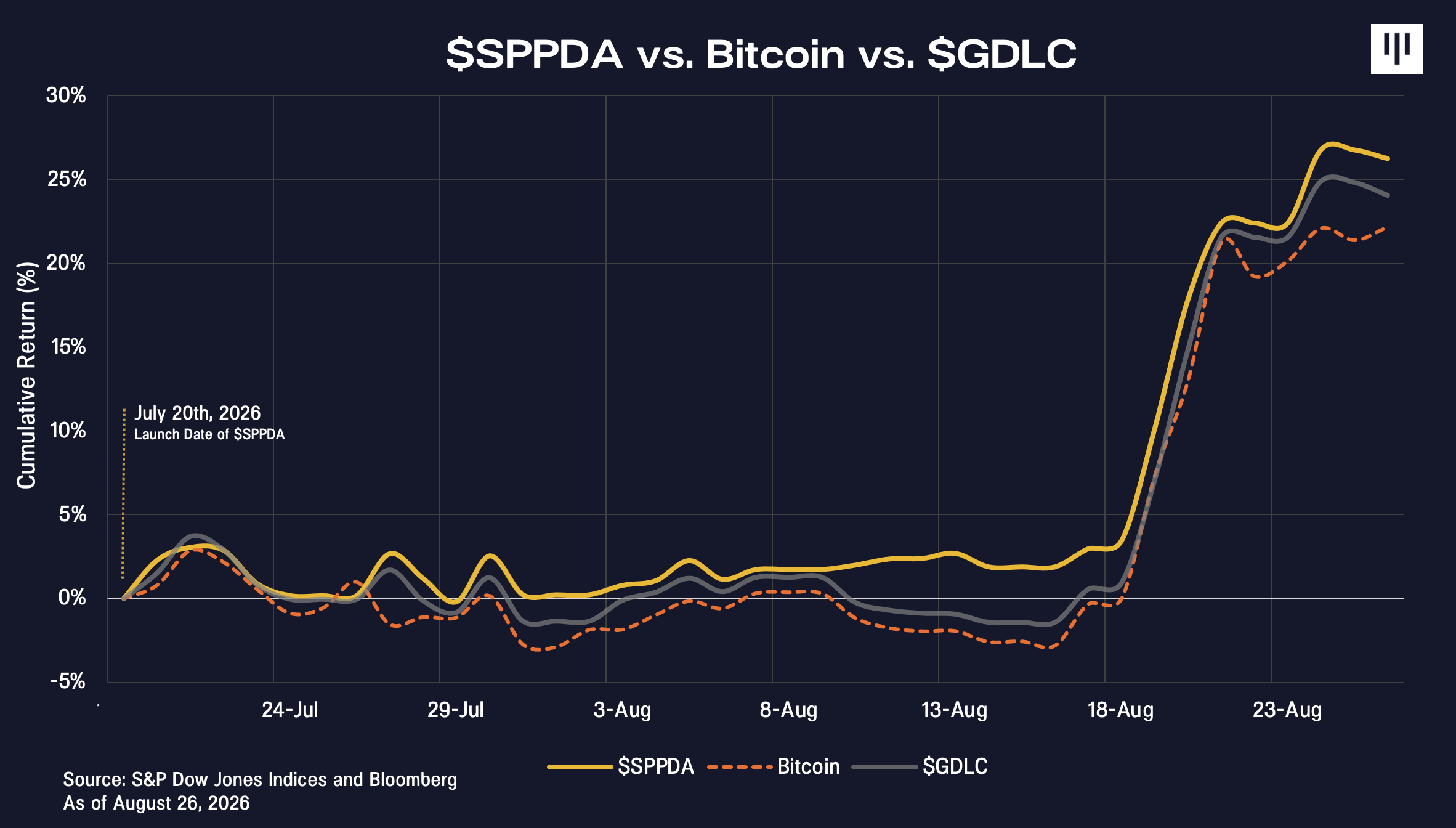
1. Index returns shown do not represent the results of actual trading of investable assets/securities. S&P Dow Jones Indices maintains the index and calculates the index levels and performance shown or discussed but does not manage actual assets. Index returns do not reflect payment of any sales charges or fees an investor may pay to purchase the assets underlying the Index or investment funds that are intended to track the performance of the Index.
The S&P Pantera Digital Asset Index ($SPPDA) captured more of the move than other benchmarks. Since its July 20, 2026 launch, $SPPDA has performed 26% versus 22% for Bitcoin.1 Outperforming in the index’s first month validates the fundamentals-based methodology. The tokens $SPPDA selects for, those with real revenues and usage, led the rally.
Join us on September 16th, 2026, for a call with S&P Dow Jones Indices CEO, Catherine Clay and Pantera Founder and Managing Partner, Dan Morehead, on the methodology behind the $SPPDA index. Register Here.
BLOCKCHAIN IS NOW ENTERING ITS REGULATORY CLARITY ERA
By Katrina Paglia, Chief Legal Officer
TL;DR: CLARITY still hasn’t passed. The Senate left for its August recess without a floor vote, and the earliest realistic restart is mid-September. The bill would replace a legal test written in 1946, for Florida orange groves, with rules written for digital assets themselves, and that is the difference between an asset class institutions must work around and one they can simply buy.
The Broader Case: Capital Markets and the U.S. Economy
CLARITY is a capital markets bill once blockchain semantics are removed. The bill determines whether digital asset activity settles inside or outside the U.S. regulatory perimeter.
Amid global conflict, the U.S. government continues to prioritize digital assets in legislative discussions. No digital asset bill has ever drawn more bipartisan support in Congress, as evidenced by the House passing CLARITY 294-134 in July 2025, with 78 Democrats crossing over in support. The SEC submitted a proposal for Regulation Crypto Assets, providing blockchain startups defined channels for raising capital in compliance with federal securities regulations.
The commercial coalition is just as unprecedented, receiving support from Wall Street leaders including BlackRock, Fidelity, Franklin Templeton, and Goldman Sachs alongside the blockchain-native firms that spent years pushing for digital asset regulation. Asset managers, founders, and broker-dealers cannot build products or price risk against a legal classification that changes with every enforcement action.
The macro stakes of CLARITY are threefold:
- Global competition: When founders and investors foresee legal uncertainty in the U.S., they build elsewhere. The EU’s MiCA regime has been fully applicable since December 2024 and is already capturing this migration.
- Market depth: A federal framework is a prerequisite for pensions, insurers, and institutional allocators to invest at scale, rather than through ETF wrappers.
- Systemic visibility: Today, regulators observe the digital asset market from the outside. Registration brings exchanges and issuers inside the perimeter and opens their operations to stringent examination.
Where AI, Blockchain, and Traditional Finance Converge
Pantera sits at the intersection this bill is built for. The impact of CLARITY is jurisdictional, drawing a statutory line between digital commodities under CFTC oversight and investment contracts under SEC oversight. Today, the standard that defines a security originates from the Howey Test, a 1946 Supreme Court case involving a Florida citrus grove. The case set the precedent for how we determine if a transaction constitutes an investment contract.
Classifying a token as a security at the moment depends on the specific facts and circumstances of its sale, leaving final determinations to a judge. No bank or insurer can underwrite risk against this regulatory uncertainty, regardless of their conviction. Passage of CLARITY transforms an asset class institutions could not clear through compliance committees into one that fits within their existing risk frameworks.
CLARITY arrives just as AI becomes the largest new user of blockchain rails. Stablecoins are becoming the default settlement layer for AI agents transacting autonomously—machine counterparties that need payment infrastructure running at all hours. Because machines transact around the clock, the venues they trade on should match this pace. Regulatory clarity is what lets digital asset infrastructure scale within U.S. law, allowing banks and asset managers building AI-driven products to plug into it without facing open-ended regulatory risks.
Who Benefits, and How Much?
Exchanges and trading infrastructure will benefit first and most directly, replacing a state-by-state patchwork of money transmitter licenses with a single federal registration. Many institutional counterparties will demand this registration before trading at scale.
Stablecoins and payments receive a second layer of certainty on top of the GENIUS Act, signed in July 2025, particularly on how yield-bearing products are treated. More than 100 amendments were filed ahead of the Senate Banking Committee’s January markup, including the banking industry’s stablecoin yield amendment, and its resolution will likely determine whether issuers can compete for the deposit-like balances banks currently hold.
DeFi is another beneficiary of CLARITY, as decentralized platforms would receive their first federal recognition that non-custodial software is not automatically an unregistered exchange. Existing legislation offers no framework for this segment, making CLARITY’s impact on DeFi arguably the most consequential of the three.
The SEC Steps In
Since the genesis of Bitcoin in 2009, there has been no legal method to sell a token to retail American investors onshore. On August 18, ten days after the Senate left for recess without a floor vote on CLARITY, the SEC proposed Regulation Crypto Assets, its first crypto-specific rulemaking. For the first time, blockchain-native companies have a path to raise capital from U.S. retail investors at home.
Historically, blockchain founders in the States raised through Reg D and Reg S. Reg D allowed companies to raise from accredited investors. Reg S allowed for international retail investment. Both left the tokens restricted and limited how much retail investors could participate. These two options forced teams to set up entities outside the U.S., just to fundraise and operate.
Reg Crypto includes a startup exemption covering $5 million over four years and a fundraising exemption covering $75 million every 12 months. More importantly, once the company has completed or permanently ceased the essential managerial efforts it promised, a safe harbor takes the crypto asset outside the investment contract and the token stops being a security. The caps will not fund a network launch, and teams that need more will still reach for Reg D. But, the numbers are fixed in advance, which means a founder can price legal risk before raising rather than after.
Reg Crypto is a proposal from a regulatory agency; CLARITY, a statute from Congress. The distinction decides how long any of this lasts. The SEC can write a path through the securities laws, and it has. Only Congress can draw the boundary between digital commodities and investment contracts, and a statute is what keeps that boundary in place after this SEC moves on. Both branches now point in the same direction, fostering innovation in America.
What It Means for Venture and Founders
For investment firms like Pantera, regulatory clarity compounds distribution as much as compliance. CLARITY is the difference between raising from blockchain-native LPs and underwriting alongside pensions and wealth platforms whose compliance committees have restricted access despite ample client demand.
Regulatory clarity is what makes institutional distribution possible. It’s why Pantera’s Fund V is on Morgan Stanley’s Alternative Investments platform, and why S&P Dow Jones Indices partnered with Pantera to develop the S&P Pantera Digital Asset Index. Neither collaboration occurs if institutions can’t explain, in plain regulatory terms, what they’re buying.
Reg Crypto carries the same logic down to a company’s first raise. A capped offering, a fixed disclosure schedule, and a defined exit from securities treatment mean the regulatory path is known on day one. Founders can put compliance on the roadmap next to the product, priced and dated, instead of expecting it as an open liability.
Registration replaces guesswork with fixed rules across the board. Teams can build roadmaps and forge enterprise partnerships without pricing in the risk that today’s compliance becomes tomorrow’s regulatory violation. Custody and registration requirements favor teams that can fund compliance, which will push some smaller projects to consolidate or build offshore. Equity markets made a similar trade-off a century ago.
For durable and well-capitalized companies, CLARITY is unambiguously a tailwind, turning “operating in a gray area” from a permanent feature of their pitch into a temporary problem with a known expiration date. The government that spent a decade regulating crypto is competing with itself to bring innovation home.
BUILDING THE GLOBAL SPORTS MARKET
By Mason Nystrom, Partner
Markets are one of the purest forms of entertainment. They combine real-time information, economic stakes, and an endless barrage of players competing against one another.
Today, players are increasingly trading on more and more types of markets, from options to corporate earnings to geopolitical events. But, by far one of the most entertaining markets is the market for sports betting. A single sports game produces hundreds of tradeable outcomes, making it one of the most dynamic markets in the world.
And as the popularity of sports has risen over the past several decades, the market for sports has evolved – first from its initially fragmented gray market dominated by neighborhood bookies, offshore websites, and informal betting networks – into a patchwork of locally regulated, one-sided markets (e.g. sportsbooks). While an improvement, this market structure still had its downsides. A sportsbook makes money when its customers lose. Consistent winners get limited or banned, the same treatment casinos have given skilled blackjack players for decades.
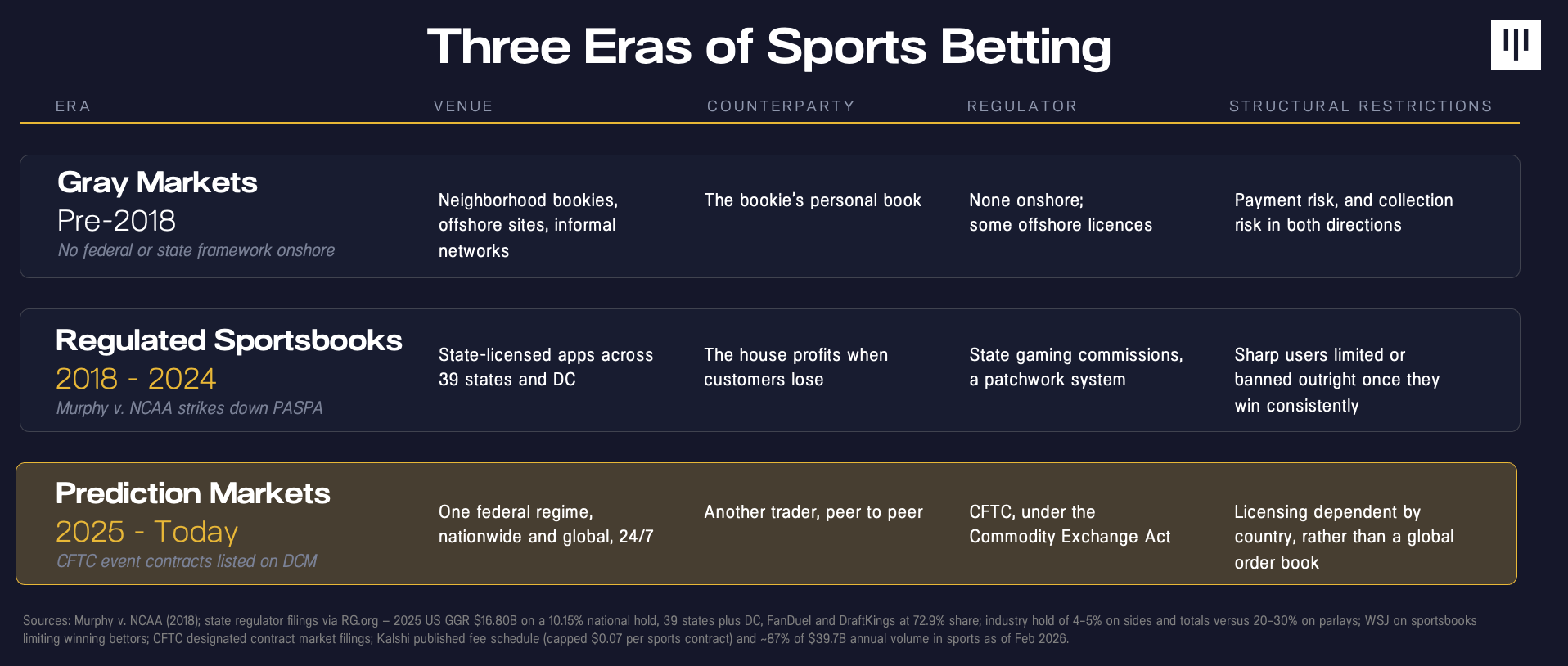
More recently, the advent of CFTC federal regulation of event contracts (or prediction markets) has led to substantial growth in the sports markets as they move away from the opaque sportsbooks into fully-fledged exchanges that act as true global trading venues for sports markets and entertainment.
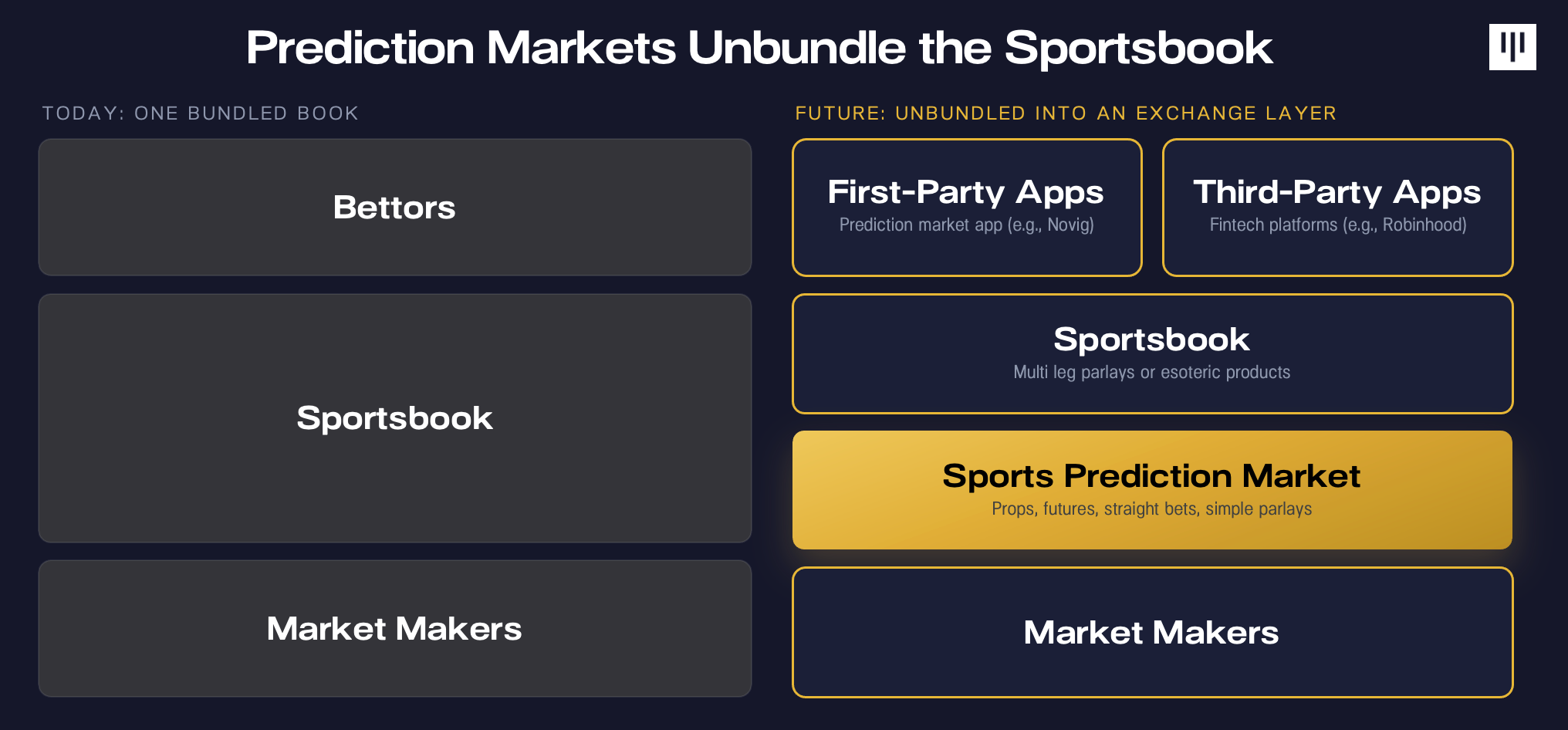
The Massive Market of Sports
Among prediction markets, the trading volume data reflects the market growth, as sports account for 65% of the $112 billion traded through prediction markets to date, per Allium.
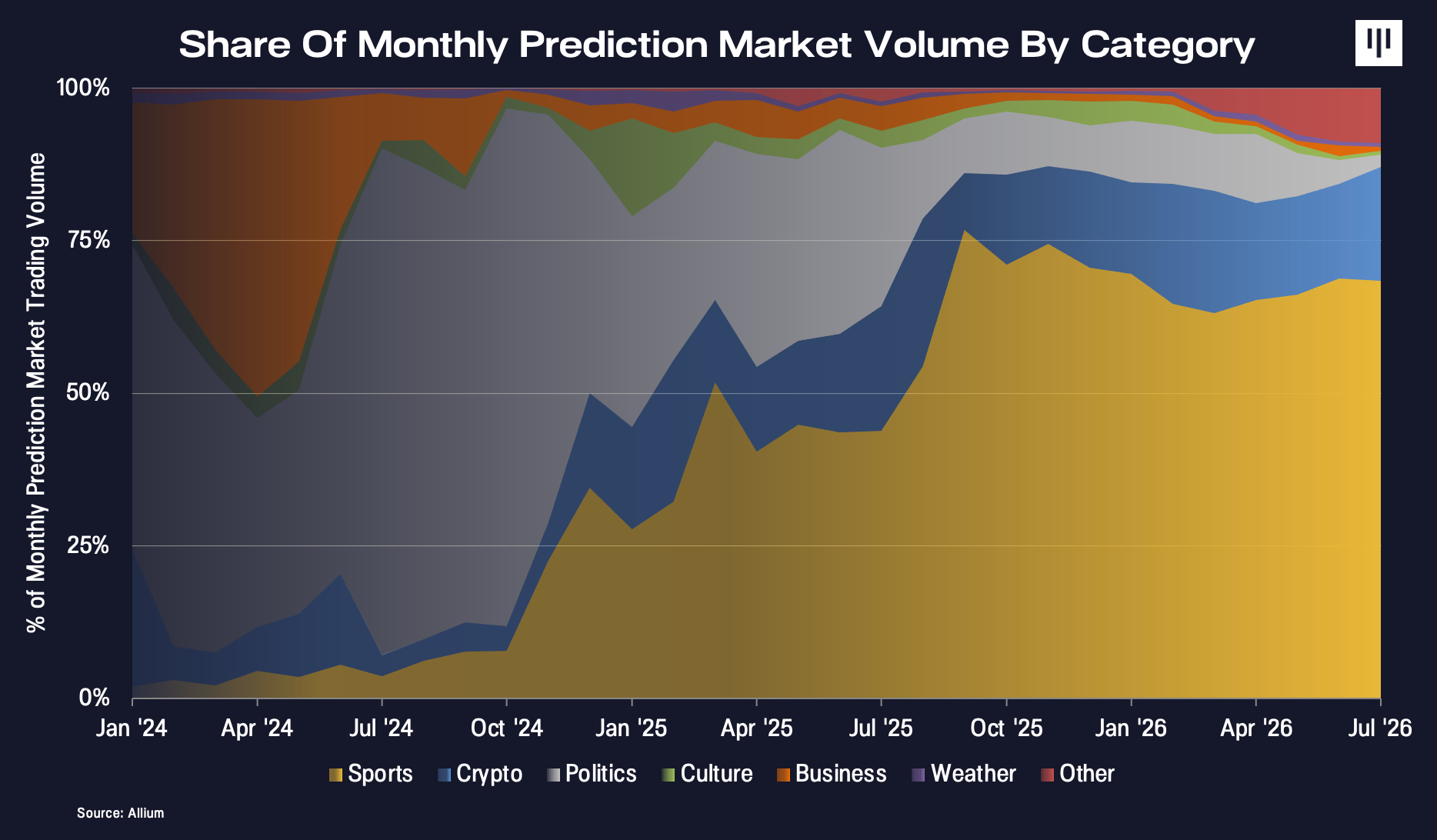
However, Bank of America estimates the potential market for U.S. sports-related event contracts at roughly $1.1 trillion in annual volume, implying even more significant growth that will come from broader market democratization away from sportsbooks into true peer-to-peer marketplaces with global liquidity.
Novig, a Pantera portfolio company, recently launched its federally-regulated venue, where it aims to offer the best exchange for sports bettors.
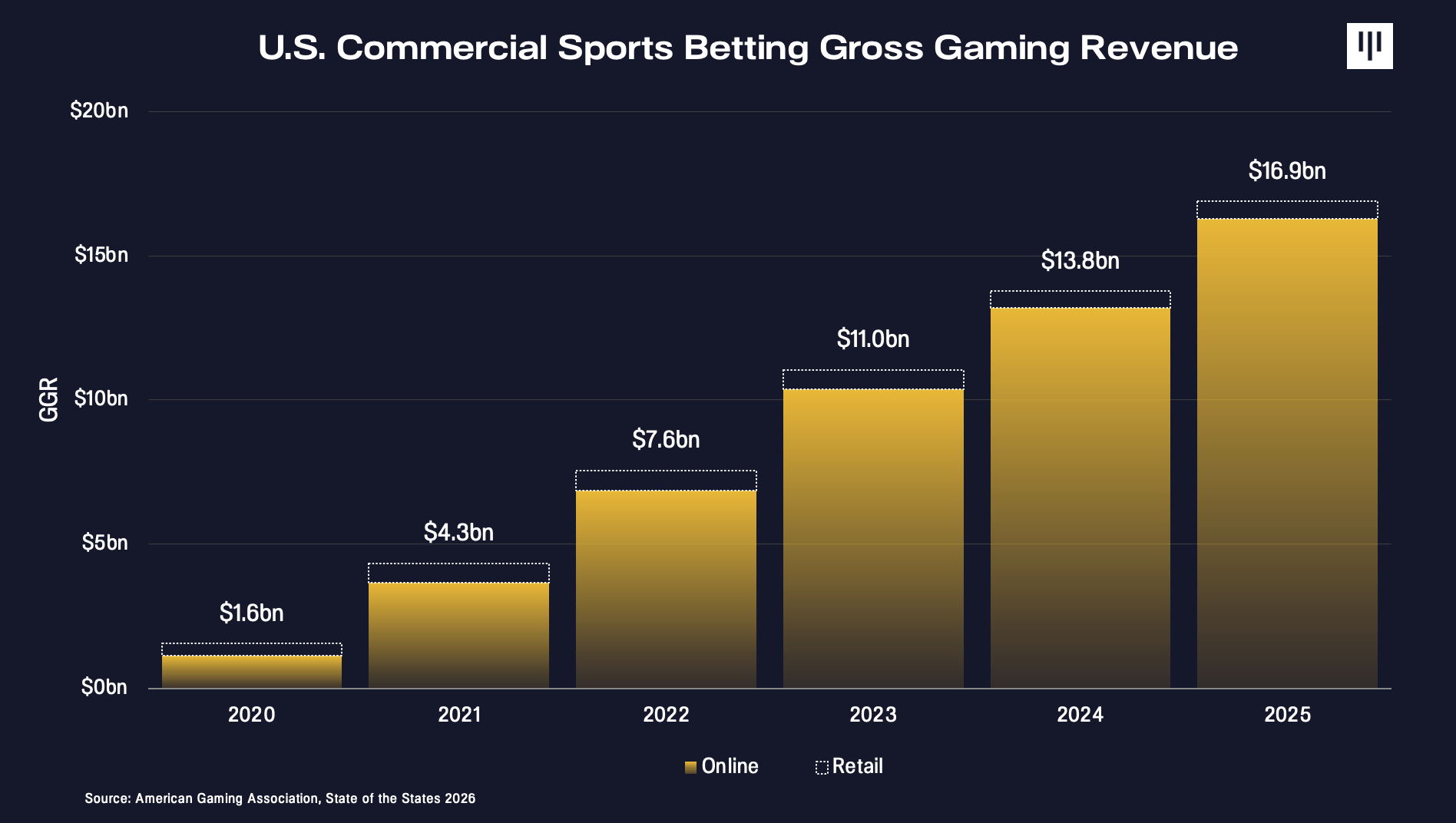
To contextualize the market Novig is tackling, sports betting as a business model generated $16.9 billion in gross gaming revenue in 2025, up more than tenfold from $1.6 billion in 2020, per the American Gaming Association. (Note: Gross gaming revenue is what the sportsbooks keep after paying out winners).
Prediction Markets: The Regularization of Sports Markets
Traditional sports betting operators spent years and considerable capital assembling licenses, one state at a time. The recent federal regulation of sports betting through event contracts enabled Novig to take a different approach and file with the CFTC in January 2026 to be regulated federally instead of state by state.
In June 2026, Novig received CFTC approval as a designated contract market (DCM) in record time. The DCM enforces regulations for Novig’s legal marketplace, including market surveillance, protections against manipulation and insider activity, and comprehensive compliance standards.
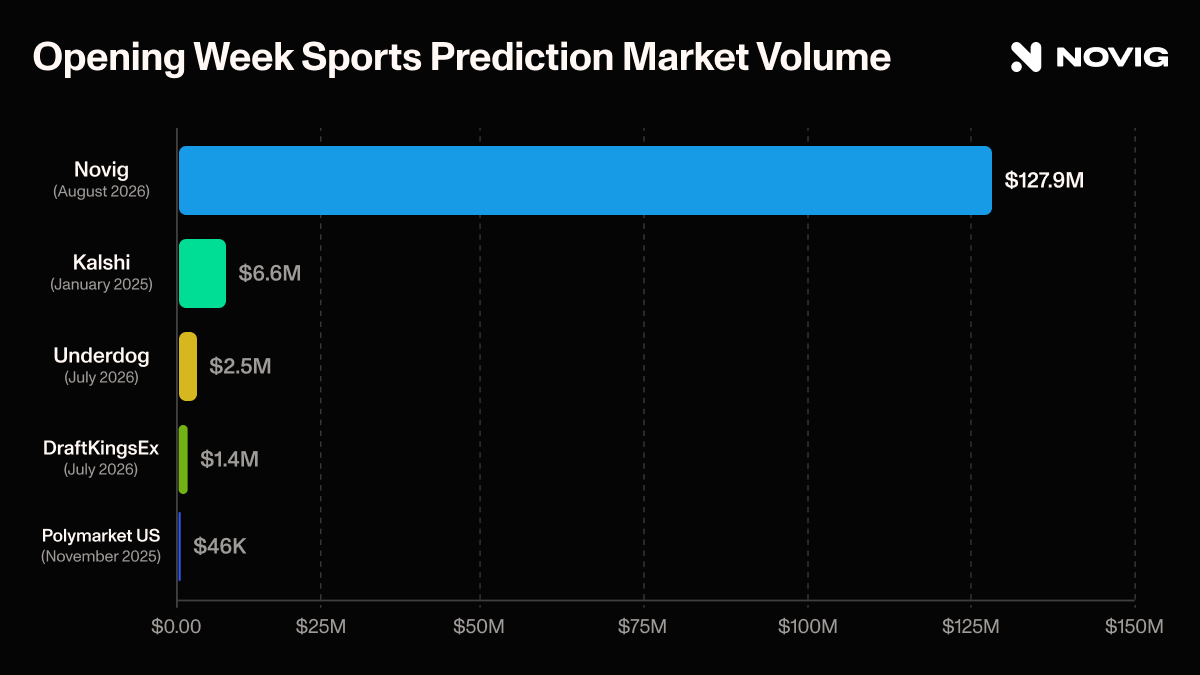
Within the first week of launching, Novig surpassed $125 million in notional trading volume. That same week, Novig also announced the adoption of a comprehensive responsible trading framework, becoming the first platform to codify a broad set of responsible trading standards, including the category’s only nationwide 21+ age requirement, directly into the rulebook of a CFTC-regulated prediction market exchange.
Distribution Follows Regulation
Following the FIFA World Cup, the New York Mets named Novig their Exclusive Official Prediction Market Partner in a multi-year agreement that includes stadium and broadcast branding, original digital content, in-game features and fan activations. This is the first partnership of its kind between a Major League Baseball franchise and a prediction market.
Ultimately, prediction markets are not creating the demand to trade sports outcomes — they provide a better market structure that expands the potential TAM for sports trading with an improved business model and better product. Novig’s opportunity is to lead this next era of sports betting, becoming the exchange venue where sports risk is priced and traded.
PANTERA FUND V
We’ve found that most investors view blockchain as an asset class and would prefer to have a manager allocate amongst the various asset types. This compelled us to create Pantera Blockchain Fund (IV) in 2021, a wrapper for the entire spectrum of blockchain assets. Its successor — Pantera Fund V — is now open for subscriptions.
Similar to its predecessor, we believe this new fund is the most efficient way to get exposure to blockchain as an asset class. It is a continuation of the strategies we have employed at Pantera for twelve years across twelve venture and hedge funds.
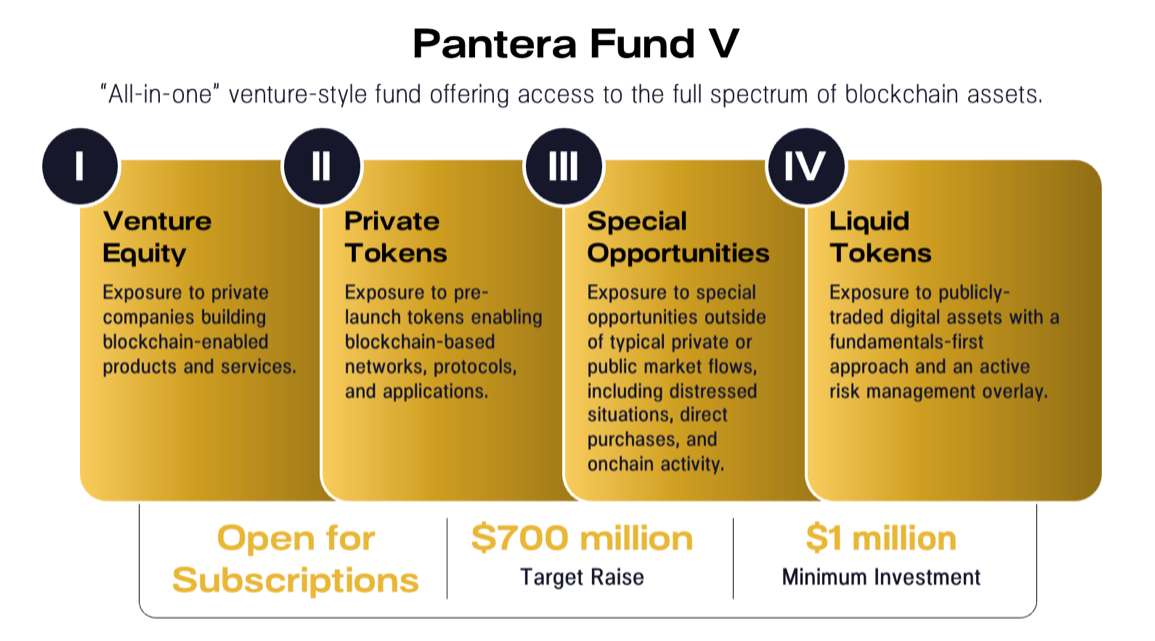
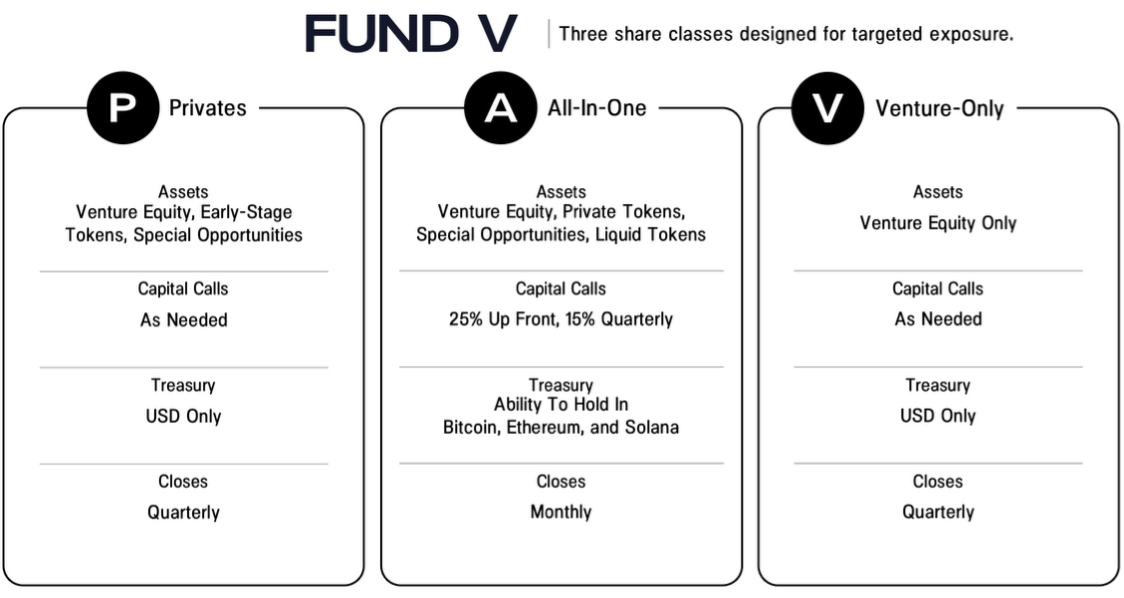
Limited Partners have the flexibility to invest in just venture (Class V for “Venture”), or in venture, private tokens, and locked-up treasury tokens (Class P for “Privates”), or the all-in-one Class A.[1],[2]
As in all previous Pantera venture funds, we strongly support helping our LPs get access to private deals in this fund. Fund LPs with capital commitments of $25mm or more will have the option to collectively co-invest in at least 10% of each venture equity, private token, and special opportunity deal that the Fund invests over $10mm in. There is no management fee or carried interest on co-investments for those with co-investment rights.
We will endeavor to offer co-investment opportunities, on a capacity available-basis, to other LPs as well. These co-investment opportunities are subject to 1/10% fees.
We are now accepting subscriptions for Fund V. If you’re ready to invest, please click the button below to begin the process.

If you are new to Fund V and would like to receive additional information, click here. We also invite you to join our next call on Pantera Fund V on Tuesday, November 3rd, at 12:00pm Eastern Time. You may register here.

Pantera donates 1% of revenue from all new funds to 1% For The Planet.
This letter is an informational document that primarily provides educational content and general market commentary. Except for certain sections specifically marked in this letter, no statements included herein relate specifically to investment advisory services provided by Pantera Capital Partners LP or its affiliates (“Pantera”), nor does any content herein reflect or contain any offer of new or additional investment advisory services. Nothing contained herein constitutes an investment recommendation, investment advice, an offer to sell, or a solicitation to purchase, any securities in Funds managed by Pantera (the “Funds”) or any entity organized, controlled, or managed by Pantera and therefore may not be relied upon in connection with any offer or sale of securities. Any offer or solicitation may only be made pursuant to a confidential private offering memorandum (or similar document) which will only be provided to qualified offerees and should be carefully reviewed by any such offerees prior to investing.
This letter aims to summarize certain developments, articles, and/or media mentions with respect to Bitcoin and other cryptocurrencies that Pantera believes may be of interest. The views expressed in this letter are the subjective views of Pantera personnel, based on information that is believed to be reliable and has been obtained from sources believed to be reliable, but no representation or warranty is made, expressed, or implied, with respect to the fairness, correctness, accuracy, reasonableness, or completeness of the information and opinions. Analyses and opinions contained herein (including market commentary, statements or forecasts) reflect the authors’ judgment as of the date this letter was published, and may contain elements of subjectivity (including certain assumptions) or be based on incomplete information. The information contained in this letter is current as of the date indicated at the front of the letter. Pantera does not undertake to update the information contained herein.
This letter is not intended to provide, and should not be relied on for accounting, legal, or tax advice, or investment recommendations. Pantera and its principals have made investments in some of the instruments discussed in this communication and may in the future make additional investments in connection with such instruments without further notice.
Certain information contained in this letter constitutes “forward-looking statements” (including predictions), which can be identified by the use of forward-looking terminology such as “may”, “will”, “should”, “expect”, “anticipate”, “target”, “project”, “estimate”, “intend”, “continue”, “believe”, or the negatives thereof or other variations thereon or comparable terminology. Due to various risks and uncertainties, actual events or results or the actual policies, procedures, and processes of Pantera and the performance of the Funds may differ materially from those reflected or contemplated in such forward-looking statements, and no undue reliance should be placed on these forward-looking statements, nor should the inclusion of these statements be regarded as Pantera’s representation that the Funds will achieve any strategy, objectives, or other plans. Past performance is not necessarily indicative of or a guarantee of future results. There is no guarantee that investments in any instrument or type of instrument described herein will be profitable – all investments carry the inherent risk of total loss.
It is strongly suggested that any prospective investor obtain independent advice in relation to any investment, financial, legal, tax, accounting, or regulatory issues discussed herein. Analyses and opinions contained herein may be based on assumptions that if altered can change the analyses or opinions expressed. Nothing contained herein shall constitute any representation or warranty as to future performance of any financial instrument, credit, currency rate, or other market or economic measure.
All information presented prior to an index’s Launch Date is hypothetical (back-tested), not actual performance. The back-test calculations are based on the same methodology that was in effect on the index Launch Date. However, when creating back-tested history for periods of market anomalies or other periods that do not reflect the general current market environment, index methodology rules may be relaxed to capture a large enough universe of securities to simulate the target market the index is designed to measure or strategy the index is designed to capture. For example, market capitalization and liquidity thresholds may be reduced. Past performance of the Index is not an indication of future results. Back-tested performance reflects application of an index methodology and selection of index constituents with the benefit of hindsight and knowledge of factors that may have positively affected its performance, cannot account for all financial risk that may affect results and may be considered to reflect survivor/look ahead bias. Actual returns may differ significantly from, and be lower than, back-tested returns. Past performance is not an indication or guarantee of future results. Please refer to the methodology for the Index for more details about the index, including the manner in which it is rebalanced, the timing of such rebalancing, criteria for additions and deletions, as well as all index calculations. Back-tested performance is for use with institutions only; not for use with retail investors.